
Estimated reading time: 12 minutes
Not every property fits a standard mold. Older homes with unusual openings, modern architectural designs with panoramic entrances, and commercial facilities with demanding operational requirements all share one common challenge: standard garage doors simply cannot meet their needs. Specialized garage doors address these gaps by offering tailored dimensions, enhanced performance characteristics, and design flexibility that off-the-shelf options cannot provide.
Key Takeaways
- Specialized track systems solve space constraints including low headroom, high lift, and vertical lift configurations
- Hurricane-rated doors protect coastal properties with wind resistance features that meet strict building codes
- Insulated garage doors with R-values up to R-18+ significantly reduce energy costs and improve comfort
- Non-traditional door styles like side-sliding and bi-fold systems address unique architectural requirements
- Professional installation is critical for specialized doors to ensure safety and long-term reliability
▼
- When Does a Property Require Something Beyond Standard Options?
- How Do Specialized Track Systems Solve Challenging Space Constraints?
- What Non-Traditional Door Styles Address Unique Architectural Needs?
- Why Do Coastal Properties Need Hurricane-Rated Garage Doors?
- How Does Insulation Transform a Garage Door Into an Energy Asset?
- What Role Do Specialized Openers Play in Complex Installations?
- What Questions Should You Ask Before Ordering a Custom Garage Door?
- Common Mistakes That Lead to Specialized Door Problems
- Frequently Asked Questions
Need a Custom Garage Door Solution?
Our specialized door experts are ready to assess your unique requirements
(210) 469-9003
Get Free Estimate
4.8 Rating from 70+ Reviews
24/7 Emergency Service
When Does a Property Require Something Beyond Standard Options?
Standard residential garage doors typically come in widths of 8, 9, or 16 feet and heights of 7 or 8 feet. Commercial doors follow similar patterns with somewhat larger dimensions. However, many properties fall outside these parameters for various reasons. A historic home might have an opening that predates modern standardization. A custom-built residence might feature an oversized garage to accommodate recreational vehicles. A workshop might need maximum ceiling clearance for equipment storage.
Beyond dimensions, certain performance requirements also push properties into specialized territory. Coastal locations demand wind-rated doors that can withstand hurricane-force conditions. Properties in extreme climates benefit from advanced insulation that standard doors cannot provide. High-security applications require reinforced panels and specialized locking mechanisms. Each of these scenarios calls for a solution engineered specifically for the challenge at hand.
Recognizing when a specialized door is necessary often prevents costly mistakes. Attempting to force a standard door into a non-standard situation typically results in operational problems, premature wear, and compromised safety. The initial investment in a properly engineered solution almost always proves more economical than repeated repairs or replacements down the line.
How Do Specialized Track Systems Solve Challenging Space Constraints?
Three critical measurements determine which track system a garage can accommodate: headroom, sideroom, and backroom. Headroom refers to the vertical space between the top of the door opening and the ceiling or nearest obstruction. Sideroom describes the horizontal space on either side of the opening where vertical tracks mount. Backroom indicates the depth of the garage from the opening to the back wall, which determines how far the door extends when fully open.
Standard track systems require approximately 12 to 15 inches of headroom, depending on the door height and spring configuration. When this clearance is not available, specialized low headroom track systems provide alternatives. According to industry specifications from Clopay’s track options guide, low headroom configurations can reduce the required clearance significantly, making installation possible in spaces that would otherwise be unsuitable.
Low Headroom Solutions for Limited Vertical Clearance
Low headroom track systems come in two primary configurations: front mount and rear mount. Front mount systems position the horizontal track in front of the torsion spring assembly, while rear mount systems place the spring assembly behind the track. Each configuration offers different headroom savings and has specific mechanical requirements.
These systems typically require between 4.5 and 9.5 inches of headroom depending on the specific configuration and whether an automatic opener will be installed. The Amarr lift options documentation provides detailed numeric requirements by track size, helping installers select the appropriate system for each situation.
Proper installation of low headroom systems demands expertise because the modified track geometry affects cable routing, spring tension, and panel alignment. Texas Pros Garage Doors technicians evaluate each installation site carefully to ensure the selected system will operate safely and reliably.
High Lift and Vertical Lift Configurations
At the opposite end of the spectrum, some properties have abundant headroom and need to maximize usable space within the garage. High lift track systems extend the vertical portion of the track upward before transitioning to horizontal, allowing the door to travel higher before leveling out beneath the ceiling. This configuration creates additional clearance inside the garage for car lifts, overhead storage, or tall vehicles.
Vertical lift systems take this concept further by eliminating the horizontal track section entirely. The door travels straight up and remains in a vertical position when fully open. According to A-1 Overhead Door Systems, vertical lift configurations require headroom approximately equal to the door height plus one foot. These systems are common in commercial and industrial settings where maximum opening clearance is essential.
| Track Configuration | Typical Headroom Required | Best Application |
|---|---|---|
| Standard Radius | 12-15 inches | Most residential garages |
| Low Headroom (Front Mount) | 4.5-6 inches | Finished ceilings, limited clearance |
| Low Headroom (Rear Mount) | 6-9.5 inches | Moderate clearance restrictions |
| High Lift | Varies by lift height | Car lifts, overhead storage |
| Vertical Lift | Door height + 12 inches | Commercial, industrial facilities |
What Non-Traditional Door Styles Address Unique Architectural Needs?
Traditional overhead sectional doors dominate the market because they work well for most applications. However, certain architectural designs and functional requirements call for alternatives. Side-sliding doors, bi-fold doors, and multi-fold systems each solve specific problems that conventional overhead doors cannot address.
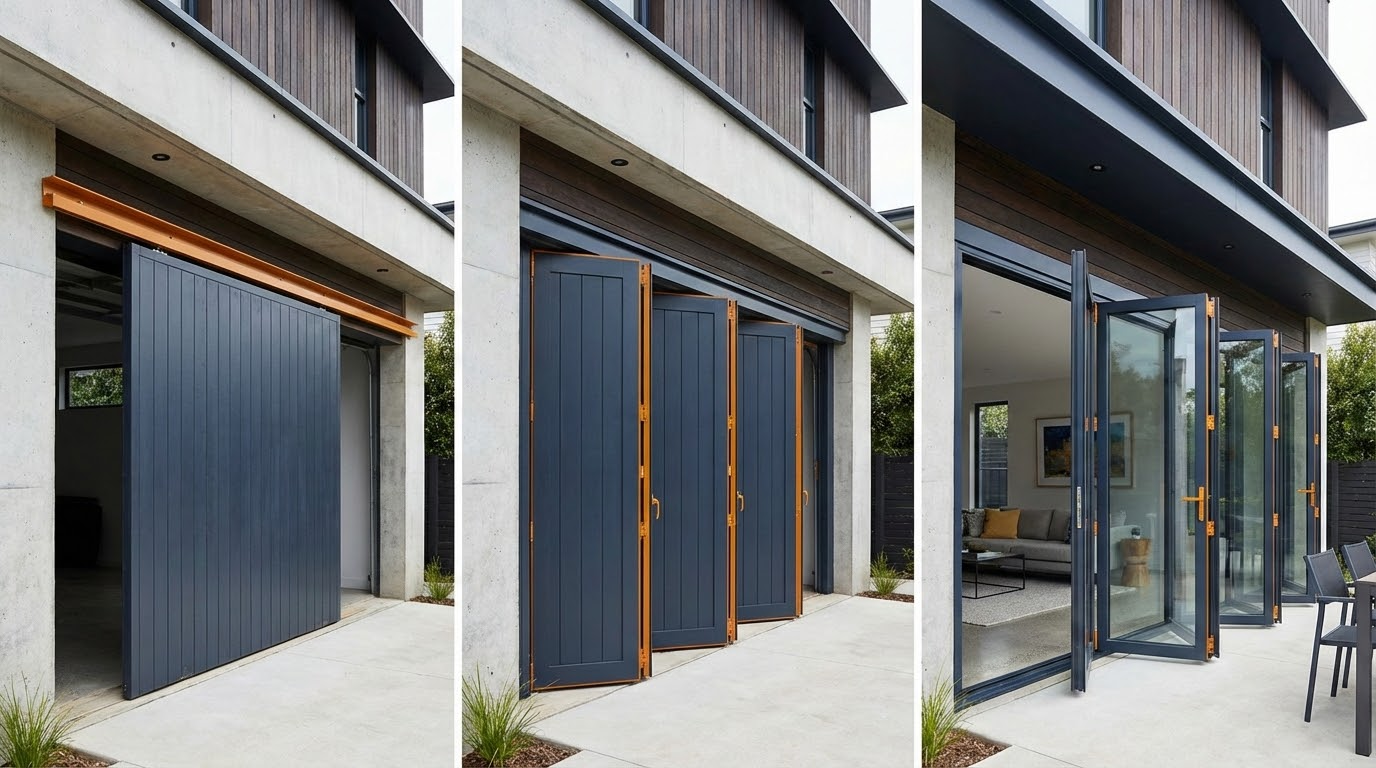
Side-sliding garage doors operate on a horizontal track mounted along the interior wall adjacent to the opening. The door panels slide to the side rather than lifting overhead. This configuration eliminates headroom requirements entirely, making it ideal for garages with extremely low ceilings, sloped roofs that prevent horizontal track installation, or situations where the ceiling space is occupied by ductwork or other obstructions.
Bi-fold and multi-fold doors create dramatic openings by folding vertically or horizontally rather than rolling up on tracks. These systems appear frequently in modern architectural designs where indoor-outdoor transitions are desired, such as garages that open onto patios or entertainment areas. The folding mechanism allows the door to stack compactly, maximizing the usable opening width.
Texas Pros Garage Doors works with property owners to identify which door style best matches their architectural vision and functional requirements. The consultation process examines not only the physical constraints of the space but also how the door will be used daily, ensuring the final solution performs as intended.
Why Do Coastal Properties Need Hurricane-Rated Garage Doors?
Garage doors represent one of the most vulnerable points in a building’s envelope during high-wind events. Their large surface area makes them susceptible to significant wind pressure loads, and failure during a storm can lead to catastrophic structural damage. When a garage door fails, wind enters the structure and creates internal pressure that can lift roofs, blow out walls, and cause total building collapse.
The Building America Solution Center explains that garage doors must be pressure-rated to withstand specific wind loads, and these ratings should match or exceed local building code requirements for the property’s wind zone. In hurricane-prone regions, codes typically mandate doors that can resist both positive pressure (wind pushing against the door) and negative pressure (suction pulling the door outward).
Wind Resistance Features and Code Compliance
Hurricane-rated garage doors incorporate several engineering features that standard doors lack. Heavier gauge steel panels provide greater rigidity. Reinforced track systems resist deflection under load. Vertical and horizontal stiffeners add structural strength across the door face. Impact-resistant glazing protects any window sections from flying debris.
FEMA P-804, the Wind Retrofit Guide for Residential Buildings, provides detailed guidance on improving garage door wind resistance for existing homes. The second edition published in April 2023 includes updated mitigation packages and retrofit measures specifically applicable to hurricane-prone regions. Property owners in coastal Texas should ensure any specialized garage door installation meets current code requirements and, ideally, exceeds minimum standards for added protection.
For properties that have experienced storm damage, Texas Pros Garage Doors provides comprehensive assessment and repair services. Learn more about our Houston Storm Damage Garage Door Repair capabilities.
Reinforced Doors for Enhanced Security Applications
Security-focused specialized doors share many construction features with wind-rated models but add additional protective elements. Heavy-gauge steel construction, typically 20-gauge or thicker, resists forced entry attempts. Reinforced mounting hardware prevents the door from being pried away from the frame. Advanced locking mechanisms engage at multiple points along the door edges rather than relying on a single central lock.
Commercial warehouses, storage facilities, and residential properties with heightened security concerns benefit from these custom solutions. The specific requirements vary by application, and Texas Pros Garage Doors evaluates each situation to recommend appropriate protective measures.
Storm Damage or Security Concerns?
Get expert assessment and custom solutions for your property
How Does Insulation Transform a Garage Door Into an Energy Asset?
An uninsulated garage door essentially creates a large opening in the building envelope. In Texas, where summer temperatures regularly exceed 100 degrees, this opening allows substantial heat transfer into attached garages and, subsequently, into conditioned living spaces. Insulated garage doors address this problem by incorporating thermal barriers that reduce heat flow.
R-value measures thermal resistance, with higher values indicating better insulating performance. According to the U.S. Department of Energy, proper insulation improves comfort, reduces energy costs, and contributes to overall building efficiency. Garage doors with R-values ranging from R-6 to R-18 or higher are available depending on the construction method and insulation material used.
Insulation Materials and Their Performance Characteristics
Two primary insulation materials appear in residential garage doors: polystyrene and polyurethane. Polystyrene panels are typically inserted between the steel skins of the door and provide moderate thermal resistance. Polyurethane is injected as a foam that expands to fill the entire cavity, bonding to both steel skins and providing higher R-values along with increased structural rigidity.
For garages used as workshops, home gyms, or conditioned living extensions, higher insulation values justify the additional investment. The door becomes an integral part of the building’s thermal envelope rather than a weak point. Building codes in some jurisdictions now require garage doors into conditioned spaces to meet specific U-factor or R-value minimums, as noted in code compliance documentation from the Building America Solution Center.
Air Sealing Completes the Thermal Barrier
Insulation alone does not guarantee energy efficiency. Air leakage around door edges, between panels, and at the floor seal can negate much of the thermal benefit. Specialized weather stripping systems, bottom seals, and perimeter gaskets work together to create a comprehensive air barrier.
Texas Pros Garage Doors addresses air sealing as part of every insulated door installation. The technicians ensure proper seal compression, verify panel alignment, and test the finished installation for drafts. This attention to detail distinguishes a high-performance installation from one that merely checks the box on insulation requirements.
| Insulation Type | Typical R-Value Range | Key Benefits |
|---|---|---|
| Non-Insulated (Single Layer) | R-0 to R-2 | Lowest cost, basic protection |
| Polystyrene | R-6 to R-10 | Moderate insulation, lighter weight |
| Polyurethane (Injected) | R-12 to R-18+ | Highest R-value, added structural strength |
What Role Do Specialized Openers Play in Complex Installations?
Standard garage door openers use a rail-mounted trolley system that runs along the ceiling. This configuration works well when adequate ceiling space exists, but specialized installations often require alternative approaches. Jackshaft openers mount directly to the wall beside the door and drive the torsion bar through a gear mechanism, eliminating the need for ceiling-mounted hardware entirely.
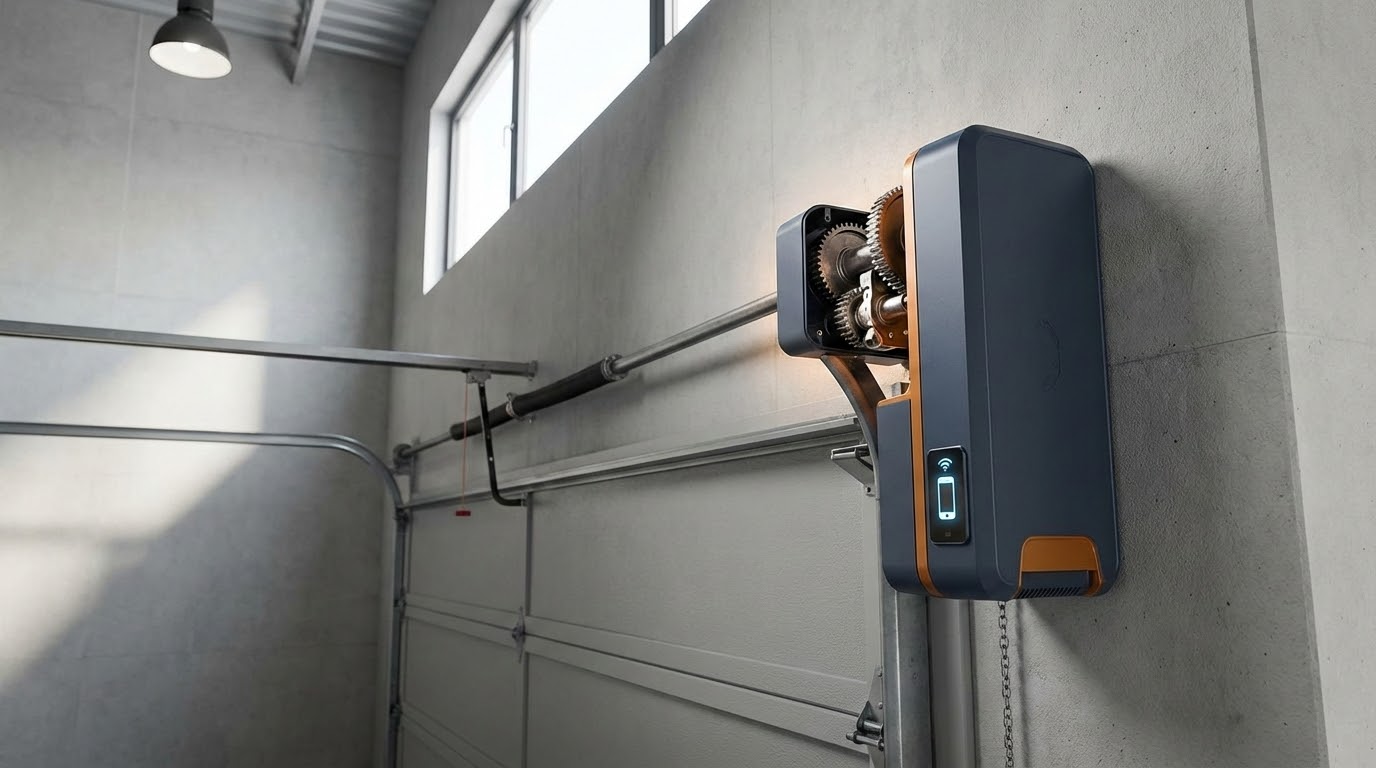
Jackshaft systems prove particularly valuable in garages with high ceilings, limited overhead clearance, or unconventional layouts. They also pair well with high lift and vertical lift track systems where traditional trolley openers would be impractical. Smart home integration capabilities allow these openers to connect with home automation platforms, providing remote access, status monitoring, and integration with security systems.
Mandatory Safety Features for All Automatic Openers
Federal regulations established in 1993 require all residential garage door openers to include entrapment protection mechanisms. According to the Consumer Product Safety Commission, openers manufactured after January 1, 1993 must incorporate external entrapment protection devices such as photo-eye sensors that detect obstructions in the door path and trigger automatic reversal.
The UL 325 standard governs garage door opener safety requirements and mandates at least two entrapment protection mechanisms: an inherent reversal system that detects physical resistance and an external device such as photo eyes or edge sensors. Modern connected openers add features like smartphone alerts when the door is opened or left open, enhancing security awareness.
Additional safety features available in specialized openers include battery backup systems that allow operation during power outages, timer-to-close functions that automatically shut the door after a set period, and vacation mode settings that disable remote access when the property is unoccupied.
For urgent opener problems, Texas Pros Garage Doors offers rapid response through our Emergency Garage Door Opener Repair in San Antonio service.
What Our Customers Say
Robert Parshall
Google Review
“The spring on my garage door broke and they were able to come out within an hour. Very professional service and fair pricing.”
Leon McPherson
Google Review
“Excellent experience from start to finish. They helped me select the right door design and the installation was completed in one day.”
Alyssa Silva
Google Review
“My garage door spring broke on a Saturday morning. They came out the same day and fixed it quickly. Great service!”
Adam Mendoza
Google Review
“Professional commercial garage door repair. They understood the urgency for our business and minimized our downtime.”
What Questions Should You Ask Before Ordering a Custom Garage Door?
Ordering a specialized garage door represents a significant investment, and the custom nature of these products means errors can be costly to correct. Proper preparation before ordering helps ensure the final product meets all requirements and installs without complications.
Start with accurate measurements. Measure the opening width at the floor and at the header, then compare the two figures. Measure the height on both sides and in the center. Check headroom, sideroom, and backroom carefully, accounting for any obstructions such as light fixtures, pipes, or structural members. A professional installer will verify these measurements, but having accurate initial numbers helps the consultation process proceed efficiently.
Consider how the door will be used daily. Will tall vehicles need to pass through? Will the door operate frequently throughout the day? Is the garage connected to conditioned living space? Does the property face exposure to high winds, salt air, or other environmental challenges? Each of these factors influences the appropriate door specification.
Discuss lead times and installation scheduling with your provider. Custom doors typically require longer manufacturing times than stock products, and complex installations may need additional preparation at the job site. Understanding the timeline helps with project planning and avoids unexpected delays.
Common Mistakes That Lead to Specialized Door Problems
Experience reveals several recurring errors that cause specialized garage door installations to underperform or fail prematurely. Awareness of these pitfalls helps property owners avoid them.
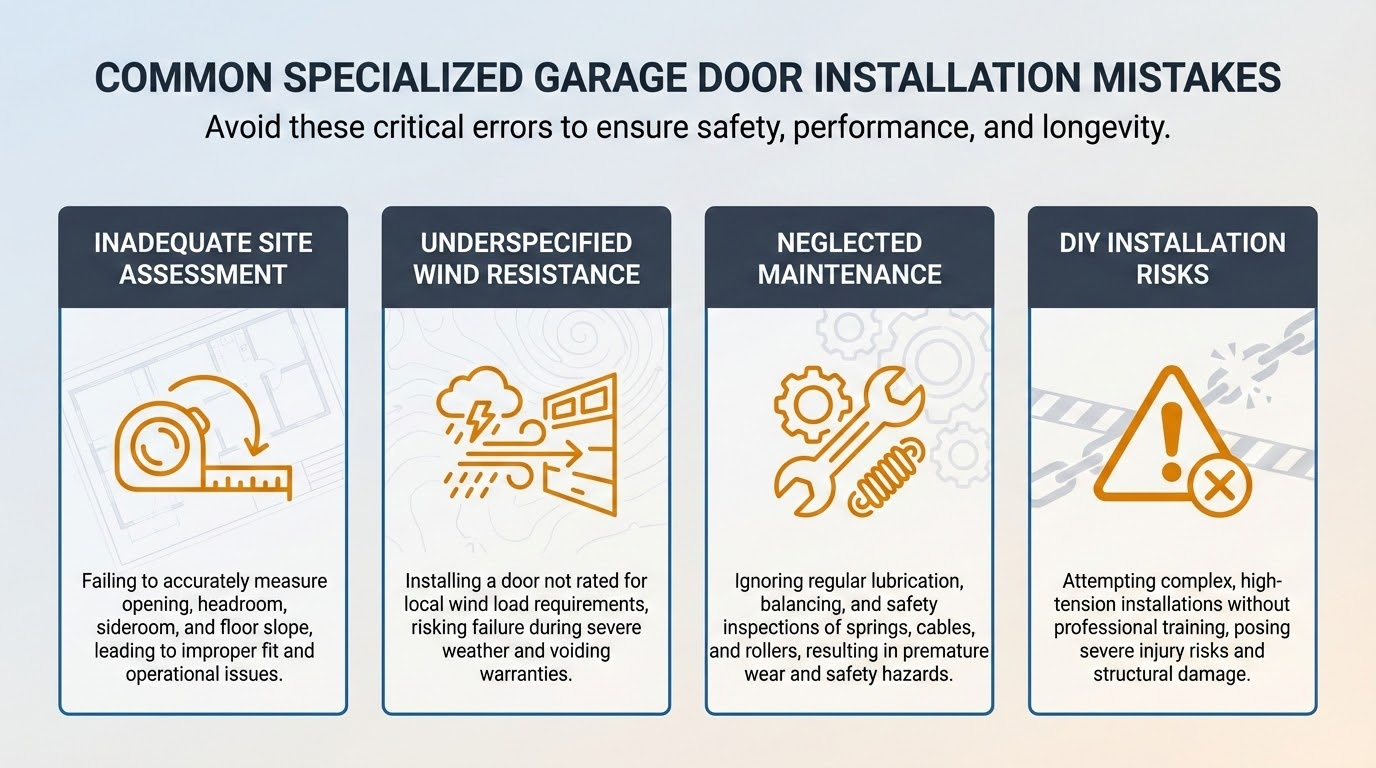
Inadequate site assessment tops the list. Rushing to order a door without thoroughly evaluating the installation conditions leads to compatibility problems. Hidden obstructions, out-of-square openings, and structural issues should be identified and addressed before the door arrives.
Underspecifying wind resistance creates risk in coastal areas. Some property owners choose doors that merely meet minimum code requirements when their exposure warrants higher ratings. The incremental cost of enhanced wind resistance pales in comparison to potential storm damage.
Neglecting maintenance accelerates wear on specialized systems. Low headroom tracks, high lift configurations, and other complex mechanisms require periodic adjustment and lubrication to operate correctly. Skipping routine maintenance leads to premature component failure and costly repairs.
Attempting DIY installation on specialized systems invites problems. These doors involve precise engineering calculations, specialized hardware, and safety-critical adjustments that require professional training and equipment. The risk of injury or property damage from improper installation far exceeds any savings from avoiding professional labor.
Ortal Peretz
Google Review
“Called on a Sunday evening when my opener stopped working. They came out the same night and got everything working again. Outstanding service!”
Frequently Asked Questions About Specialized Garage Doors
Pricing varies significantly based on the specific customization required. Simple dimensional adjustments may add 10-20% to the base price, while complex configurations involving specialized track systems, enhanced insulation, or wind ratings can double or triple the cost. The investment typically proves worthwhile when the alternative is an ill-fitting standard door that causes ongoing problems.
Manufacturing lead times for custom doors typically range from 3 to 8 weeks depending on the complexity of the order and manufacturer capacity. Installation itself usually requires one day for residential projects, though complex commercial installations may extend longer. Planning ahead allows adequate time for manufacturing without rushing the process.
In some cases, yes. Enlarging an opening may be feasible if the surrounding structure supports it. However, structural modifications often cost more than simply ordering a door built to fit the existing opening. A professional assessment determines which approach makes more sense for each situation.
Warranties vary by manufacturer and component. Door panels typically carry warranties ranging from 1 year to lifetime depending on the material and construction. Hardware components usually have separate warranty terms. Installation workmanship warranties from professional installers provide additional protection. Review all warranty documents carefully before making a purchase decision.
The fundamental maintenance requirements remain similar: lubrication of moving parts, inspection of hardware, testing of safety systems, and attention to weather sealing. However, specialized components may require more frequent attention or specific procedures. Your installer should provide maintenance guidance appropriate to the specific system installed.
Ready to Discuss Your Specialized Garage Door Requirements?
Get expert guidance on custom solutions for your unique property needs
(210) 469-9003
Request Free Consultation
Family Owned Since 2006
Satisfaction Guaranteed
Every specialized garage door project begins with understanding the unique circumstances of the property and the goals of the owner. Texas Pros Garage Doors brings experience with complex installations across residential and commercial applications throughout Texas, combined with a commitment to getting the details right the first time.
Whether your project involves challenging space constraints, demanding environmental conditions, energy efficiency goals, or simply an opening that does not fit standard dimensions, professional guidance helps ensure the best outcome. Explore our comprehensive services for Garage Door Repair and Installation in Houston or learn about our capabilities for Commercial Garage Doors in Houston.
What specific challenges does your property present? Contact Texas Pros Garage Doors to start the conversation about your specialized garage door needs.

Recent Comments