
If you are considering a new garage door for your home, you have likely come across the term sectional garage doors. These doors have become the modern standard across residential properties in the United States, and for good reason. They combine practical engineering with visual appeal, and they are built to handle the unique demands of the Texas climate. This guide walks you through how sectional doors work, why they outperform older alternatives, what to look for in insulation and wind ratings, and how to maintain them safely for years to come.
- Sectional garage doors use multi-panel construction that rolls along tracks, eliminating outward swing and allowing you to park close to the door safely.
- Polyurethane insulation delivers higher R-values per inch than polystyrene, directly reducing energy costs for attached Texas garages during extreme summer heat.
- Wind load compliance is mandatory in many Texas counties, and a non-rated door can void insurance coverage and compromise your home’s structural integrity during storms.
- Individual damaged panels can often be replaced without buying an entire new door, making sectional doors more cost-effective for long-term ownership.
- Spring tension work is never a DIY project. Torsion and extension springs store enough energy to cause severe injury and must be handled by trained professionals.
▼
- Understanding Sectional Garage Doors for Your Texas Home
- Why Does the Door Move Vertically Instead of Swinging Out?
- How Do Sectional Doors Compare to Single-Panel and Roll-Up Doors?
- Common Mistakes When Choosing a Sectional Door
- Energy Efficiency and the Importance of R-Value
- Does the Panel Style Actually Affect Performance?
- Wind Load Requirements Every Texas Homeowner Should Know
- What Factors Influence the Total Cost?
- When Is It Smarter to Replace One Panel Instead of the Whole Door?
- Safety First: Why Spring Tension Is Not a DIY Project
- How Does Climate Affect Spring Lifespan in Texas?
- Measuring Your Garage: What Numbers Matter Before You Buy?
- What Should a Seasonal Maintenance Routine Look Like?
- Frequently Asked Questions
- Ready to Find the Right Sectional Door?
Understanding Sectional Garage Doors for Your Texas Home
A sectional garage door is made up of several horizontal panels — typically between three and eight — connected by hinges. When you open the door, these panels roll along a pair of vertical and curved tracks, eventually resting parallel to the ceiling inside the garage. This is fundamentally different from the older “one-piece” tilt doors that swing outward and upward as a single slab.
The system relies on a few essential components. Vertical tracks guide the panels upward from the floor. Curved track sections transition the panels from vertical to horizontal movement. Horizontal tracks hold the door flat against the ceiling when fully open. Rollers mounted on each panel side glide within these tracks, while a spring system — either torsion or extension — counterbalances the door’s weight so the opener does not carry the full load. Industry terminology defined by DASMA TDS #160 includes terms like “headroom” (clearance above the opening) and “backroom” (depth of ceiling space needed for horizontal tracks), both of which determine whether a sectional door will fit a specific garage.
Because of this multi-panel construction, these doors are often called panel garage doors. They are also classified under the broader category of overhead garage doors, since they travel upward and rest overhead. Homeowners prefer them for three primary reasons: they do not swing outward (so you can park right against the door), they seal tightly around all four edges, and they come in a wide variety of styles and materials. Given the complexity of the tracking system and spring calibration, working with professional garage door installation services ensures every component is aligned correctly from day one.
Why Does the Door Move Vertically Instead of Swinging Out?
The vertical movement of a sectional door is its most practical advantage. Because the panels travel straight up and then tuck under the ceiling, the door never extends beyond the plane of the garage opening. This means you can park your vehicle inches from the door without worrying about clearance when it opens — a significant benefit for homes with short driveways or garages facing a busy sidewalk.
This design also improves durability in a way many homeowners do not initially consider. If a single panel is dented by a ball, a bicycle, or a minor fender bump, a qualified technician can often replace just that one section rather than the entire door. This modular approach keeps long-term repair costs lower compared to one-piece doors, where any damage affects the whole structure.
Modern sectional doors also integrate well with automatic openers that meet the UL 325 safety standard, which requires entrapment protection devices such as photo-eye sensors and auto-reverse mechanisms. The locking track design adds another layer of security: when the door is closed, the panels nest tightly into the tracks, making it far more difficult to force open from the outside than an older tilt-style door.
Our expert technicians are standing by to help you choose the right sectional door for your home. Free estimates with no hidden charges.
(210) 469-9003
Schedule Free Estimate
4.8 Stars on Google
24/7 Emergency Service
How Do Sectional Garage Doors Compare to Single-Panel and Roll-Up Doors?
Homeowners frequently confuse different garage door types. The table below clarifies the core differences so you can identify exactly what you have — or what you need.
| Feature | Sectional Door | Single-Panel (Tilt-Up) | Roll-Up (Coiling) |
|---|---|---|---|
| Opening Mechanism | Panels glide on tracks upward and horizontal | One piece tilts outward then slides up | Slats coil around a drum above the opening |
| Space in Front of Garage | No outward swing needed | Requires clearance for outward swing | No outward swing needed |
| Ceiling Space Required | Moderate (headroom + backroom) | Less ceiling track, but needs pivot room | Minimal (coils into compact drum) |
| Insulation Options | Excellent (polystyrene or polyurethane fill) | Limited (often single-layer) | Limited (thin slats) |
| Panel Replacement | Individual sections replaceable | Entire door must be replaced | Individual slats sometimes replaceable |
| Best For | Most residential homes | Budget retrofits, older garages | Commercial or very limited headroom |
A quick way to identify what is already installed on your home: look for horizontal hinge lines between sections. If you see them, you have a sectional door. If the door is a single flat surface with no visible joints, it is likely a one-piece tilt-up.
What Common Mistakes Do Homeowners Make When Choosing a Sectional Door?
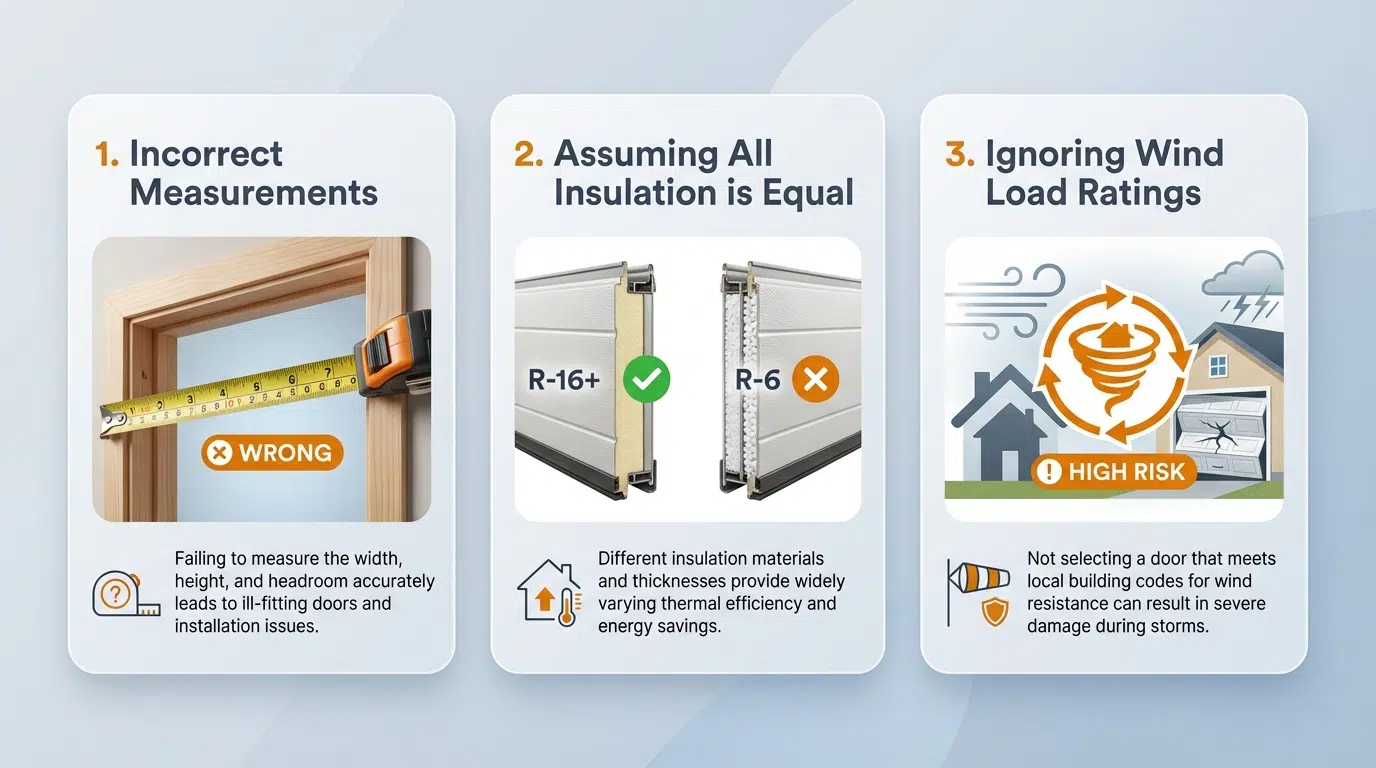
One of the most frequent errors is focusing only on appearance while overlooking practical specifications. A door that looks beautiful in a showroom photo may not fit a garage with low headroom or shallow backroom depth. Before selecting any model, measure the clear opening height, the distance from the top of the opening to the ceiling (headroom), and the depth from the opening to the back wall (backroom).
Another common mistake is assuming all “insulated” doors perform equally. Two doors may both claim insulation, yet one uses a thin polystyrene board loosely placed between steel layers while another features injected polyurethane bonded to the skins. The thermal performance and structural rigidity differ dramatically between these approaches.
A third pitfall involves ignoring wind load requirements. In many Texas counties, building codes mandate specific wind resistance ratings. Installing a non-rated door in a wind-designated area can void insurance coverage and put your entire home structure at risk during a storm. Always verify local code requirements before purchasing.
Energy Efficiency and the Importance of R-Value
Because sectional garage doors are composed of distinct panels, each panel can be individually insulated. This modular design makes them ideal candidates for high-performance thermal barriers. The two most common insulation materials are polystyrene (rigid foam boards inserted between panel layers) and polyurethane (liquid foam injected and bonded to the panel skins during manufacturing).
The key metric here is R-value, defined by the U.S. Department of Energy as “resistance to heat flow.” The higher the R-value, the better the material resists thermal transfer. In practical terms, a door with an R-value of 12 will keep significantly more heat out of your garage than one rated at R-6. For Texas homeowners — especially those with attached garages that share a wall with living space — this can translate directly into lower cooling bills during the brutal summer months.
However, there is a critical nuance. R-value is typically measured for the panel section alone. The overall thermal performance of the entire door assembly is more accurately captured by the U-factor, which accounts for the panels, joints, weatherstripping, and framing. A door with high-R panels but poor edge seals will underperform its rating. When seals degrade or panels sustain damage, the effective insulation drops, and professional garage door repair and maintenance becomes necessary to restore thermal integrity.
Polystyrene vs. Polyurethane: Which Insulation Performs Better?
Polyurethane insulation generally delivers a higher R-value per inch of thickness compared to polystyrene. It also bonds to the steel skins, adding structural rigidity and reducing noise when the door operates. Polystyrene, on the other hand, is more affordable and still provides meaningful insulation for homeowners who do not use their garage as a living or work space. The right choice depends on budget, intended garage use, and how the garage connects to the rest of the home.
Does the Panel Style Actually Affect Performance?
When browsing panel garage doors, you will encounter several design families. Raised panels feature a traditional recessed-rectangle pattern and remain the most popular residential choice. Carriage-house styles mimic the look of old swing-out barn doors while retaining the modern sectional mechanism. Flush panels offer a clean, contemporary aesthetic with flat surfaces and minimal ornamentation.
Material choice intersects directly with both longevity and appearance. Steel is the dominant material for residential sectional garage doors because it balances strength, affordability, and compatibility with insulation fills. Aluminum is lighter and naturally resistant to corrosion, making it a strong option for coastal Texas properties. Wood composite or faux-wood overlays deliver the warmth of natural wood without the intensive maintenance that solid wood demands — no annual staining, no warping in humid conditions.
Our team helps San Antonio homeowners match the right door style and material to their home architecture and budget every day.
Wind Load Requirements Every Texas Homeowner Should Know
Texas weather is not forgiving. High winds from tropical storms, hurricanes along the Gulf Coast, and severe thunderstorms across the interior make wind load compliance a genuine safety concern. The Texas Department of Insurance outlines specific building codes adopted under the state’s windstorm program, and garage doors are a critical element of that framework.
A sectional door installation in wind-designated counties must meet the International Residential Code (IRC) standards for both positive pressure (wind pushing against the door) and negative pressure (suction pulling the door outward). Compliant doors carry a permanent label listing their tested wind pressure ratings and the applicable testing standard. If your door does not have this label and you live in a designated zone, your homeowner’s insurance may not cover wind damage.
Why does this matter structurally? When a garage door fails during high winds, the sudden pressurization of the garage interior can blow off the roof or collapse walls. Essentially, the garage door is often the largest and weakest opening in a home’s envelope. Reinforcing or replacing it with a properly rated sectional door is one of the most cost-effective storm protection measures available.
What Factors Influence the Total Cost of a Sectional Garage Door Project?
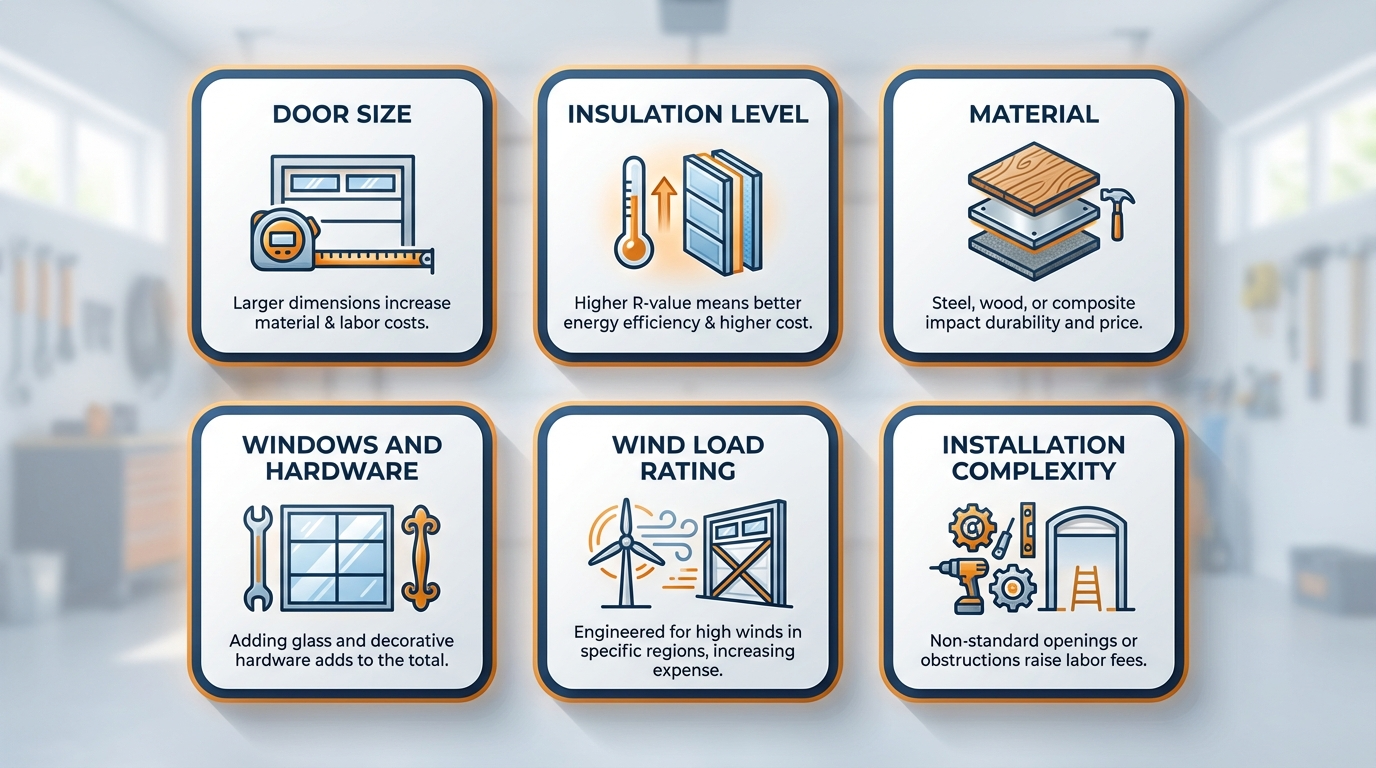
Pricing for a sectional garage door varies widely because multiple variables stack on top of each other. Understanding what drives cost helps you make decisions that align with your priorities rather than simply choosing the cheapest option and regretting it later.
| Cost Factor | Impact on Price | What to Consider |
|---|---|---|
| Door Size (single vs. double) | High | A two-car door uses significantly more material and heavier hardware |
| Insulation Level (R-value) | Moderate to High | Polyurethane-filled doors cost more but offer better performance |
| Material (steel, aluminum, composite) | Moderate | Composite and faux-wood finishes carry a premium over basic steel |
| Windows and Decorative Hardware | Low to Moderate | Adds curb appeal but increases cost per panel |
| Wind Load Rating | Moderate | Reinforced bracing and heavier gauge steel raise the base price |
| Installation Complexity | Variable | Low headroom kits, old door removal, and track modifications add labor |
It is essential to distinguish between “door-only” pricing you may see advertised and the actual installed cost, which includes removal of the existing door, new track and hardware installation, spring calibration, opener integration, and weatherstripping. Texas Pros Garage Doors provides transparent project estimates that account for every component so homeowners understand the full scope before work begins — no hidden charges after the fact.
A Scenario: When Is It Smarter to Replace One Panel Instead of the Whole Door?
Imagine a teenager backs into the garage door and dents two bottom panels. The rest of the door is in excellent condition, the springs have plenty of cycle life left, and the tracks are straight. In this scenario, replacing only the damaged sections makes financial and practical sense. A qualified installer can source matching panels, swap them out, and recalibrate the door in a single visit.
However, there are situations where panel-only replacement is not advisable. If the door is more than fifteen years old, finding an exact color and profile match can be difficult because manufacturers discontinue styles regularly. If multiple panels are damaged, the cumulative cost of individual replacements may approach the price of a new door that comes with a fresh warranty and improved insulation. And if the springs or tracks show significant wear, patching panels without addressing the underlying system creates a short-term fix with a long-term liability.
Working with an experienced team matters here. Texas Pros Garage Doors technicians evaluate the full system — not just the visible damage — before recommending repair or replacement. This approach prevents homeowners from spending money on panel swaps only to face spring failure a few months later.
What Our Customers Say
“The spring on my garage door broke and they were able to come out within an hour. Very professional service and fair pricing.”
“Excellent experience from start to finish. They helped me select the right door design and the installation was completed in one day.”
“My garage door spring broke on a Saturday morning. They came out the same day and fixed it quickly. Great service!”
“Professional commercial garage door repair. They understood the urgency for our business and minimized our downtime.”
Safety First: Why Spring Tension Is Not a DIY Project
Overhead garage doors rely on high-tension springs to counterbalance panels that can weigh anywhere from 130 to over 400 pounds. Torsion springs, mounted on a shaft above the door opening, store enormous energy when wound. Extension springs, mounted along the horizontal tracks, stretch under load. Both types can cause severe injury or death if improperly handled.
The DASMA consumer checklist (TDS #167) is explicit: spring adjustment, replacement, and cable work should only be performed by trained professionals. This is not an exaggeration for liability purposes — it reflects decades of documented emergency room visits from homeowners who attempted spring repairs without the correct tools or training.
A Quick Safety Check You Can Do Yourself
While spring work is off-limits for DIY, there are basic checks every homeowner should perform monthly. First, test the photo-eye sensors by placing an object in the door’s path and pressing the close button. The door should reverse immediately. Second, disconnect the opener and manually lift the door halfway. If it stays in place, the springs are properly balanced. If it slides down or shoots up, the spring tension needs professional adjustment. Third, visually inspect cables, rollers, and hinges for fraying, cracking, or rust. Early detection of worn parts prevents sudden failures.
How Does Climate Affect Spring Lifespan in Texas?
Springs are rated by cycle life — one cycle equals one full open-and-close sequence. A standard spring might be rated for 10,000 cycles, while a high-cycle spring can handle 25,000 or more. But these ratings assume controlled conditions. In Texas, wide temperature swings between scorching summers and occasional winter freezes accelerate metal fatigue. Humidity along the Gulf Coast promotes corrosion, which weakens the wire and reduces cycle life below the manufacturer’s rating.
Regular lubrication with a non-silicone-based garage door lubricant helps mitigate corrosion and friction. The DASMA technical sheet on spring cycle factors (TDS #190) also notes that installation quality matters: an improperly wound spring will wear unevenly and fail prematurely. This is another reason to invest in professional installation and periodic maintenance rather than waiting for a spring to snap at an inconvenient — or dangerous — moment.
Measuring Your Garage: What Numbers Matter Before You Buy?
Before any purchase decision, accurate measurements determine which doors will physically fit your garage. The four critical dimensions are the width of the opening, the height of the opening, the headroom (from the top of the opening to the ceiling or nearest obstruction), and the backroom (depth from the opening to the back wall). Standard residential sectional doors require roughly 12 to 15 inches of headroom and at least the door height in backroom depth.
If your garage has low headroom — common in older Texas homes or garages with storage platforms — specialized low-headroom track kits exist, but they add complexity and cost to the installation. Similarly, if there are obstructions like water heaters, HVAC units, or structural beams near the ceiling, the track layout may need custom routing. Getting these measurements wrong leads to costly returns or unsafe installations, which is why Texas Pros Garage Doors includes a pre-installation site assessment as a standard part of every project.
Our technicians perform a complete site assessment including precise measurements, headroom evaluation, and wind code verification — all before you commit to anything.
(210) 469-9003
Book Free Assessment
Licensed & Insured
70+ 5-Star Reviews
What Should a Seasonal Maintenance Routine Look Like?
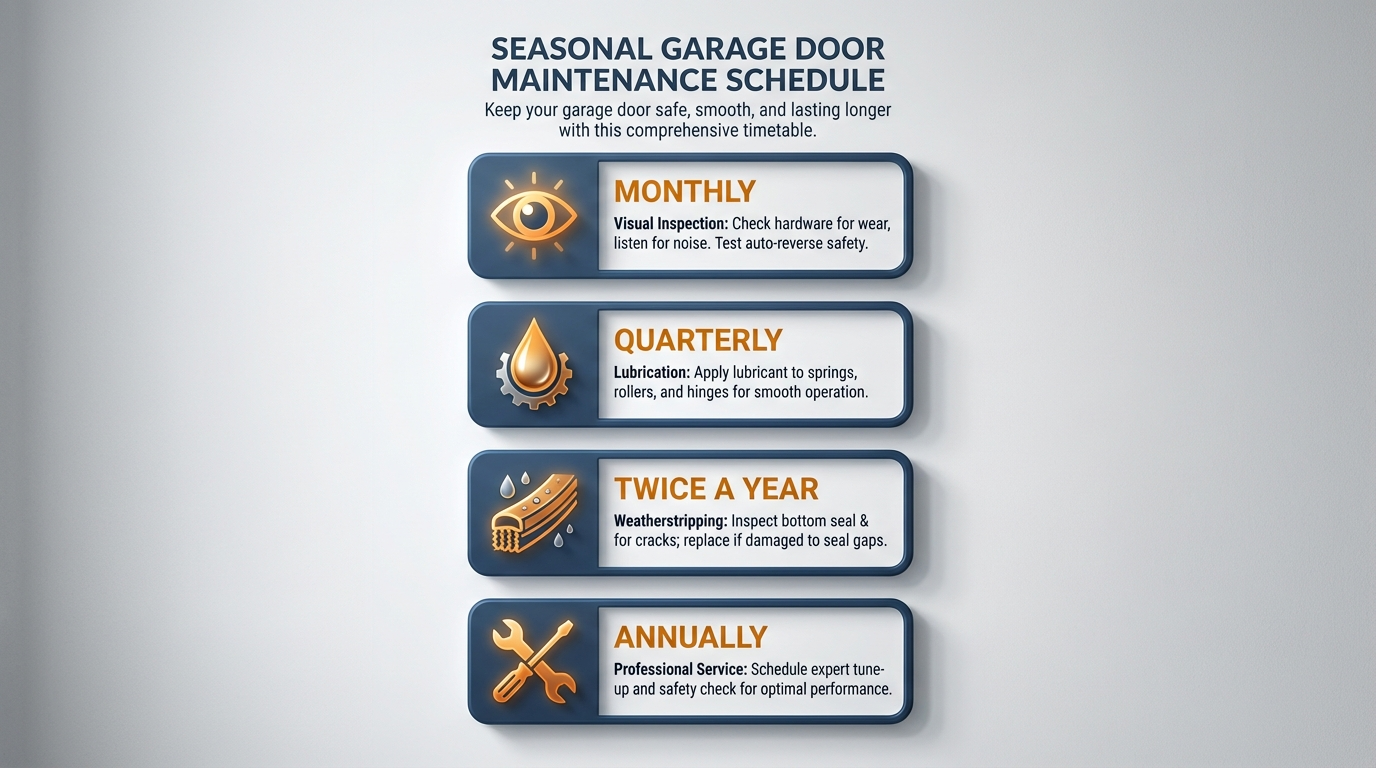
Consistent maintenance extends the life of your sectional garage doors and keeps them operating safely. A practical seasonal schedule helps homeowners stay organized without overcomplicating things.
| Frequency | Task | Purpose |
|---|---|---|
| Monthly | Visual inspection of springs, cables, rollers, and hinges | Detect wear, rust, or fraying before failure |
| Monthly | Test photo-eye sensors and auto-reverse | Ensure entrapment protection is functioning |
| Quarterly | Lubricate rollers, hinges, and spring coils | Reduce friction, noise, and corrosion |
| Quarterly | Clean tracks with a damp cloth (no lubricant on tracks) | Remove debris that causes rollers to bind |
| Twice a Year | Check and replace weatherstripping if cracked or flattened | Maintain thermal seal and keep pests out |
| Annually | Professional balance test and hardware inspection | Catch spring fatigue and alignment issues early |
One important detail: never apply lubricant to the tracks themselves. Lubricated tracks cause rollers to slide rather than roll, which strains the opener and can lead to the door jumping off the track. Lubrication belongs on moving metal-to-metal contact points only — hinges, roller bearings, and spring coils.
“Called on a Sunday evening when my opener stopped working. They came out the same night and got everything working again. Outstanding service!”
Frequently Asked Questions
Ready to Find the Right Sectional Door for Your Home?
Choosing the right sectional garage door involves more than picking a color. It requires matching insulation levels to your climate, verifying wind load compliance for your county, selecting hardware that will hold up under daily use, and ensuring the door fits your garage’s specific dimensions. Whether you are replacing a failing door, upgrading for energy savings, or building new, working with a knowledgeable local team makes the difference between a door that performs for decades and one that becomes a recurring headache. If you are ready to explore your options or need a professional assessment of your current setup, contact our expert team today for a straightforward conversation about what your home actually needs.
From selection to installation, our San Antonio team handles every detail. Transparent pricing, professional craftsmanship, and doors built for the Texas climate.
(210) 469-9003
Request Free Estimate
24/7 Service Available
Locally Owned & Operated

Recent Comments