
If your garage ceiling is cluttered with storage racks, lighting fixtures, or ductwork, you already know the frustration of a standard overhead door gobbling up every inch of available space. Roll up garage doors for residential use solve that problem at the root. Instead of sliding along ceiling-mounted tracks, these doors consist of a curtain of interlocking slats that coil tightly around a barrel drum positioned just above the opening. The result is near-total ceiling freedom, impressive durability, and a streamlined look that more and more Texas homeowners are choosing for their properties.
Whether you are building a new home, replacing an aging sectional door, or converting a workshop space, understanding how rolling garage doors work and what they demand in terms of clearance, insulation, and maintenance can save you from costly mistakes. This guide walks through every consideration, from measuring your space to choosing between insulated and non-insulated slats, so you can make a confident decision. When precision during the initial setup matters most, professional garage door installation services ensure the barrel, guides, and counterbalance springs perform exactly as designed from day one.
- Roll up garage doors coil into a compact drum above the header, freeing your entire ceiling for storage, lighting, or car lifts unlike traditional sectional doors.
- Headroom requirements are typically 10 to 15 inches above the opening; accurate measurement of headroom, sideroom, and opening dimensions is critical before ordering.
- Insulated double-skin slats are strongly recommended for attached garages in Texas to reduce heat transfer and operating noise significantly.
- The enclosed barrel and guide system offers superior security compared to sectional doors, with fewer pry points and concealed mechanical components.
- Annual professional inspections combined with a simple monthly homeowner checklist extend door lifespan well beyond the rated cycle count and prevent costly emergency repairs.
▼
- What Exactly Is a Residential Roll Up Garage Door?
- When Does a Rolling Door Make More Sense Than a Sectional Door?
- Rolling, Coiling, or Compact – Are These the Same Thing?
- How Much Headroom Does a Residential Roll Up Door Actually Need?
- Why Sideroom Clearance Deserves Its Own Attention
- What Scenario Makes Insulation Worth the Extra Investment?
- Are Roll Up Garage Doors Noisy – and Can You Fix That?
- How Secure Are Residential Rolling Garage Doors?
- A Mistake Homeowners Make When Choosing Automation
- What Drives the Cost of a Residential Roll Up Garage Door?
- How Long Can You Expect a Rolling Garage Door to Last?
- The Five-Minute Monthly Homeowner Checklist
- Red Flags That Mean You Should Call a Professional
- What Should You Verify Before Signing a Purchase Order?
- Commercial Technology in a Residential Package
- Frequently Asked Questions
Need Help Choosing the Right Roll Up Door for Your Garage?
Our experienced technicians provide free on-site assessments with precise measurements and transparent pricing. Serving San Antonio and surrounding areas since 2006.
(210) 469-9003
Schedule Free Assessment
70+ Verified Reviews
24/7 Availability
What Exactly Is a Residential Roll Up Garage Door?
A roll up garage door, sometimes called a coiling door, is built from horizontal slats that interlock like links in a chain. When the door opens, those slats travel upward along vertical side guides and wrap around a spring-loaded barrel (also called a drum) concealed inside a protective hood above the header. The entire curtain disappears into a compact coil, leaving the opening and the ceiling completely clear. According to industry component references, the core assembly includes interlocking slats, a barrel, counterbalance springs, side guides, and a hood or housing that shields the coiled curtain from dust and debris.
Unlike sectional doors that rely on horizontal tracks running deep into the garage, rolling garage doors need only a few inches of headroom above the opening for the coil. This fundamental difference makes them a practical choice for garages where ceiling space is at a premium or where homeowners simply want unobstructed overhead room.
When Does a Rolling Door Make More Sense Than a Sectional Door?
Choosing between a roll up door and a standard sectional design is not about one being universally better. It is about matching the door to the garage. A rolling door earns its place when ceiling-mounted obstacles prevent track installation, when the homeowner parks a tall vehicle or uses a car lift, or when the garage doubles as a workspace that needs every bit of vertical clearance. It also excels in situations where security ranks higher than decorative flexibility, since the steel or aluminum curtain and enclosed barrel mechanism leave fewer exposed leverage points for forced entry.
Sectional doors, on the other hand, often win on design variety, quieter operation out of the box, and wider availability of high-R-value insulated panels. If your garage is attached to the main living area and aesthetic continuity matters, a sectional door may be a better visual fit. The table below maps common homeowner scenarios to the door style that typically serves them best.
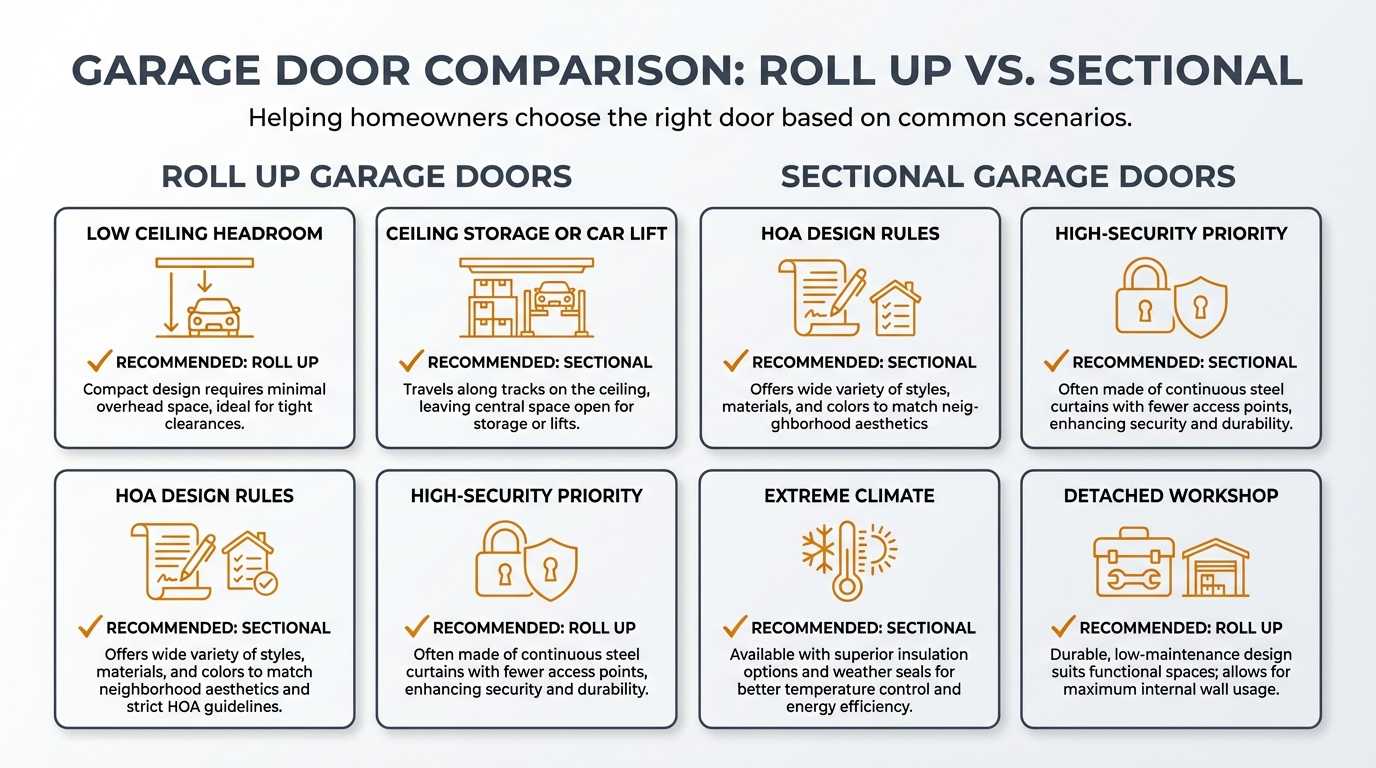
| Homeowner Scenario | Recommended Style | Why |
|---|---|---|
| Low ceiling / limited headroom | Roll up | Coil sits above header, no ceiling tracks needed |
| Ceiling storage or car lift installed | Roll up | Entire ceiling remains unobstructed |
| Attached garage with HOA design rules | Sectional | More panel styles, colors, and window options |
| High-security priority (tools, equipment) | Roll up | Enclosed mechanism, fewer pry points |
| Extreme climate with attached living space | Sectional (insulated) | Wider range of high-R-value panel options |
| Detached workshop or hobby garage | Either | Both work; roll up saves space, sectional adds curb appeal |
Rolling, Coiling, or Compact – Are These the Same Thing?
The terms “rolling door,” “coiling door,” and “compact door” appear across product listings and contractor websites, often used interchangeably, but subtle distinctions exist. “Rolling” and “coiling” describe the same basic mechanism, slats wrapping around a drum. In everyday conversation, “coiling” tends to appear in heavier-duty or commercial contexts, while “rolling” is the broader, more consumer-friendly label. A “compact” garage door is typically a specific product category within the rolling family, engineered with thinner slats and a smaller coil diameter to fit spaces with even less headroom than a standard roll up configuration.
For residential buyers, the takeaway is straightforward: focus less on the label and more on the measurable specs such as slat gauge, coil diameter, required headroom, and whether the door meets your insulation and wind-load needs. If a contractor quotes a “coiling” door or a “compact” door, ask for the clearance requirements and R-value rather than getting caught up in naming conventions.
How Much Headroom Does a Residential Roll Up Door Actually Need?
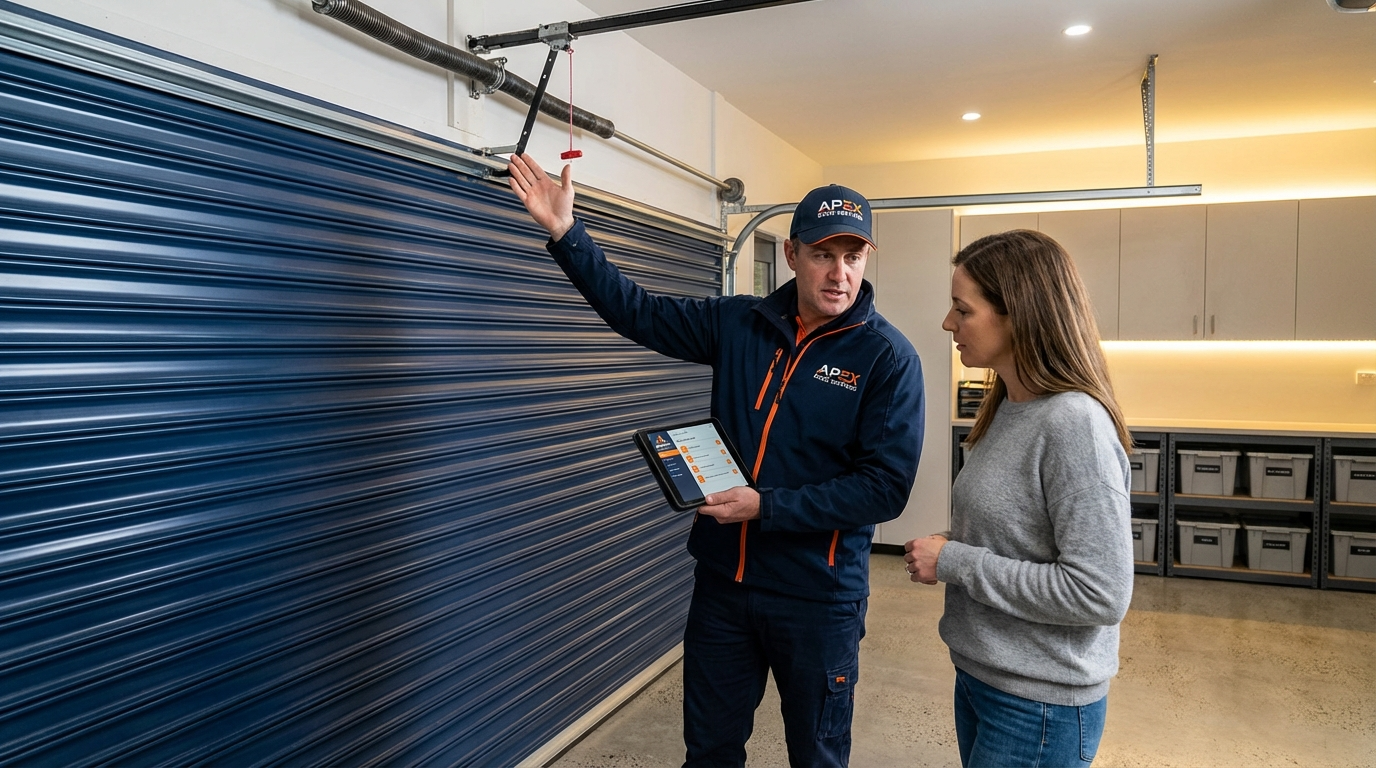
Headroom is the vertical distance between the top of the door opening and the nearest ceiling obstruction, whether that is a joist, beam, pipe, or shelf. Because a roll up door coils into a drum rather than sliding along tracks, the headroom demand is different from a sectional door. Most residential roll up assemblies require roughly 10 to 15 inches above the header for the barrel, hood, and any motorization hardware. That said, exact dimensions depend on door height, slat profile, and whether the door is insulated (insulated slats are thicker, so the coil is wider).
How to Measure Headroom, Sideroom, and Backroom
Start by measuring the finished opening, width and height, at three points each and recording the smallest dimension. Next, measure from the top of the opening straight up to the lowest overhead obstruction; that is your available headroom. For sideroom, measure the distance from each side of the opening to the nearest wall, pipe, or electrical panel. Backroom (depth into the garage from the opening) matters far less for roll up doors than for sectional ones, but confirm there is nothing within a few inches of the guides that could interfere with curtain travel. Resources from clearance-requirement reference charts can help you cross-check your numbers against specific configurations.
Common Measuring Mistakes That Delay Installation
The most frequent error is measuring to the drywall or trim instead of to the structural header. If the header sits higher or lower than the visible frame, the installer may arrive to find inadequate clearance. A second common mistake is ignoring obstructions that are not directly above the opening, including garage door openers, light fixtures, or sprinkler pipes that extend into the coil zone. Finally, measuring only one side of the opening and assuming symmetry can lead to problems, since many older garages are not perfectly square. Taking three measurements per dimension and using the smallest figure prevents surprises on installation day.
Why Sideroom Clearance Deserves Its Own Attention
Sideroom is the horizontal space on each side of the door opening required for the vertical guides and, if motorized, for the operator bracket or chain hoist. A roll up door with a tubular motor built into the barrel may need different sideroom than one driven by an external operator mounted to the wall. When the available sideroom is tight, say the opening is near a perpendicular wall, a technician may need to specify a guide configuration that sits flush or partially inset into the jamb. Overlooking sideroom during the planning stage is a leading reason homeowners end up ordering modifications after the door has already been manufactured.
What Scenario Makes Insulation Worth the Extra Investment?
Not every residential roll up door needs insulation, but in certain scenarios the upgrade pays for itself. If the garage is attached to the house and shares a wall with climate-controlled living space, an uninsulated steel curtain becomes a thermal bridge that drives up cooling costs, especially in Texas summers. The same logic applies when the garage serves as a home gym, workshop, or media room where temperature comfort matters. According to the U.S. Department of Energy, insulation effectiveness is measured by R-value, which indicates resistance to heat flow; higher R-values mean better thermal performance.
Insulated roll up doors use foam-filled or double-skin slats that sandwich a layer of polyurethane or polystyrene between two steel faces. Beyond temperature control, insulated slats dampen vibration and reduce the metallic rattle that single-skin doors sometimes produce. For detached garages used purely for vehicle parking, non-insulated doors are often sufficient and more budget-friendly. The key is matching insulation level to actual use, not defaulting to the cheapest or the most expensive option. Texas Pros Garage Doors helps homeowners evaluate their specific garage layout and usage pattern so the insulation choice aligns with real-world conditions rather than guesswork.
Not Sure If Insulation Is Worth It for Your Garage?
Our technicians evaluate your garage layout, wall sharing, and usage patterns to recommend the right insulation level. No guesswork, just data-driven advice.
Are Roll Up Garage Doors Noisy – and Can You Fix That?
Noise is one of the most-searched concerns among homeowners considering a rolling garage door. The honest answer: they can be louder than well-insulated sectional doors, primarily because the interlocking slats articulate individually as the curtain travels, and a single-skin steel curtain can vibrate when wind gusts hit. However, noise levels vary widely depending on slat gauge, guide fit, spring tension, and whether the door is insulated.
Common sounds include rattling during windy conditions, squeaking at the guides, and a low rumble as the curtain coils and uncoils. Most of these are manageable. Ensuring the guides are properly aligned and the slats are seated correctly eliminates the majority of rattling. Adding brush seals or rubber weatherstripping along the bottom bar and side guides reduces wind-driven vibration. Insulated double-skin slats inherently produce less resonance than hollow single-skin versions.
When it comes to lubrication, silicone-based sprays are generally the safest choice for the guides and barrel bearings. Standard penetrating oils like WD-40 may attract dust and grit over time, creating abrasive buildup that accelerates wear. Consumer maintenance guides specifically caution against using WD-40 on garage door tracks for this reason. Apply a light coat of silicone lubricant to the guides and end-bearing plates every few months, and wipe away excess to prevent dripping onto vehicles below.
How Secure Are Residential Rolling Garage Doors Compared to Other Types?
Security is a genuine strength of the roll up design. The curtain sits inside the guides with minimal gap, making it difficult to pry apart from the outside. The barrel and spring mechanism are enclosed in the hood above the header, out of reach and out of sight. Compared to sectional doors, where panel joints and exposed track hardware can sometimes be exploited, a well-installed rolling door presents fewer obvious attack points.
That said, security is only as strong as the weakest link. A basic latch lock on a roll up door is no more secure than the same lock on any other door. Upgrading to an internal slide bolt, anti-lift pins in the bottom bar, or an electric lock integrated with the opener significantly raises the barrier. The quality of the side guides also matters; if the guides flex easily or leave a gap between the curtain and the wall, an intruder could potentially lever the curtain aside. Having the door professionally installed and periodically inspected ensures the guides remain firmly anchored and the locking hardware functions as intended, a service that the team at Texas Pros Garage Doors provides as part of routine maintenance visits.
A Mistake Homeowners Make When Choosing Automation
Yes, residential roll up doors can absolutely be motorized. Tubular motors that fit inside the barrel are the most common solution, offering clean aesthetics and quiet operation. External operators mounted to the wall are another option, typically for larger or heavier doors. The mistake many homeowners make is selecting an opener based on price alone without verifying compatibility with the door’s weight, cycle speed, and safety features.
An undersized motor strains under load, shortening its lifespan and potentially stalling mid-cycle. An oversized motor can slam the door open or closed too aggressively, stressing the slats and guides. The opener must also include auto-reverse functionality, photo-eye sensors or edge sensors that stop and reverse the door if an obstruction is detected. The U.S. Consumer Product Safety Commission has warned for decades that non-reversing openers pose a serious entrapment hazard, particularly to children. Always confirm that any motorization package includes compliant safety sensors and a manual release mechanism for power outages.
What Drives the Cost of a Residential Roll Up Garage Door?
Pricing a roll up door is rarely as simple as looking up a dimension on a chart. The final cost is shaped by a combination of factors that interact with each other. Understanding these drivers helps you compare quotes intelligently and avoid the trap of choosing the lowest sticker price only to face higher long-term costs from repairs or energy loss.
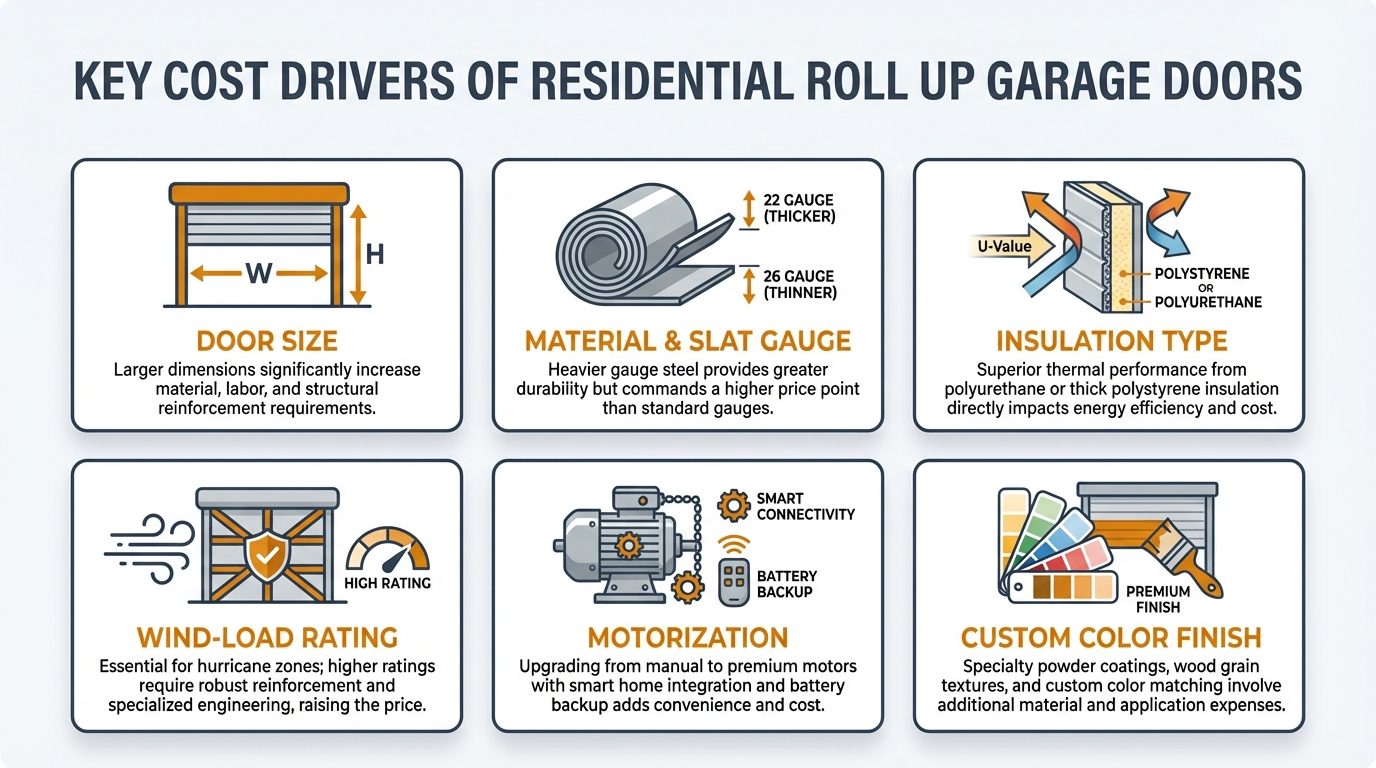
| Cost Driver | Impact on Price | When It Matters Most |
|---|---|---|
| Door size (width x height) | Larger doors use more material and heavier springs | Double-wide garages, tall openings |
| Material and slat gauge | Thicker steel or aluminum increases cost and durability | High-wind zones, security priority |
| Insulation (single vs. double-skin) | Foam-filled slats add 20-40% to door cost | Attached garages, climate-controlled spaces |
| Wind-load rating | Reinforced guides, heavier curtain, stronger springs | Coastal Texas, hurricane-prone regions |
| Motorization | Tubular motors add cost but increase convenience and safety | Daily-use residential garages |
| Custom color or finish | Powder-coat or color-match finishes carry a premium | HOA requirements, curb appeal |
| Installation complexity | Non-standard openings, structural reinforcement, electrical work | Older homes, converted spaces |
A common budgeting mistake is pricing the door in isolation. The total project includes the door itself, installation labor, any necessary electrical work for the opener, weatherstripping, and safety hardware. Requesting an all-inclusive quote rather than separate line items that may omit critical components protects you from unexpected add-ons after the contract is signed.
How Long Can You Expect a Rolling Garage Door to Last?
Lifespan depends on three interlocking variables: usage frequency, environmental exposure, and maintenance consistency. Manufacturers typically rate doors by “cycles,” where one cycle equals one full open-and-close operation. A standard residential door rated for 20,000 to 30,000 cycles, used twice daily, would theoretically last decades before the springs need replacement. In practice, coastal humidity, salt air, heavy dust, or extreme heat can accelerate corrosion and component fatigue well before the cycle count is reached.
Investing in a galvanized or powder-coated curtain, keeping the guides and barrel bearings lubricated, and scheduling a professional inspection at least once a year significantly extends service life. When minor issues like a bent slat or a squeaky bearing are caught early, they remain inexpensive repairs. Left unaddressed, they cascade into curtain misalignment, spring failure, or motor burnout, repairs that cost many times more than preventive maintenance.
The Five-Minute Monthly Homeowner Checklist
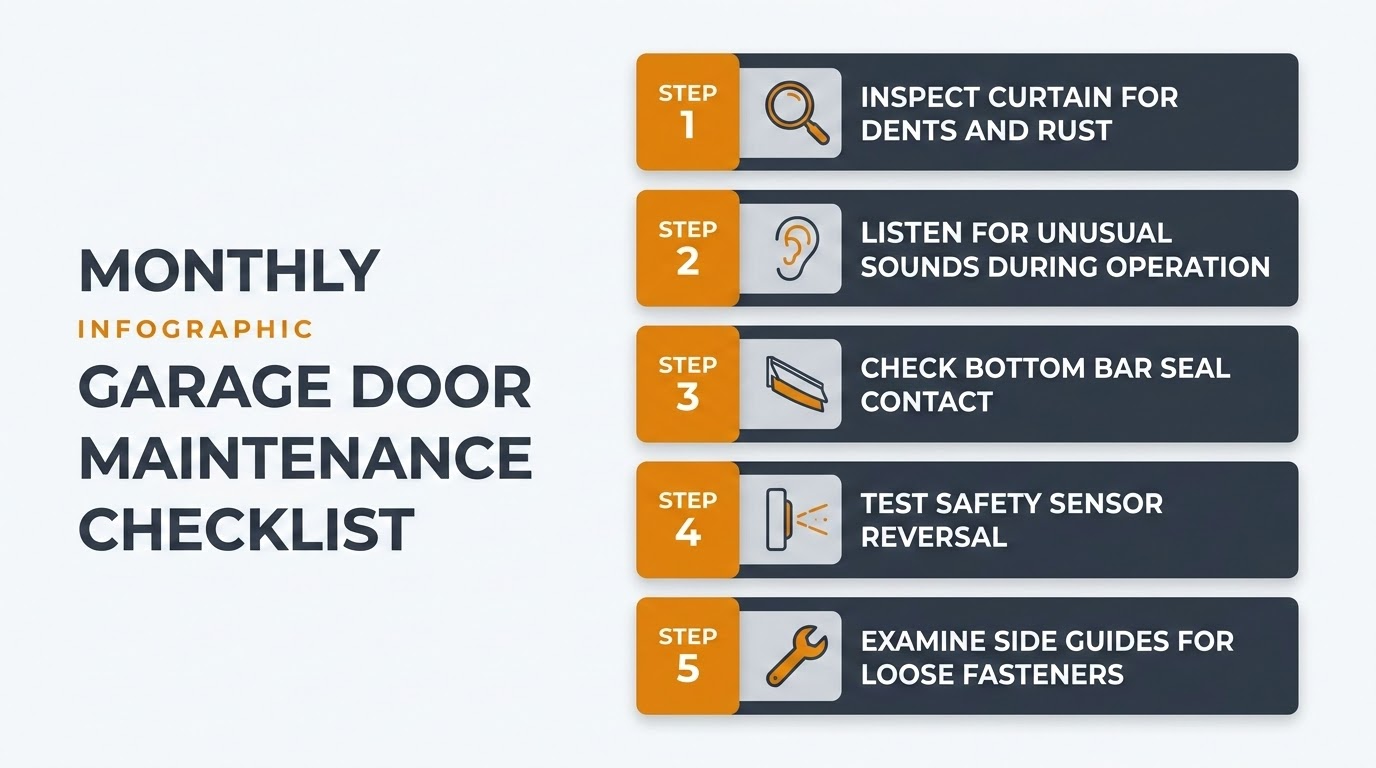
You do not need specialized tools or training to keep tabs on your rolling garage door between professional service visits. Once a month, stand inside the garage with the door closed and visually inspect the curtain for dents, gaps between slats, or signs of rust. Listen for unusual sounds, including grinding, scraping, or clicking, during a full open-close cycle. Check that the bottom bar seal contacts the floor evenly across the full width. Confirm that the safety sensors (if motorized) trigger a reversal when you place an object in the door’s path. Finally, look at the guides on both sides for loose fasteners or visible wear marks. This five-minute routine catches the vast majority of developing problems before they become emergencies.
What Our Customers Say
“The spring on my garage door broke and they were able to come out within an hour. Very professional service and fair pricing.”
“Excellent experience from start to finish. They helped me select the right door design and the installation was completed in one day.”
“My garage door spring broke on a Saturday morning. They came out the same day and fixed it quickly. Great service!”
“Professional commercial garage door repair. They understood the urgency for our business and minimized our downtime.”
Red Flags That Mean You Should Call a Professional
Certain issues sit outside the DIY comfort zone and involve components under extreme tension. If the door suddenly feels significantly heavier when operated manually, the counterbalance springs may be losing tension or breaking, and spring work should never be attempted without proper training and tools. A curtain that tracks off its guides, binds partway through travel, or drops faster than normal on closing are all signs of mechanical failure that require an experienced technician. Likewise, any electrical issue with the opener, including sparking, burning smell, or inconsistent sensor behavior, warrants immediate professional attention. The garage door repair experts at Texas Pros Garage Doors respond to these situations promptly, diagnosing root causes rather than applying temporary fixes.
What Should You Verify Before Signing a Purchase Order?
Before committing to a specific roll up garage door, run through a short verification process that protects your investment. Confirm that your measurements have been validated by the installer, not just taken from your own tape measure. Ask whether the quoted wind-load rating meets your local building code, which is critical in many Texas counties. Verify that the warranty covers both the curtain and the mechanical components, and clarify what voids the warranty, such as improper lubrication, unauthorized modifications, or lack of annual service. Finally, check that the installation quote includes disposal of the old door, electrical hookup for the opener, and a post-install safety test. Taking these steps before signing avoids disputes and ensures you receive exactly what you are paying for.
| Verification Item | What to Ask / Confirm |
|---|---|
| Measurements | Has the installer verified headroom, sideroom, and opening dimensions on-site? |
| Wind-load compliance | Does the door meet local building code wind-speed requirements? |
| Warranty scope | Does the warranty cover springs, motor, and curtain separately? What voids it? |
| Included services | Does the quote cover old-door removal, electrical work, and post-install testing? |
| Safety sensors | Are photo-eye sensors and auto-reverse included and code-compliant? |
| Maintenance plan | Does the installer offer an annual service agreement? |
Commercial Technology in a Residential Package
One of the underappreciated advantages of roll up garage doors is that the core technology is borrowed from commercial and industrial applications where reliability is non-negotiable, including loading docks, warehouse bays, and fire stations. Residential versions scale down the size and weight while retaining the same coiling mechanism, counterbalance engineering, and guide architecture. This means homeowners benefit from decades of commercial R&D without paying commercial prices. For businesses that also need robust rolling door service, Texas Pros Garage Doors extends the same expertise to commercial rolling door solutions, ensuring consistent quality across both residential and commercial projects.
“Called on a Sunday evening when my opener stopped working. They came out the same night and got everything working again. Outstanding service!”
Frequently Asked Questions About Roll Up Garage Doors Residential
In most cases, yes. Standard single-car (8-10 ft wide) and double-car (16 ft wide) openings can accommodate roll up doors as long as the headroom and sideroom meet the manufacturer’s clearance requirements. An on-site measurement by a qualified installer confirms fit before the door is ordered.
They perform well when the right configuration is chosen. Insulated double-skin slats reduce heat transfer significantly, and proper weatherstripping along the bottom bar and side guides prevents hot air infiltration. For attached garages, insulation is strongly recommended.
At minimum, once per year. A professional service visit typically includes spring tension adjustment, guide alignment check, lubrication of moving parts, safety sensor testing, and a full curtain inspection for wear or damage. Homes in high-dust or coastal areas benefit from twice-yearly visits.
Yes. Most manufacturers offer a range of standard powder-coat colors, and custom color matching is available at additional cost. Powder-coated finishes also provide an extra layer of corrosion resistance beyond the base galvanized coating.
Individual slats can usually be replaced without removing the entire curtain. A technician detaches the damaged slat from its interlocking neighbors, slides it out of the guides, and inserts a replacement. This is one of the practical maintenance advantages of the roll up design, as localized damage does not require a full door replacement.
Single-skin roll up doors can produce more operational noise than insulated sectional doors, primarily due to slat articulation and curtain vibration. However, insulated roll up doors with properly tensioned springs and well-maintained guides operate at noise levels comparable to many sectional models. Lubrication and guide alignment are the two biggest factors homeowners can control.
Ready to Find Out if a Roll Up Door Fits Your Garage?
Every garage is different. Ceiling height, wall obstructions, climate exposure, and daily usage patterns all shape the right door choice. Instead of guessing, have an experienced technician evaluate your space and walk you through the options that match your specific situation.
(210) 469-9003
Schedule No-Obligation Consultation
24/7 Emergency Service
Transparent Pricing

Recent Comments