
A garage door used to be nothing more than a heavy panel that rolled up and down. Today, modern garage doors serve as the defining architectural element of a commercial facade or an upscale residence. Clean sightlines, floor-to-ceiling glass, and slim aluminum frames transform what was once a utilitarian barrier into a statement of brand identity and design sophistication. For property owners across Texas, choosing the right system means balancing aesthetics with the state’s unique demands — intense heat, high winds, and strict building codes.
Texas Pros Garage Doors specializes in guiding commercial and residential clients through that selection process. From initial consultation to final hardware adjustment, the company’s approach centers on matching each property’s functional requirements with a design that elevates curb appeal. Whether you operate a restaurant patio that needs a seamless indoor-outdoor transition or a showroom that relies on natural light, the right modern door changes how people experience your space — and how they perceive your business.
- Modern glass and aluminum frame garage doors serve as architectural statements that boost curb appeal and brand identity for Texas properties.
- Glass opacity options (clear, frosted, tinted, mirrored, Low-E) let you control privacy, natural light, and solar heat gain without sacrificing style.
- Wind-load ratings and impact-rated glazing are not optional in many Texas counties — non-compliance can void insurance and delay occupancy.
- Thermally broken aluminum frames with insulated glazing units dramatically reduce energy costs in conditioned commercial and residential spaces.
- Professional installation and high-cycle hardware selection ensure modern doors perform reliably under the demands of daily Texas use.
▼
- How Did Garage Doors Evolve into Architectural Statements?
- What Defines the Look of Contemporary Garage Doors?
- Turning a Closed Storefront into an Inviting Space
- Choosing Glass Opacity: Clear, Frosted, Tinted, or Mirrored?
- Why Insulation Matters Even in a Hot Climate
- Understanding U-Factor and SHGC for Modern Doors
- A Common Mistake: Ignoring Wind-Load Ratings in Texas
- What Safety Standards Apply to Glass in Garage Doors?
- Comparing Aluminum Frame Doors to Steel Alternatives
- How Texas Pros Matches Doors to Real Business Needs
- What Drives the Cost of Modern Garage Doors?
- Does the Door Style Affect Ongoing Maintenance?
- What Separates “Full-View” from Other Contemporary Designs?
- Frequently Asked Questions
Get a Free Modern Garage Door Consultation
Our design specialists help you select the perfect glass, frame, and finish for your Texas property. Same-day estimates available.
(210) 469-9003
Schedule Free Consultation
70+ Verified Reviews
Since 2006
How Did Garage Doors Evolve into Architectural Statements?
Decades ago, garage doors were selected based on two criteria: price and durability. Steel panels in white or beige dominated the market. The shift began when architects started treating the garage opening — often the largest single element on a building’s front elevation — as a design opportunity rather than an afterthought. Commercial developers noticed that a sleek, transparent door drew foot traffic and communicated openness. Residential builders followed, integrating flush panels and glass sections into contemporary home designs.
This evolution was accelerated by advances in materials engineering. Extruded aluminum profiles became strong enough to span wide openings without bulky frames, while tempered and laminated glass met rigorous safety standards without sacrificing transparency. The result is a category of doors that performs at a commercial grade while looking like custom-fabricated architectural glazing. Businesses that invest in commercial garage door services find that ongoing professional maintenance protects both the investment and the visual impact of these systems.
What Defines the Look of Contemporary Garage Doors?
Contemporary garage doors share a visual vocabulary: horizontal lines, minimal visible hardware, monochromatic or two-tone color palettes, and an emphasis on material honesty. Rather than mimicking wood grain through embossed steel, a contemporary door showcases the raw elegance of brushed aluminum or the contrast between dark frames and clear glass. Hardware is concealed or integrated into the track system, so nothing interrupts the surface plane.
For modern Texan architecture — whether it leans minimalist, industrial, or mid-century modern — aluminum frame doors are the natural fit. Aluminum resists corrosion in humid Gulf Coast climates, weighs less than steel (reducing strain on openers and springs during high-cycle commercial use), and accepts powder-coat finishes in virtually any color. Sectional door specifications, such as those referenced in DASMA 102-2004, outline the structural expectations these doors must meet, ensuring that style never compromises structural integrity.
A Scenario: Turning a Closed Storefront into an Inviting Space
Imagine a restaurant on a busy Texas avenue. The original facade features a solid roll-up door that hides the interior from passersby. Replacing it with a full-view glass garage door changes the dynamic entirely. Diners see activity inside, natural light floods the space during daytime service, and when the door is raised during mild evenings, the boundary between sidewalk and dining room dissolves. The same principle applies to breweries, auto showrooms, yoga studios, and co-working spaces.
The “Full-View” concept uses large glass panels set within a slim aluminum framework. Each panel can be configured with a different opacity — clear at eye level for visibility, frosted at the base for modesty, or tinted across the entire surface for solar control. This flexibility lets business owners curate exactly how much of their interior is on display.
Choosing Glass Opacity: Clear, Frosted, Tinted, or Mirrored?
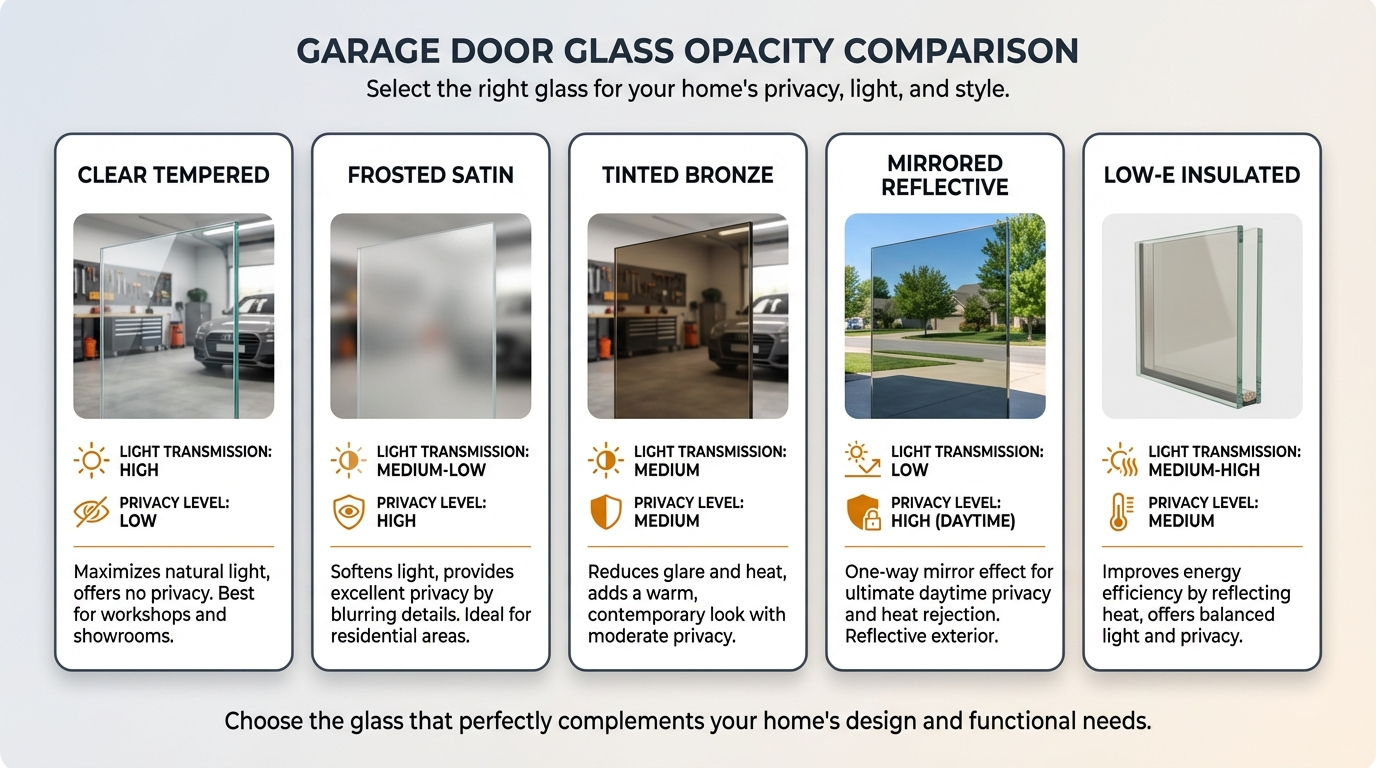
| Glass Type | Light Transmission | Privacy Level | Best Commercial Use |
|---|---|---|---|
| Clear Tempered | High | Low | Showrooms, galleries, lobbies |
| Frosted / Satin | Medium-High | High | Offices, workshops, storage areas |
| Tinted (Gray, Bronze) | Medium | Medium | Restaurants, gyms, retail |
| Mirrored / Reflective | Low-Medium | Very High (daytime) | Studios, salons, secure facilities |
| Low-E Insulated | Medium-High | Low-Medium | Climate-controlled spaces |
Privacy concerns are one of the most common reasons business owners hesitate before choosing glass garage doors. The table above shows that opacity is not an all-or-nothing decision. According to the U.S. Department of Energy, supplementary window attachments and coatings — including interior films and motorized shades — can further control solar heat gain and visibility without altering the door’s exterior appearance.
Why Insulation Matters Even in a Hot Climate
Texas heat makes insulation counterintuitive to some buyers. If the garage is not air-conditioned, why insulate? The answer depends on how the space is used. A detached storage building with infrequent access may not need insulated glazing. However, a commercial space connected to a conditioned interior — a restaurant, a retail store, a finished workshop — benefits dramatically from reduced heat transfer through the door.
Insulated glazing units (IGUs) use two or more panes of glass separated by an air or gas-filled gap. Adding Low-E coatings to one or more surfaces reflects infrared energy, keeping heat outside in summer and inside during winter cold snaps. The measurable result is a lower U-factor, which indicates less heat transfer through the assembly. According to the Department of Energy’s performance ratings guide, a lower U-factor directly correlates with improved energy efficiency.
Understanding U-Factor and SHGC for Modern Doors
Two ratings govern the thermal performance of any glazed system. U-factor measures the rate of non-solar heat transfer — the lower the number, the better the insulation. SHGC (Solar Heat Gain Coefficient) measures how much solar radiation passes through the glass as heat; in Texas, a lower SHGC is generally preferred to reduce cooling loads. Both values appear on NFRC labels when a product is certified.
For contemporary garage doors with aluminum frames, a critical detail is the thermal break — a strip of low-conductivity material inserted into the frame extrusion to prevent the aluminum from acting as a heat bridge. Without a thermal break, even the best insulated glass panel loses efficiency because heat conducts rapidly through the metal surround. When evaluating products, ask the installer whether the frame profile includes an engineered thermal break and what U-factor the complete assembly achieves.
Need Help Choosing the Right Glass and Frame?
Our specialists walk you through every option — opacity, insulation, wind-load ratings — so your door performs and looks exactly right.
A Common Mistake: Ignoring Wind-Load Ratings in Texas
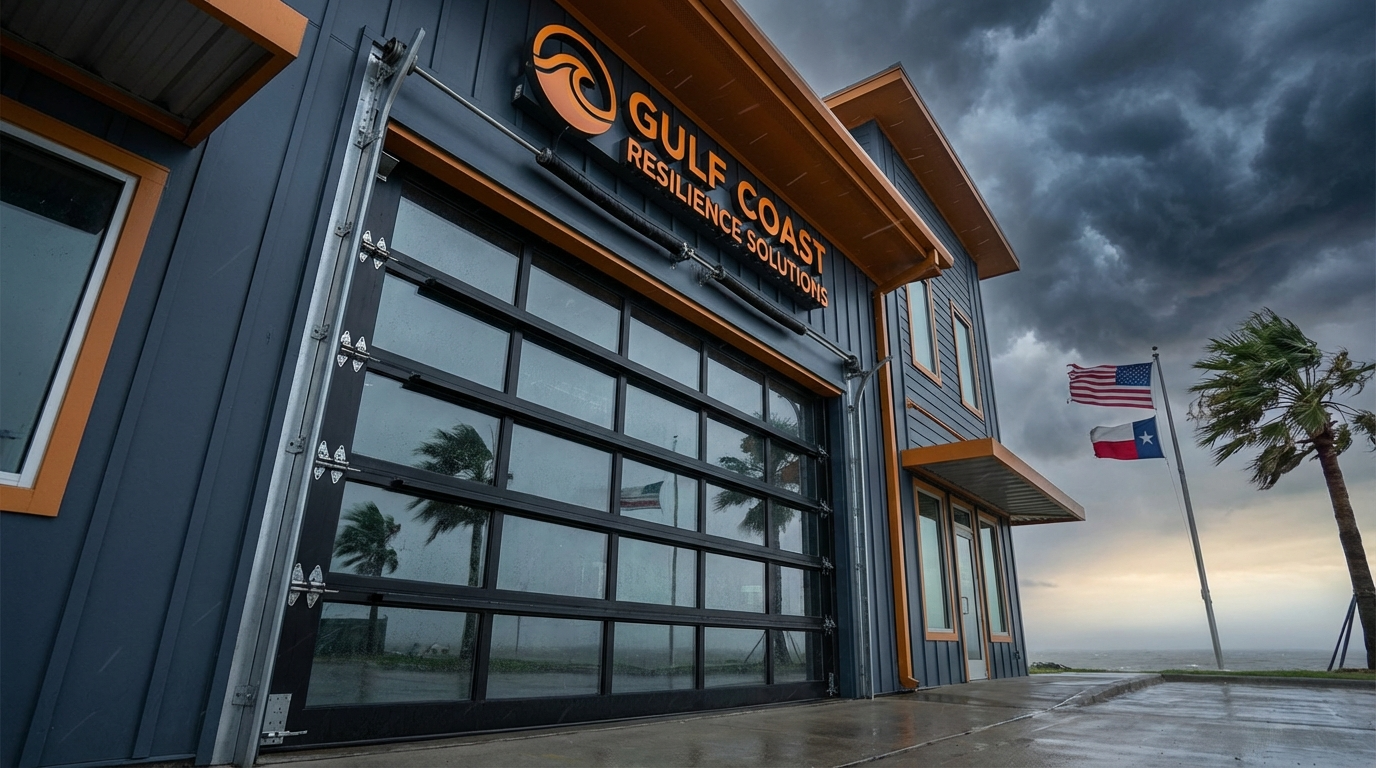
One of the most consequential oversights in garage door selection is treating wind-load compliance as optional. In many Texas counties — particularly along the Gulf Coast — the International Residential Code (IRC) and local amendments mandate that garage doors be pressure-rated to withstand specific wind speeds. The Building America Solution Center confirms that doors must be tested according to ASTM E330 or ANSI/DASMA 108 for static air-pressure resistance.
In designated windborne-debris regions, doors may also need to pass impact testing under ANSI/DASMA 115, which simulates missile-borne debris striking the surface. For glass garage doors, this means the glazing must be impact-rated or protected by an approved shutter system. Failing to meet these requirements can void insurance coverage, delay certificate-of-occupancy approvals, and — most importantly — put occupants at risk during severe weather events.
What Safety Standards Apply to Glass in Garage Doors?
Beyond wind loads, all architectural glazing materials in the United States must comply with 16 CFR Part 1201, enforced by the Consumer Product Safety Commission (CPSC). This regulation establishes impact-resistance categories for glass used in doors, shower enclosures, and similar hazardous locations. Tempered glass shatters into small, relatively harmless fragments upon impact, while laminated glass holds together because a plastic interlayer bonds the panes even after breakage.
For commercial applications, tempered glass is the baseline. Laminated glass adds a further layer of security because it resists penetration, which deters forced entry and reduces liability if a panel is struck by equipment, a vehicle, or storm debris. When storms do cause damage, having access to responsive emergency repair services minimizes downtime and protects the building envelope until permanent restoration is completed.
Comparing Aluminum Frame Doors to Steel Alternatives
| Criterion | Aluminum Frame | Steel Frame |
|---|---|---|
| Corrosion Resistance | Excellent — naturally oxide-protected | Moderate — requires paint or galvanizing |
| Weight | Lighter — less opener/spring stress | Heavier — may need higher-cycle hardware |
| Sightline Width | Narrow profiles possible | Wider profiles typical |
| Finish Options | Anodized, powder-coat, woodgrain wrap | Powder-coat, paint |
| Thermal Break Availability | Widely available in commercial lines | Less common in standard models |
| Cost Range | Mid to high | Low to mid |
Neither material is universally superior. Steel delivers strength at a lower price point and may suit industrial applications where aesthetics are secondary. Aluminum excels when the design calls for slender frames, maximum glass area, and long-term resistance to coastal or humid environments — conditions found across much of Texas.
What Our Customers Say
“The spring on my garage door broke and they were able to come out within an hour. Very professional service and fair pricing.”
“Excellent experience from start to finish. They helped me select the right door design and the installation was completed in one day.”
“My garage door spring broke on a Saturday morning. They came out the same day and fixed it quickly. Great service!”
“Professional commercial garage door repair. They understood the urgency for our business and minimized our downtime.”
How Texas Pros Garage Doors Matches Doors to Real Business Needs
| Business Need | How It Is Addressed in Practice |
|---|---|
| Maximizing storefront visibility | Full-view glass panel selection with clear tempered glazing and narrow aluminum frames |
| Meeting local wind-load codes | Pre-installation engineering review, sourcing pressure-rated assemblies tested to ASTM E330/ANSI-DASMA 108 |
| Reducing energy costs in conditioned spaces | Insulated glazing units with Low-E coating and thermally broken frames |
| Maintaining doors under heavy daily use | Commercial-grade springs, high-cycle openers, and scheduled maintenance programs |
| Fast response after storm damage | 24/7 emergency service with on-hand inventory for common panel sizes |
This approach reflects a philosophy of practical problem-solving rather than one-size-fits-all sales. Each project begins with a site assessment that considers opening dimensions, exposure direction, local code requirements, and the owner’s operational workflow. Because the team works exclusively in the garage door space, their familiarity with manufacturer lead times, hardware compatibility, and Texas-specific regulatory nuances streamlines the process from specification to commissioning.
What Drives the Cost of Modern Garage Doors?
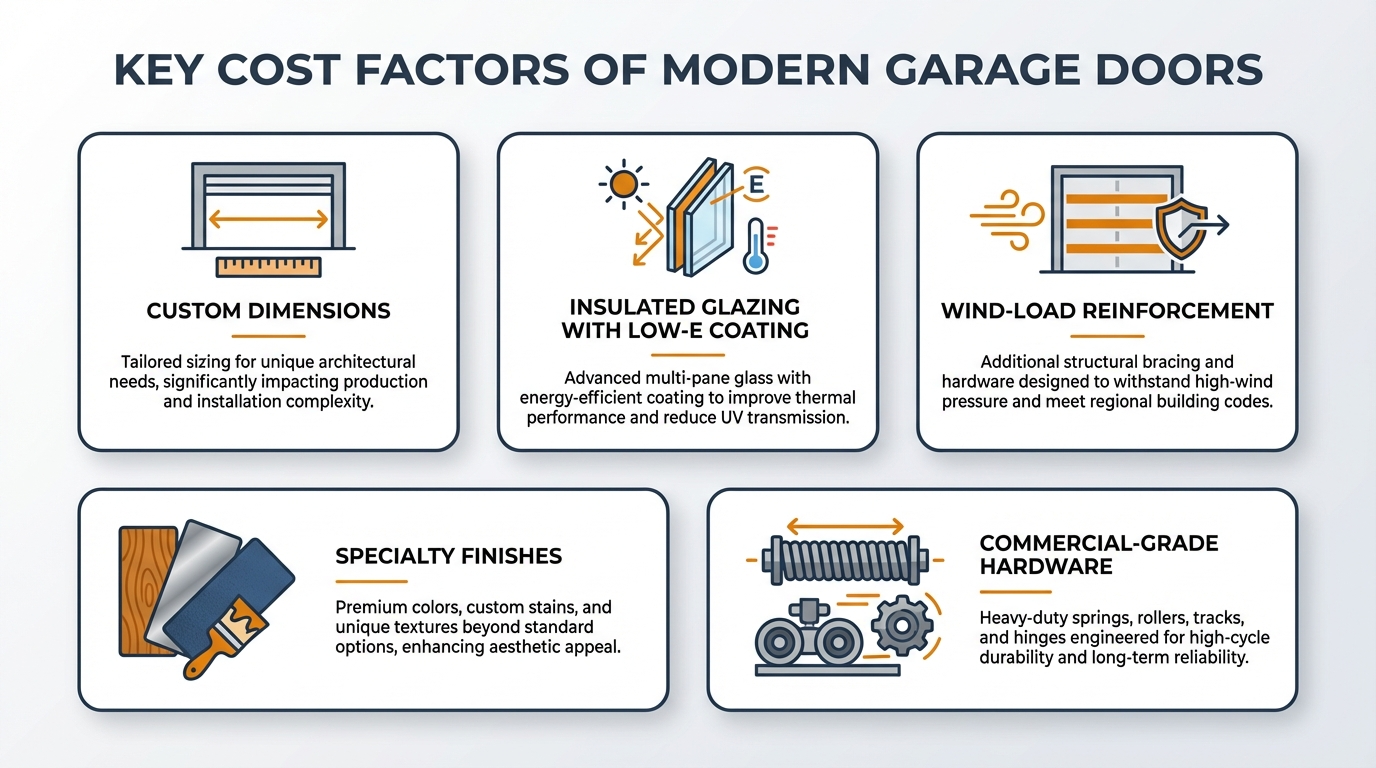
Price is rarely a single number. A basic non-insulated aluminum-and-glass panel for a standard single-car opening starts at a fundamentally different point than a wind-load-rated, insulated, powder-coated commercial system spanning a 20-foot bay. The variables that push cost upward include the following factors working in combination, not in isolation.
Door dimensions beyond standard sizes require custom extrusions. Insulated glazing with Low-E coatings adds material cost per panel. Wind-load reinforcement means heavier tracks, additional bracing, and sometimes impact-rated glass. Specialty finishes — dark bronze anodizing, custom RAL colors, woodgrain wraps — carry premiums over standard white or clear anodized. Finally, commercial-grade hardware (high-cycle springs, heavy-duty openers, chain hoists for manual backup) represents a separate line item that residential buyers may not encounter.
Does the Door Style Affect Ongoing Maintenance?
One practical advantage of aluminum frame doors is their low maintenance profile. Aluminum does not rust, so there is no need for periodic repainting to prevent corrosion. Glass panels clean easily with standard glass cleaner and a squeegee — a task that takes minutes and keeps the facade looking sharp between professional washes. Tracks, rollers, and weatherseals require the same periodic lubrication and inspection as any sectional door, but the absence of wood rot, steel oxidation, or composite delamination simplifies the long-term care schedule.
For businesses that operate doors dozens of times per day — loading docks, auto service bays, event venues — spring and opener longevity becomes the primary maintenance concern. Specifying high-cycle torsion springs (rated for 25,000 to 100,000 cycles rather than the residential standard of 10,000) extends service intervals dramatically. Texas Pros Garage Doors factors cycle count into every commercial recommendation, ensuring that the hardware matches the intensity of daily use.
What Separates “Full-View” from Other Contemporary Designs?
“Contemporary” is a style category that encompasses several sub-types. Flush panel doors use smooth, unembossed steel or aluminum sections with no raised panels or window inserts — they look modern but are opaque. Plank-style doors mimic horizontal wood siding with clean lines. Full-view doors, by contrast, maximize glass area within a structural frame, making them the most transparent option available. Not every contemporary door is full-view, but virtually every full-view door reads as contemporary because of its emphasis on openness and minimal framing.
The distinction matters at the specification stage. A business that wants a modern aesthetic but needs to conceal interior operations — a warehouse, a commercial kitchen — may be better served by a flush panel door with a small vision lite. A business that wants to showcase its interior should consider a full-view configuration. Understanding the difference prevents costly re-orders and ensures the final product matches the intended function.
“Called on a Sunday evening when my opener stopped working. They came out the same night and got everything working again. Outstanding service!”
Frequently Asked Questions About Modern Garage Doors
Yes, when specified correctly. Tempered glass is four to five times stronger than standard annealed glass. Laminated glass adds penetration resistance. Combined with commercial-grade locking mechanisms and optional alarm contact sensors, a glass garage door can meet or exceed the security level of a traditional steel door. The key is selecting the right glass type and hardware for the threat profile of the location.
For any space that is heated, cooled, or occupied for extended periods, insulation provides measurable return. Property owners consistently report noticeable temperature differences after upgrading to insulated doors — particularly in climates with extreme heat like Texas. The cost premium for insulated glazing typically pays for itself through lower energy bills within a few cooling seasons, especially when the door faces south or west.
Wipe the aluminum with a mild detergent solution and rinse with clean water two to four times per year. Avoid abrasive cleaners that can scratch anodized or powder-coated finishes. Clean glass panels with any ammonia-free glass cleaner. Inspect weatherseals, track alignment, and spring tension at least annually — or more frequently for high-cycle commercial installations.
They can, provided they carry the appropriate wind-load rating for the property’s geographic zone. The Texas Department of Insurance outlines testing criteria — including ASTM E330 and ANSI/DASMA 108 — that doors must pass for windstorm certification in designated coastal areas. Impact-rated glazing or approved shutters may be required in windborne-debris zones.
Without mitigation, clear single-pane glass can transmit significant solar heat. The solution is specifying Low-E coated, insulated glazing with a low SHGC rating. Tinted or reflective glass further reduces solar gain. Interior roller shades or exterior awnings provide additional control for west-facing openings that receive intense afternoon sun.
Lead times vary by manufacturer, finish, and glass specification. Standard configurations may ship within two to four weeks. Custom sizes, specialty finishes, or impact-rated glazing can extend delivery to six to ten weeks. Working with an installer who maintains relationships with multiple manufacturers helps identify the fastest path to delivery without compromising specification requirements.
Ready to Transform Your Property’s First Impression?
The right modern garage door defines how people see your business or home from the street. From selecting the ideal glass opacity to ensuring every wind-load requirement is met, the details demand expertise. Reach out for a site-specific consultation today.
(210) 469-9003
Contact Us Today
Serving San Antonio Since 2006
Free On-Site Estimates
Have you assessed whether your current door is costing you energy, curb appeal, or code compliance? From initial consultation to final hardware adjustment, Texas Pros Garage Doors turns a functional necessity into a competitive advantage. Discover how professional garage door installation elevates your property — contact us today to start the conversation.

Recent Comments