
Estimated reading time: 12 minutes
Walk through any established neighborhood in San Antonio and you will notice something reassuring: the majority of homes still rely on traditional garage doors to anchor their curb appeal. Even as contemporary flush-panel designs gain attention in architectural magazines, homeowners across Texas keep returning to the warmth, symmetry, and proven reliability of classic raised-panel styles. A garage door can represent up to 40 percent of a home’s visible facade, and choosing a design that communicates stability is a decision that pays dividends in daily enjoyment and long-term property value.
For San Antonio residents who want this classic look built to handle local wind loads, intense UV exposure, and triple-digit summer afternoons, Texas Pros Garage Doors provides consultation, supply, and installation services designed specifically around the realities of the Texas climate. Their team evaluates each home’s orientation, structural framing, and aesthetic goals before recommending a door specification — an approach that prevents the costly mismatch between “looks great online” and “performs well on your house.”
Key Takeaways
- Traditional raised-panel garage doors remain the most popular choice for San Antonio homes, offering timeless curb appeal that works across colonial, craftsman, and ranch-style architecture.
- Choosing between short-panel and long-panel layouts depends on your home’s facade proportions — busier facades suit short panels, while simpler elevations benefit from long panels.
- Steel doors with woodgrain embossing deliver the best balance of appearance, durability, and low maintenance for the Texas climate, though real wood remains ideal for high-end properties.
- Wind-load ratings (Design Pressure) and proper insulation with complete perimeter sealing are critical performance factors often overlooked during purchase decisions.
- Professional installation by manufacturer-trained technicians ensures warranty validity, wind-load certification compliance, and safe long-term operation.
▼
- What Exactly Makes a Garage Door “Traditional”?
- Raised Panel Doors: Short Panel vs. Long Panel
- Colonial Style Doors and Matching Your Facade
- Are Traditional Garage Doors Still Relevant in 2025?
- Choosing Between Steel, Wood, and Composite
- Five Common Mistakes When Buying
- Wind Ratings and Design Pressure Explained
- How R-Value Works and Why Sealing Matters
- Insulation: Attached vs. Detached Garage
- What Happens With Incorrect Installation?
- How the Texas Sun Affects Finish and Color
- Windows: When They Add Value and When to Skip
- What Influences the Final Price?
- A Practical Checklist Before You Commit
- What Texas Pros Garage Doors Delivers
- Frequently Asked Questions
Need Help Choosing the Right Traditional Garage Door?
Our San Antonio team will evaluate your home’s orientation, style, and wind zone to recommend the perfect door specification — no guesswork involved.
(210) 469-9003
Schedule Free Consultation
70+ Verified Reviews
Since 2006
What Exactly Makes a Garage Door “Traditional”?
The term traditional garage doors covers a family of designs that share several visual traits: symmetrical panel layouts, clean horizontal and vertical lines, and proportions that echo colonial, craftsman, or ranch-style architecture. Unlike modern flush doors that aim for a sleek, uninterrupted surface, traditional models use recessed or raised panels to create depth and shadow lines across the face of the door. That interplay of light and shadow is what gives a traditional door its character — and why it looks at home on such a wide range of facade styles.
Decorative hardware — strap hinges, ring handles, and step plates — can be added to mimic old-world carriage-house doors while the actual door glides on a modern sectional track above. This blend of vintage appearance and contemporary mechanics is central to the category’s lasting popularity.
Raised Panel Doors: Short Panel vs. Long Panel — Which Suits Your Home?
Raised panel doors are the most recognizable subset of traditional garage doors. Each rectangular section of the door features a center panel that projects slightly outward, producing a three-dimensional texture visible from the street. The two main layout options are short panel and long panel, and the choice between them is largely a matter of proportion.
How the Two Layouts Change the Visual Effect
Short-panel doors divide each section into more individual rectangles. The result is a busier, more detailed surface that works well on homes with ornate trim, brick coursing, or multiple small windows. Long-panel doors use fewer, wider rectangles, creating a calmer, more horizontal visual rhythm. They tend to look best on double-wide openings and on homes whose facades already have strong horizontal lines — such as ranch-style residences with wide eaves.
A useful rule of thumb: if your home’s front elevation has many small decorative elements, short panels will echo that detail. If the elevation is relatively plain, long panels add just enough visual interest without competing with the architecture.
Colonial Style Doors and the Art of Matching Your Facade
Colonial style doors take the traditional concept a step further by prioritizing strict symmetry and period-appropriate window grids. On a classic colonial home — center entry, evenly spaced windows on either side, sometimes with shutters — the garage door needs to follow the same rhythm. That usually means a top section fitted with divided-lite windows whose grid spacing mirrors the window mullions on the upper floors.
Color selection matters here as well. Colonial homes typically feature a restrained palette: white, cream, slate gray, or deep navy. Choosing a garage door color that complements (rather than contrasts with) the front door and shutters keeps the facade unified. Adding arched window inserts can work if the home already has arched elements elsewhere, but on a true colonial elevation, rectangular grids almost always look more authentic.
Are Traditional Garage Doors Still Relevant in 2025 and Beyond?
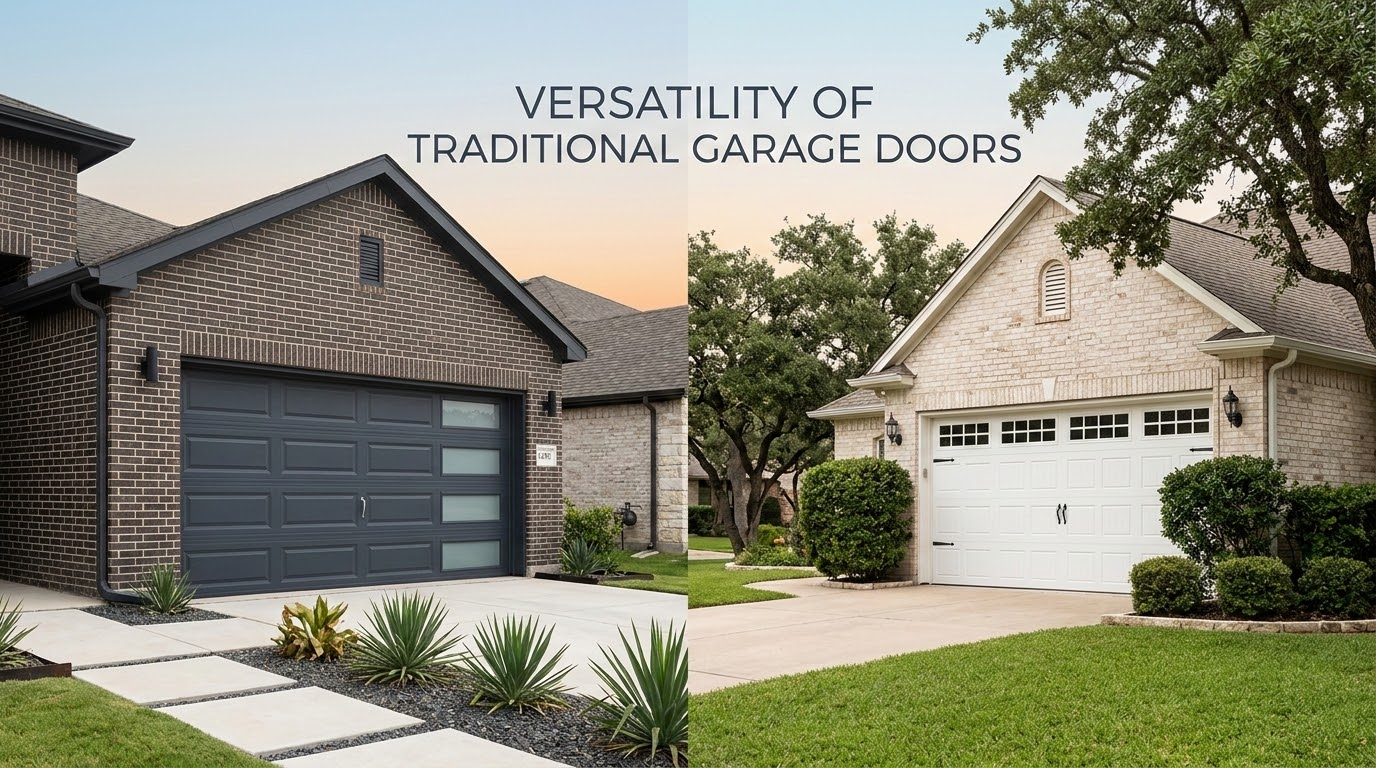
Design trends cycle, but the traditional category has remained commercially dominant for decades. One reason is versatility: a raised-panel steel door painted charcoal with minimal hardware can read as “transitional” rather than old-fashioned, bridging classic and modern without committing fully to either. Another reason is resale appeal. Real estate agents consistently report that neutral, classic exteriors attract the widest buyer pool — especially in suburban markets across Texas.
Updating a traditional door for a more current feel does not require a style change. A darker paint color, frosted rather than clear window glass, and streamlined hardware are enough to move a classic garage door into contemporary territory while preserving its inherent warmth and symmetry.
A Scenario Most Homeowners Face: Choosing Between Steel, Wood, and Composite
| Material | Appearance | Maintenance | Durability in Texas Heat | Cost Range |
|---|---|---|---|---|
| Steel (woodgrain emboss) | Convincing wood-look finish from the curb | Low — occasional wash and touch-up | High — resists warping and cracking | Mid |
| Real Wood (cedar, hemlock) | Authentic grain, natural warmth | High — staining or painting every 2-3 years | Moderate — susceptible to UV and moisture | High |
| Composite / Faux Wood | Realistic texture, consistent color | Low-to-moderate | High — engineered for UV stability | Mid-to-High |
| Fiberglass | Smooth or embossed finish | Low | Good — lightweight, resists denting | Mid |
For most homeowners in the San Antonio area, steel raised panel doors offer the best balance between visual appeal and practical ownership. Modern embossing techniques produce woodgrain textures that are surprisingly convincing at normal viewing distances, and factory-applied finishes are formulated to resist the fading that relentless Texas sun causes on lower-quality coatings. Real wood doors remain the gold standard for upscale properties, but the maintenance commitment is substantial — something to weigh carefully in a climate where humidity, heat, and UV radiation are year-round factors.
Five Common Mistakes When Buying a Traditional Garage Door
Ignoring the door-to-facade proportion. A gorgeous door that is too small or too tall relative to the roofline, windows, and entry will look awkward regardless of quality. Always evaluate the door in relation to the full elevation — not in isolation on a showroom screen.
Overlooking wind-load requirements. In many Texas counties, especially along the Gulf coast, garage doors must carry a certified wind-load rating. Buying a door that looks right but lacks the required Design Pressure certification can create code-compliance headaches during inspections or insurance claims.
Choosing insulation level without context. A three-layer, high-R-value door makes sense for an attached garage beneath a bedroom. For a detached workshop, that same door may be an unnecessary expense. Match the insulation investment to how the space connects to living areas.
Skipping perimeter seals. Even a well-insulated door loses its thermal advantage if the bottom seal is cracked or the side weatherstripping is worn. Seals are inexpensive components that deliver outsized comfort and energy benefits.
DIY installation on a wind-rated system. Wind-load certifications are typically valid only when the door is installed according to the manufacturer’s exact specifications — including specific fasteners, reinforcement struts, and track anchoring patterns. A shortcut during installation can void the certification entirely.
Wind Ratings and Design Pressure: What Do the Numbers Actually Mean?
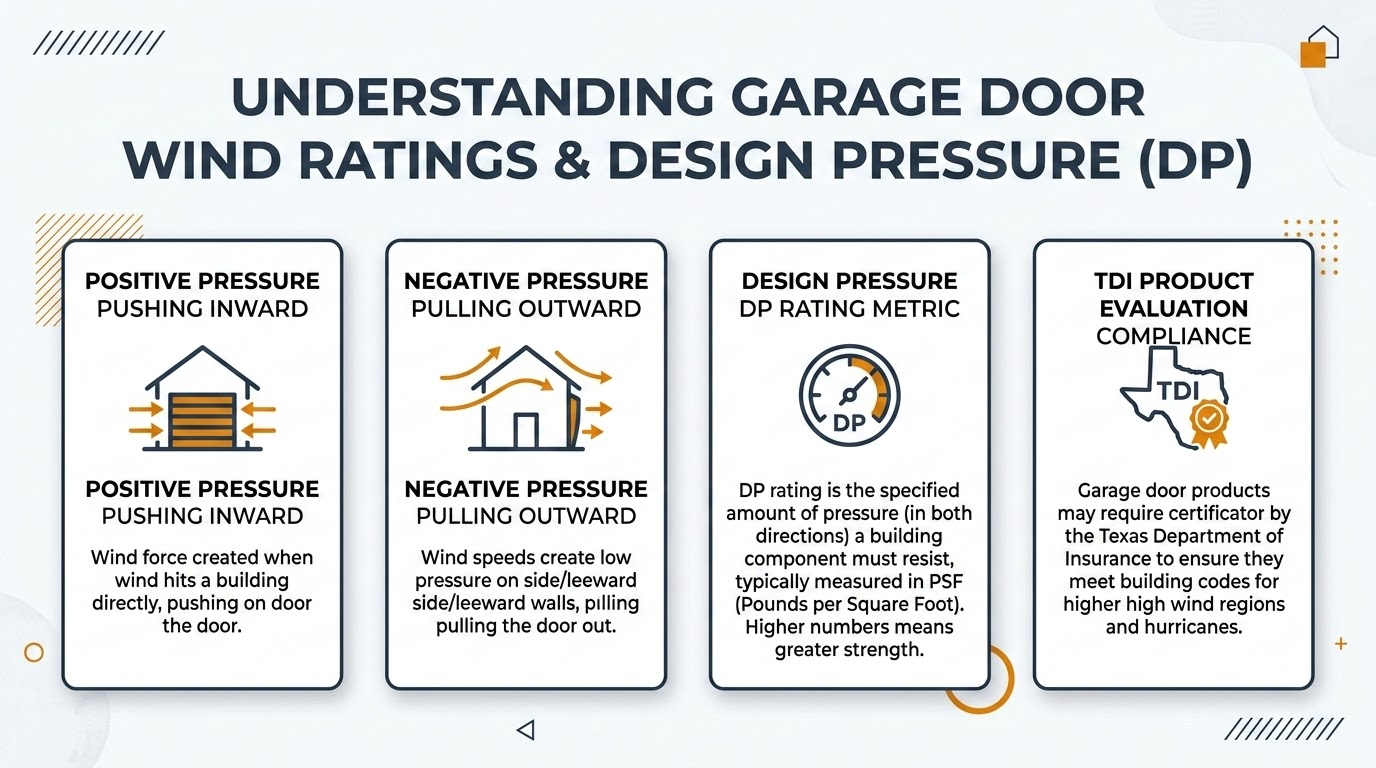
In Texas, a garage door is not just a design choice — it is a structural component of the building envelope. When high winds strike a home, the garage door is often the largest and weakest opening. If it fails, wind enters the structure, pressurizes the interior, and can lift the roof or blow out walls. This is why wind-rated doors exist.
Design Pressure (DP) is the metric used to quantify a door’s resistance to wind load. It represents the pounds per square foot of pressure the door can withstand, both positive (pushing inward) and negative (pulling outward). The required DP for a specific home depends on wind speed zone, building height, exposure category, and the size of the door opening.
Garage doors sold for use in Texas windstorm-designated areas must comply with testing standards such as ASTM E 330 or ANSI/DASMA 108, as confirmed by the Texas Department of Insurance. Homeowners can verify whether a specific door model has been evaluated and approved by checking the TDI Product Evaluation Index for Garage Doors. Even in areas outside the formal windstorm zone, choosing a wind-rated traditional garage door adds a meaningful layer of safety and can improve insurance positioning.
Questions About Wind Ratings or Insulation?
Our technicians can assess your home’s wind zone, check existing door ratings, and recommend the right specification for your property.
How R-Value Works — and Why Sealing Matters More Than Most People Think
R-value measures a material’s resistance to heat flow: the higher the number, the better the insulation performance. In the context of classic garage doors, R-value is determined by the type and thickness of insulation sandwiched between the door’s layers. Common options include polystyrene (rigid boards placed inside the panel) and polyurethane (injected foam that bonds to the steel skins and adds structural rigidity).
However, R-value alone does not tell the full story. The U.S. Department of Energy emphasizes that air sealing is equally critical — especially between an unconditioned garage and living spaces above or beside it. A door rated at R-16 will underperform if the bottom rubber seal is flattened, the side weatherstripping has gaps, or the top header seal is missing. For homeowners noticing drafts or temperature swings in rooms adjacent to the garage, a professional evaluation of seals and panel condition is a practical first step. When seals deteriorate or panels sustain damage, timely garage door repair in San Antonio can restore the thermal barrier without requiring a full door replacement.
Comparing Insulation Needs: Attached Garage vs. Detached Garage in Texas
| Factor | Attached Garage | Detached Garage |
|---|---|---|
| Thermal impact on living space | Direct — shares walls or ceiling with conditioned rooms | Minimal — separate structure |
| Recommended insulation priority | High — invest in mid-to-high R-value door plus full perimeter sealing | Low-to-moderate — basic insulation or single-layer may suffice |
| Air-sealing importance | Critical — prevents hot air and vehicle exhaust from migrating into the home | Lower — unless used as a workshop or studio |
| Cost-benefit of upgrading | Strong — noticeable comfort and HVAC efficiency gains | Situational — depends on usage |
Texas sits in a cooling-dominated climate zone, meaning homes spend more energy on air conditioning than heating. An attached garage that absorbs afternoon sun and transfers that heat through shared walls or an uninsulated ceiling forces the HVAC system to work harder. Investing in an insulated traditional garage door — and ensuring tight perimeter seals — directly reduces that thermal load.
What Happens When a Traditional Garage Door Is Installed Incorrectly?
Even the highest-quality traditional garage doors rely on precise installation to function safely and maintain their warranties. Torsion springs must be calibrated to the exact weight of the door; an imbalance of just a few pounds can cause uneven wear on cables, rollers, and the opener motor. Over time, this leads to premature component failure, noisy operation, and potential safety hazards.
For wind-rated doors, the stakes are higher. Reinforcement struts, bracket spacing, fastener types, and track anchoring all must match the manufacturer’s engineering drawings. If a single detail deviates, the wind-load certification may be void — meaning the door could fail in a storm and the homeowner’s insurance claim could be denied. This is why certified, manufacturer-trained installation teams are essential. Texas Pros Garage Doors assigns technicians who are familiar with the specific reinforcement requirements of each door model and who verify every connection point before the job is signed off. That installation rigor is a practical advantage homeowners often do not realize they need until a storm season arrives.
How the Texas Sun Affects Finish and Color Over Time
San Antonio averages over 220 sunny days per year, and south- or west-facing garage doors absorb intense UV radiation for hours every afternoon. Lower-quality paint finishes can fade noticeably within three to five years, leaving the door looking washed out against the rest of the home. When selecting a traditional garage door, it is worth asking about the specific coating technology: baked-on polyester finishes with UV stabilizers tend to hold color far longer than basic primers with topcoat.
Dark colors absorb more heat, which accelerates both fading and thermal expansion. If your garage faces west and you prefer a dark charcoal or black finish, choose a steel door with a multi-layer paint system rated for UV resistance. Alternatively, composite and fiberglass doors are engineered with color integrated into the material, reducing surface-level fade. These are details that a knowledgeable local provider can walk you through based on your home’s specific orientation — another area where Texas Pros Garage Doors’ familiarity with regional conditions proves useful.
What San Antonio Homeowners Say
“The spring on my garage door broke and they were able to come out within an hour. Very professional service and fair pricing.”
“Excellent experience from start to finish. They helped me select the right door design and the installation was completed in one day.”
“My garage door spring broke on a Saturday morning. They came out the same day and fixed it quickly. Great service!”
“Professional commercial garage door repair. They understood the urgency for our business and minimized our downtime.”
Windows on Traditional Garage Doors: When They Add Value and When to Skip Them
Windows in the top section of a traditional garage door accomplish two things: they admit natural light into an otherwise dark garage, and they break up the visual mass of a large panel surface. For most homes, a single row of windows across the top section strikes the right balance between aesthetics and function. Grid patterns — colonial muntin bars, prairie-style frames, or simple stockton arches — should echo the window styles already present on the home’s facade.
Privacy and Security Considerations
Clear glass windows provide maximum light but allow passersby to see stored items, vehicles, and tools inside the garage. Frosted, obscured, or tinted glass options solve this problem while still permitting diffused daylight. Homeowners who store high-value items in the garage or whose door faces a busy street often prefer to skip windows entirely and rely on interior lighting instead. There is no universal right answer — the decision should reflect the specific property’s exposure and usage.
What Influences the Final Price of a Traditional Garage Door Installation?
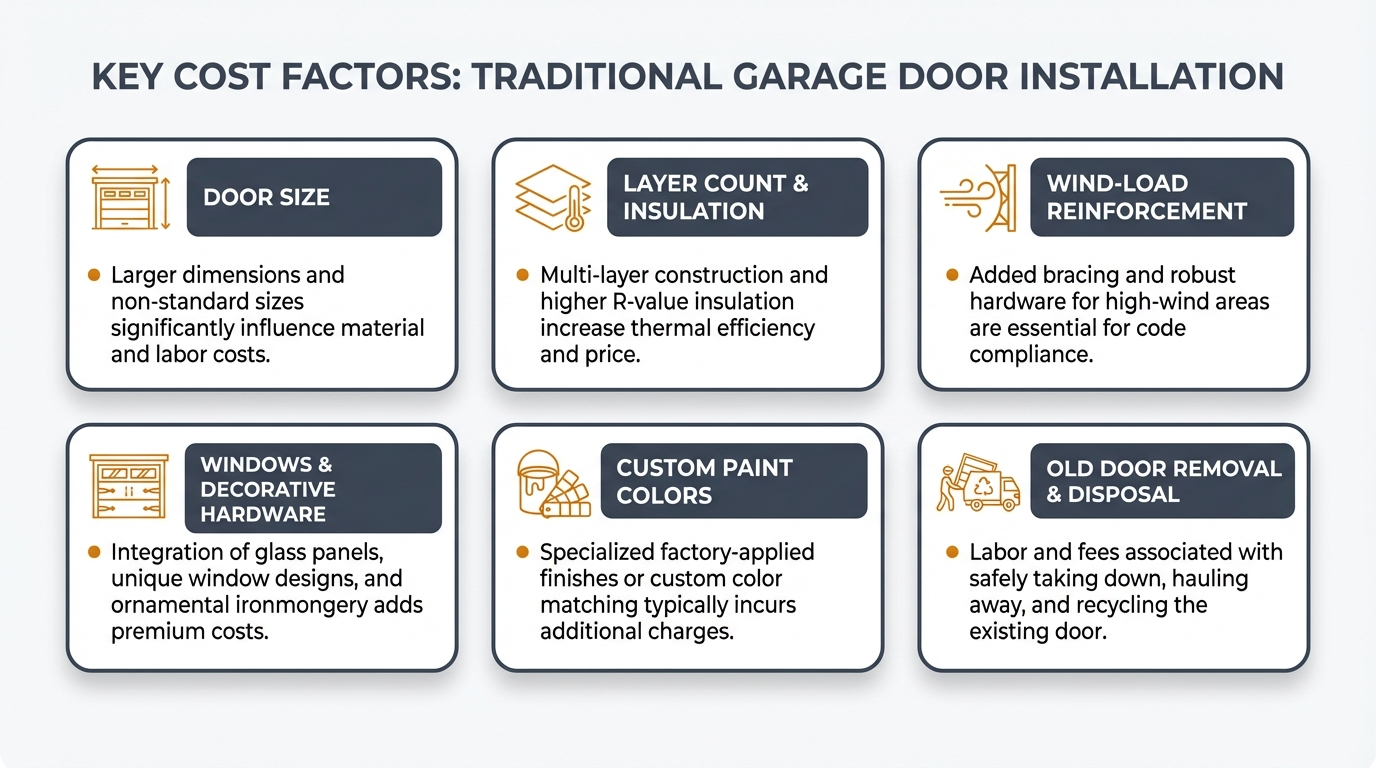
Homeowners frequently search for a single price number, but traditional garage door costs vary across a wide spectrum depending on several interacting factors. Understanding those factors prevents sticker shock and helps ensure you are comparing equivalent specifications when reviewing estimates.
Door size is the starting point. A standard single-car opening (8 x 7 or 9 x 7 feet) costs significantly less than a double-car opening (16 x 7 or 18 x 8 feet). Layer count matters next: a single-layer (non-insulated) steel door is the entry point; a two-layer door adds insulation; a three-layer “sandwich” construction adds a finished interior steel skin for maximum rigidity and thermal performance. Wind-load reinforcement adds material and engineering cost. Windows, decorative hardware, and custom paint colors each increment the total. Finally, removal and disposal of the old door, track and spring upgrades, and opener compatibility adjustments all factor into the installed price.
The most reliable way to budget is to request an itemized estimate that lists each component separately. This transparency allows you to make informed trade-offs — for example, choosing a higher insulation level but skipping decorative hardware to stay within budget.
A Practical Checklist Before You Commit to a Door
Rather than presenting a generic feature list, consider walking through these decision checkpoints in order. Each one narrows the field and prevents backtracking later.
Step 1: Measure the rough opening and verify headroom and sideroom — these dimensions determine which door models physically fit. Step 2: Identify the architectural style of your home and decide whether short-panel, long-panel, or colonial-grid windows best match. Step 3: Determine whether you need a wind-load rated door based on your county’s requirements and your insurer’s expectations. Step 4: Choose an insulation level based on whether the garage is attached, detached, or used as a living or work space. Step 5: Select material and finish, keeping UV exposure and maintenance tolerance in mind. Step 6: Decide on window configuration (style, glass type, or no windows). Step 7: Request a written, itemized estimate from a qualified installer who can verify spring sizing, track compatibility, and opener capacity before the door arrives.
“Called on a Sunday evening when my opener stopped working. They came out the same night and got everything working again. Outstanding service!”
What Texas Pros Garage Doors Delivers in Practice
| Homeowner Need | How the Team Addresses It |
|---|---|
| Climate-appropriate material guidance | Evaluates facade orientation, sun exposure, and local wind zone before recommending steel gauge, finish type, and insulation level |
| Code and wind-load compliance | Verifies TDI product evaluation status and installs reinforcement per manufacturer engineering drawings |
| Accurate cost transparency | Provides itemized estimates separating door, hardware, removal, and installation labor so homeowners can compare line by line |
| Post-installation support | Offers follow-up adjustments for spring tension and seal alignment as the door settles during the first season of use |
These are operational details — not marketing slogans. The difference between a satisfying garage door purchase and a frustrating one often comes down to whether the installer anticipated site-specific variables before ordering the door, not after.
Frequently Asked Questions About Traditional Garage Doors
They can, with careful color and hardware choices. A raised panel door in a dark matte finish with no decorative hardware and minimal window grids can complement a transitional or soft-modern facade. The key is reducing ornamental detail so the panel texture adds depth without clashing with clean contemporary lines.
A quality steel door with a factory-applied finish can last 20 to 30 years with basic maintenance — periodic washing, lubricating moving parts, and replacing weatherstripping as it wears. Real wood doors may need refinishing every two to three years but can also last decades if properly maintained.
If the garage is attached to your home, yes. Even if you never heat or cool the garage itself, an insulated door reduces heat transfer into adjacent living spaces and dampens street noise. For a detached garage used solely for vehicle storage, basic or no insulation is usually sufficient.
Some door models allow window inserts to be added to the top panel after installation. However, cutting into a panel that was not factory-prepared for windows can compromise structural integrity and void the warranty. It is generally better to specify windows at the time of purchase.
Inspect the bottom seal, side weatherstripping, and top header seal at least twice a year — once before summer heat and once before winter cold fronts. Replace any section that is cracked, flattened, or pulling away from the frame. These components are inexpensive but have an outsized impact on comfort and energy efficiency.
San Antonio is not in the formal TDI windstorm-designated area, so a wind-rated door is not legally required in most cases. However, Texas storms can produce straight-line winds exceeding 70 mph anywhere in the state. A wind-rated door provides an added safety margin and may qualify for insurance premium reductions — worth discussing with both your installer and your insurer.
Ready to Find the Right Traditional Garage Door for Your Home?
Choosing a traditional garage door involves more decisions than most homeowners expect. Start with a conversation with a team that handles them every day across San Antonio.
(210) 469-9003
Schedule Your Free Consultation
Serving San Antonio Since 2006
Free Itemized Estimates

Recent Comments