
Estimated reading time: 12 minutes
You’re standing in your driveway, staring at the front of your garage, and a surprisingly tricky question hits you: should you go with a single car garage door or a double garage door? It sounds simple, but the answer affects everything from how easily you park your truck to how much cooled air escapes during a brutal San Antonio summer. The decision also shapes curb appeal, long-term maintenance costs, and what happens the day something breaks down and you need to get to work.
At Texas Pros Garage Doors, we walk homeowners through this exact decision regularly. Below, we break down the real differences — not just dimensions on paper — so you can make a confident choice that fits your home, your vehicles, and your budget.
Key Takeaways
- Two single garage doors provide redundancy — if one breaks, you can still access the other side and get your car out.
- A single double door typically costs less upfront because it requires only one opener, one track system, and one spring assembly.
- In San Antonio’s extreme heat, two single doors let you open only the side you need, reducing thermal exchange with the outdoors.
- Converting between layouts involves structural work (adding or removing a center pillar) and usually requires a permit and professional evaluation.
- Door dimensions should be chosen based on the largest vehicle you may own in the next ten years, not just what you drive today.
▼
- What Counts as a One Car Garage Door?
- What Counts as a Two Car Garage Door?
- How Do the Standard Dimensions Actually Compare?
- A Scenario Every Two-Car Household Should Consider
- Is One Double Door Actually Cheaper Than Two Singles?
- What About Curb Appeal — Does Layout Really Matter?
- How Does Texas Heat Affect the Decision?
- Measuring Your Space: Headroom, Sideroom, and Backroom
- Common Mistakes Homeowners Make When Choosing a Layout
- Safety Standards You Should Know About
- How Vehicle Type Should Guide Your Decision
- What Does a Professional Installation Actually Include?
- Can You Convert From One Layout to the Other?
- A Quick Decision Framework
- What Maintenance Looks Different Between the Two Layouts?
- Frequently Asked Questions
What Counts as a One Car Garage Door?
A one car garage door, sometimes called a single garage door, is designed to cover an opening wide enough for one vehicle. The most common widths are 8 feet and 9 feet, with a standard height of 7 feet. Some newer homes in the San Antonio area install 9×7 doors as the default because they give extra breathing room when opening car doors or squeezing past side mirrors. A 10-foot-wide single door exists too, but it is far less common and typically reserved for oversized single bays.
The 9-foot width has become especially popular among owners of full-size trucks and SUVs — vehicles you see everywhere in Texas. If you drive a Chevy Silverado or a Ford Expedition, that extra foot of clearance can be the difference between a relaxed pull-in and a white-knuckle maneuver every single evening.
What Counts as a Two Car Garage Door?
A two car garage door (double garage door) spans a single wide opening intended to fit two vehicles side by side. The standard dimension is 16 feet wide by 7 feet tall. You will also find 16×8 doors when ceiling height allows it, and occasionally 18×7 doors for homeowners who want generous clearance on both sides. Municipal building codes in many areas actually define a two-car garage opening as being no less than 16 feet wide, reinforcing that number as the practical baseline.
The appeal of a double door is its uninterrupted opening — great for pulling in a boat, parking a wide vehicle off-center, or simply enjoying a clean, symmetrical look from the street.
How Do the Standard Dimensions Actually Compare?
| Feature | Single (One Car) Door | Double (Two Car) Door |
|---|---|---|
| Common Width | 8 ft or 9 ft | 16 ft (sometimes 18 ft) |
| Common Height | 7 ft or 8 ft | 7 ft or 8 ft |
| Openers Required | 1 per door | 1 (higher horsepower) |
| Center Pillar Needed | Yes, if two singles share a wall | No |
| Typical Spring System | Lighter torsion or extension | Heavier torsion (higher cycle rating) |
These numbers come from widely cited industry standards. Angi’s garage door sizing guide provides a detailed breakdown of common residential dimensions, confirming that the 8×7, 9×7, and 16×7 configurations dominate the market.
A Scenario Every Two-Car Household Should Consider
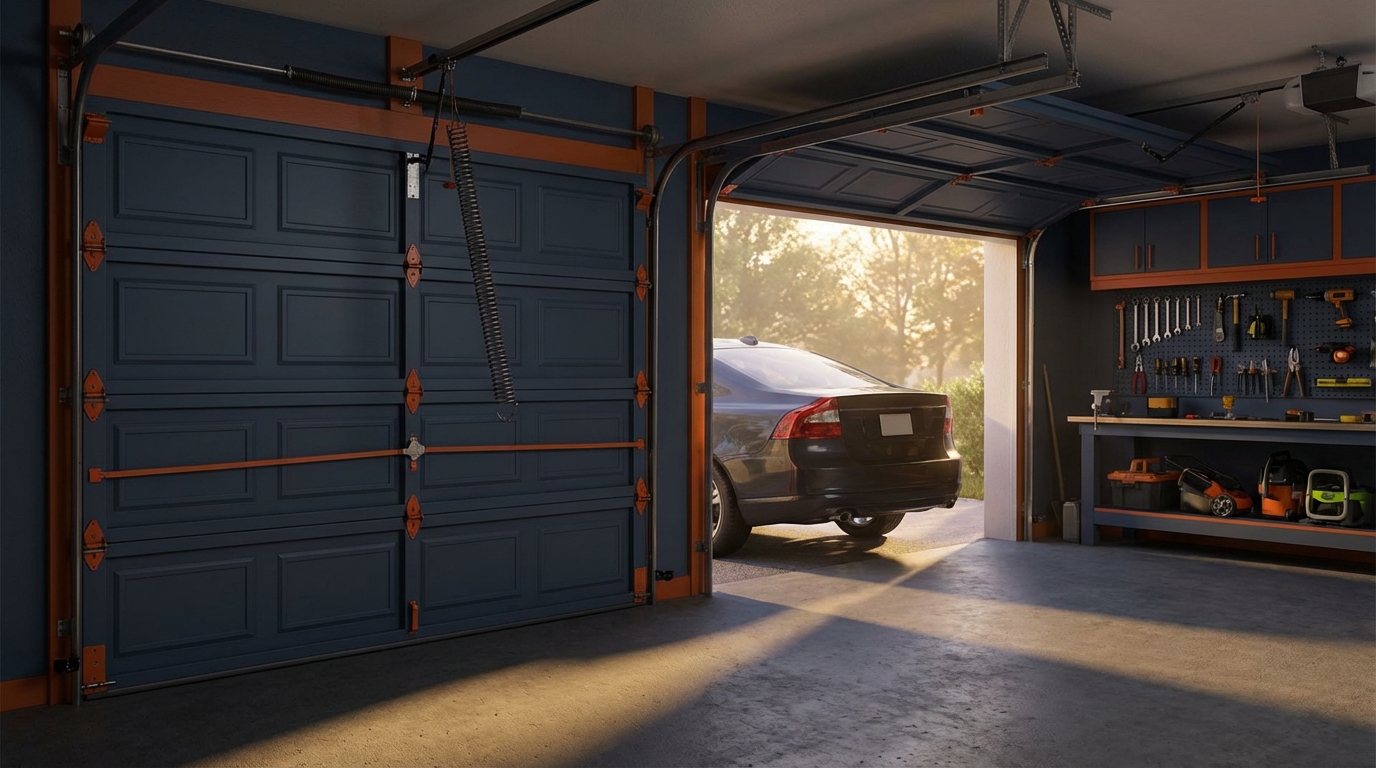
Imagine it is 6:45 a.m. on a Monday. Your partner’s car is parked on the left side of the garage and yours is on the right. A torsion spring snaps overnight — loud bang, door won’t budge. If you have one double door, neither car is going anywhere until a technician arrives. If you have two single doors, only one side is stuck; the other door still opens normally, and at least one of you can get to work on time.
This “hostage cars” scenario is one of the most practical reasons homeowners choose two singles over one double. It is not about style or price — it is about redundancy. When Texas Pros Garage Doors responds to emergency spring repairs in San Antonio, we regularly see families stranded behind a single large door who wish they had a backup opening.
Stuck Behind a Broken Garage Door Right Now?
Don’t let a broken spring or opener keep you trapped. Our San Antonio technicians respond fast — often within the hour.
(210) 469-9003
Schedule Emergency Repair
70+ Verified Reviews
24/7 Availability
Is One Double Door Actually Cheaper Than Two Singles?
The short answer: it depends on what you count. A single double door requires only one opener, one set of tracks, and one torsion spring assembly. That typically makes the initial hardware and labor cost lower than installing two separate single doors, each with its own opener, tracks, and springs. According to Angi’s cost data for Texas, doubling the number of independent door systems increases both material and labor expenses.
However, the long-term picture is more nuanced. A double door is heavier, which means heavier-duty springs that can cost more per replacement. And if a panel on a 16-foot door gets damaged, the replacement panel is larger and pricier than a panel for a 9-foot door. Factor in the “hostage cars” risk — potentially needing an urgent, premium-priced service call — and the savings gap narrows.
What About Curb Appeal — Does Layout Really Matter?
It matters more than most people expect. Two single garage doors with a center pillar between them can create a more traditional, high-end architectural look. Think carriage-house style doors, each with its own set of decorative hardware and window inserts. Many neighborhoods in the San Antonio area favor this approach because it breaks up the facade and adds visual interest.
A single double door, on the other hand, delivers a modern, symmetrical, and clean-lined appearance. It works well on contemporary homes and homes where the garage is a prominent visual element from the street. Some municipalities actually regulate maximum door widths to maintain neighborhood character. For example, certain residential appearance standards limit garage door opening widths specifically to encourage a balanced facade.
How Does Texas Heat Affect the Decision?
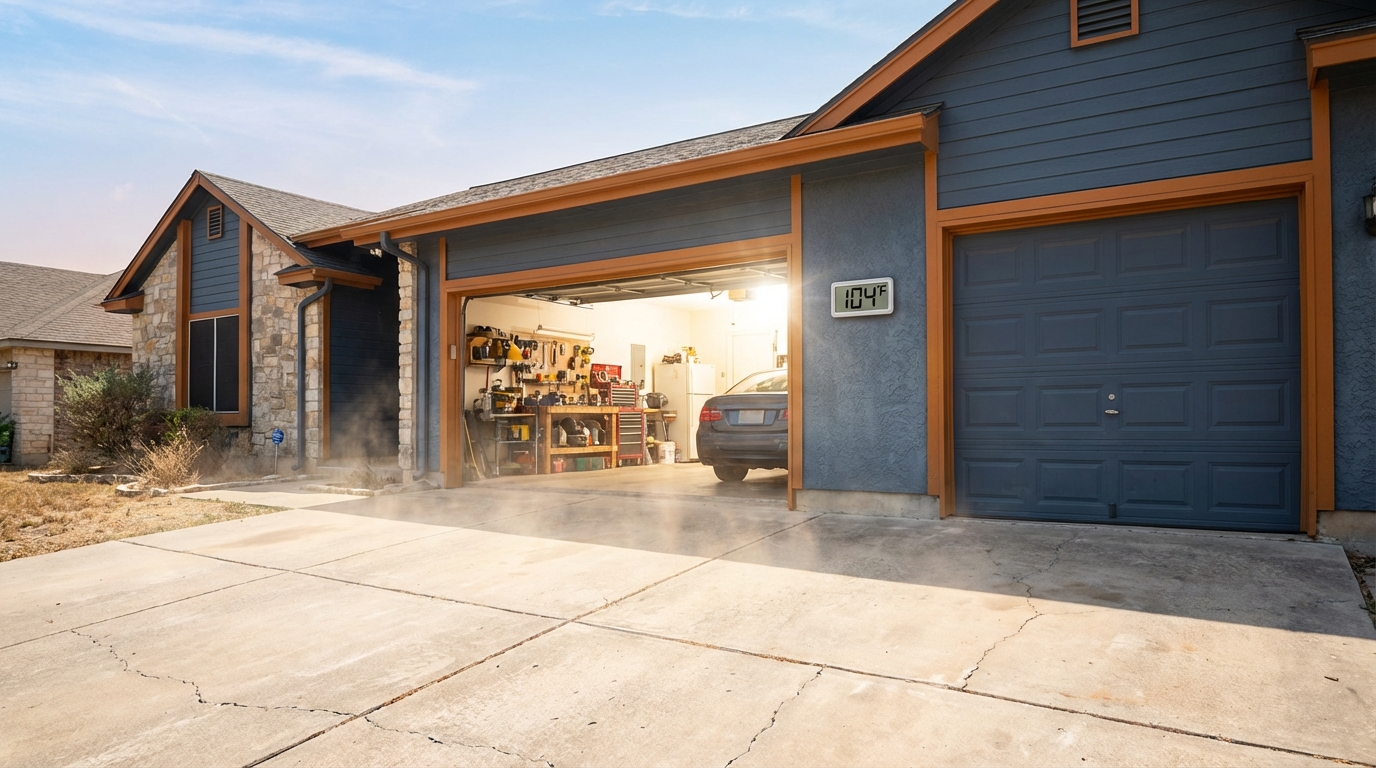
San Antonio summers regularly push past 100 degrees F. Every time a garage door opens, conditioned air from an attached garage — or even from the house itself — escapes, and hot air rushes in. The larger the opening, the more air exchange occurs in a single cycle. A 16-foot double door exposes roughly twice the square footage to the outdoors compared to opening just one 8-foot or 9-foot single door.
With two single doors, you only open the side you need. Heading out alone in the morning? Open your side, leave the other closed. This simple behavior can meaningfully reduce thermal loss over the course of a summer. The U.S. Department of Energy emphasizes the importance of maintaining thermal barriers between garages and conditioned living spaces — and minimizing how often and how wide you open the garage is part of that strategy.
Measuring Your Space: Headroom, Sideroom, and Backroom Explained
Before you decide on single or double, you need to know whether your garage structure can physically accommodate your preferred layout. Three measurements matter most. Headroom is the distance from the top of the door opening to the ceiling or nearest obstruction — most standard installations need at least 10 to 12 inches. Sideroom is the space between the side of the opening and the nearest wall, typically requiring 3.75 to 5 inches on each side for track hardware. Backroom (or depth) is the distance from the opening to the back wall, which must be long enough to fit the door when it is fully open overhead.
Why Two Singles May Need More Structural Work
If you are converting from a double door to two singles, you will need to add a center pillar, often called a mullion. This pillar must bear part of the header load above the garage opening. Depending on the span and roof load, engineering and permits may be required. Conversely, removing a center pillar to go from two singles to one double may require installing a larger structural header beam — an even more significant construction project. Clopay’s support resources outline the specific clearance values you should verify before ordering any door system.
Common Mistakes Homeowners Make When Choosing a Layout
The first mistake is measuring only for today’s vehicle. You might drive a compact sedan now, but your next vehicle could be a full-size truck. Choosing a door width with minimal clearance leaves no margin for the future. The second mistake is ignoring the opener’s power requirements. A 16-foot double door is significantly heavier than a 9-foot single, and pairing it with an underpowered opener leads to premature motor burnout, noisy operation, and safety risks.
A third mistake — especially common in older San Antonio neighborhoods — is assuming the existing framing can handle a layout change without inspection. Removing or adding a center pillar without consulting a professional can compromise structural integrity. Texas Pros Garage Doors includes a framing and clearance assessment as part of every new installation consultation, so homeowners know exactly what their garage can support before any work begins.
Not Sure What Your Garage Can Handle?
Our technicians perform a full structural and clearance assessment before any work begins. Free estimates for San Antonio homeowners.
Safety Standards You Should Know About
Regardless of whether you choose single or double, every automatic garage door opener sold in the United States must comply with UL 325, the safety standard for door, drapery, gate, louver, and window operators. This standard requires at least two entrapment protection devices: an automatic reversal mechanism that stops and reverses the door if it contacts an obstruction, and a photoelectric sensor (“electric eye”) near the floor that detects objects in the door’s path. The UL Standards & Engagement overview explains how these requirements protect families from serious injury.
A double door has a wider sweep area, which means the photoelectric sensors are spaced farther apart and alignment becomes more critical. If the sensors drift even slightly on a 16-foot opening, false triggers or — worse — failure to detect an obstruction can occur. Regular sensor checks and alignment are part of proper maintenance, and this is an area where professional service pays for itself in peace of mind.
How Vehicle Type Should Guide Your Decision
| Vehicle Category | Recommended Min. Door Width | Best Layout Option |
|---|---|---|
| Compact car or sedan | 8 ft | Single 8×7 or 9×7 |
| Mid-size SUV | 9 ft | Single 9×7 or Double 16×7 |
| Full-size truck (F-150, Silverado) | 9-10 ft | Single 10×7 or Double 16×7 |
| Two vehicles side by side | 16 ft total | Double 16×7 or Two singles (9×7 each) |
| Boat, RV, or trailer access | 16-18 ft | Double 16×8 or 18×8 |
A good rule of thumb: choose your door dimensions based on the largest vehicle you might reasonably own in the next ten years, not just the one parked in the driveway today. If you are unsure about the right fit, a professional on-site measurement is the most reliable way to confirm.
What Does a Professional Installation Actually Include?
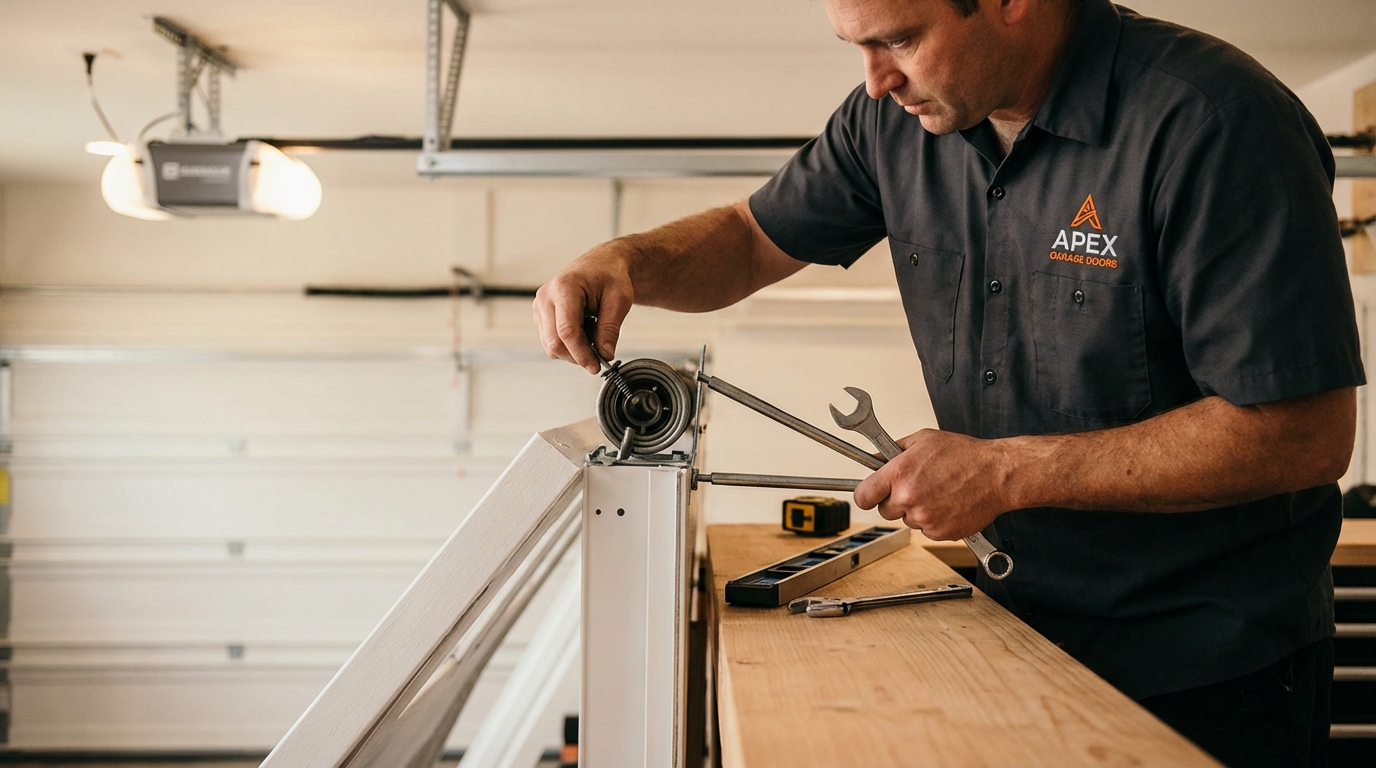
A reputable garage door installation is more than just hanging panels and plugging in a motor. When Texas Pros Garage Doors handles a new installation in the San Antonio area, the process includes a detailed measurement of headroom, sideroom, and backroom; verification that the structural framing and header can handle the chosen door weight; selection of the correct spring system rated for the door’s weight and expected cycle life; precise track alignment; opener installation with full sensor calibration; a balance test to confirm the door stays in place when manually lifted halfway; and a final safety inspection covering all moving components.
That methodical approach matters because a door that is even slightly misaligned or improperly balanced will wear out springs and rollers faster, create excessive noise, and potentially become a safety hazard. Homeowners who invest in professional installation up front typically see fewer repair calls over the life of the door.
What San Antonio Homeowners Are Saying
“The spring on my garage door broke and they were able to come out within an hour. Very professional service and fair pricing.”
“Excellent experience from start to finish. They helped me select the right door design and the installation was completed in one day.”
“My garage door spring broke on a Saturday morning. They came out the same day and fixed it quickly. Great service!”
“Professional commercial garage door repair. They understood the urgency for our business and minimized our downtime.”
Can You Convert From One Layout to the Other?
Yes, but the scope of work varies. Going from two single doors to one double usually involves removing the center pillar, installing a larger structural header, widening the opening, and then fitting the new door, tracks, and opener. This is a significant project that may require a building permit and structural engineering review.
Going from one double to two singles is generally less invasive structurally — you are adding a pillar rather than removing one — but you still need two new door systems, two openers, and potentially electrical work for the additional motor. Either way, this is not a weekend DIY project. Spring and cable systems are under extreme tension and should only be handled by trained technicians.
A Quick Decision Framework
| Your Priority | Best Fit | Why |
|---|---|---|
| Redundancy (access if one door fails) | Two singles | One door out of service does not trap both cars |
| Lowest upfront cost | One double | Single opener, single track system, less labor |
| Curb appeal (traditional/carriage style) | Two singles | Architectural detail and visual balance |
| Widest unobstructed opening | One double | No center pillar blocking the bay |
| Energy efficiency in hot climate | Two singles | Open only the side you need |
| Easier future conversion or resale flexibility | Two singles | Adding a pillar is simpler than removing one |
What Maintenance Looks Different Between the Two Layouts?
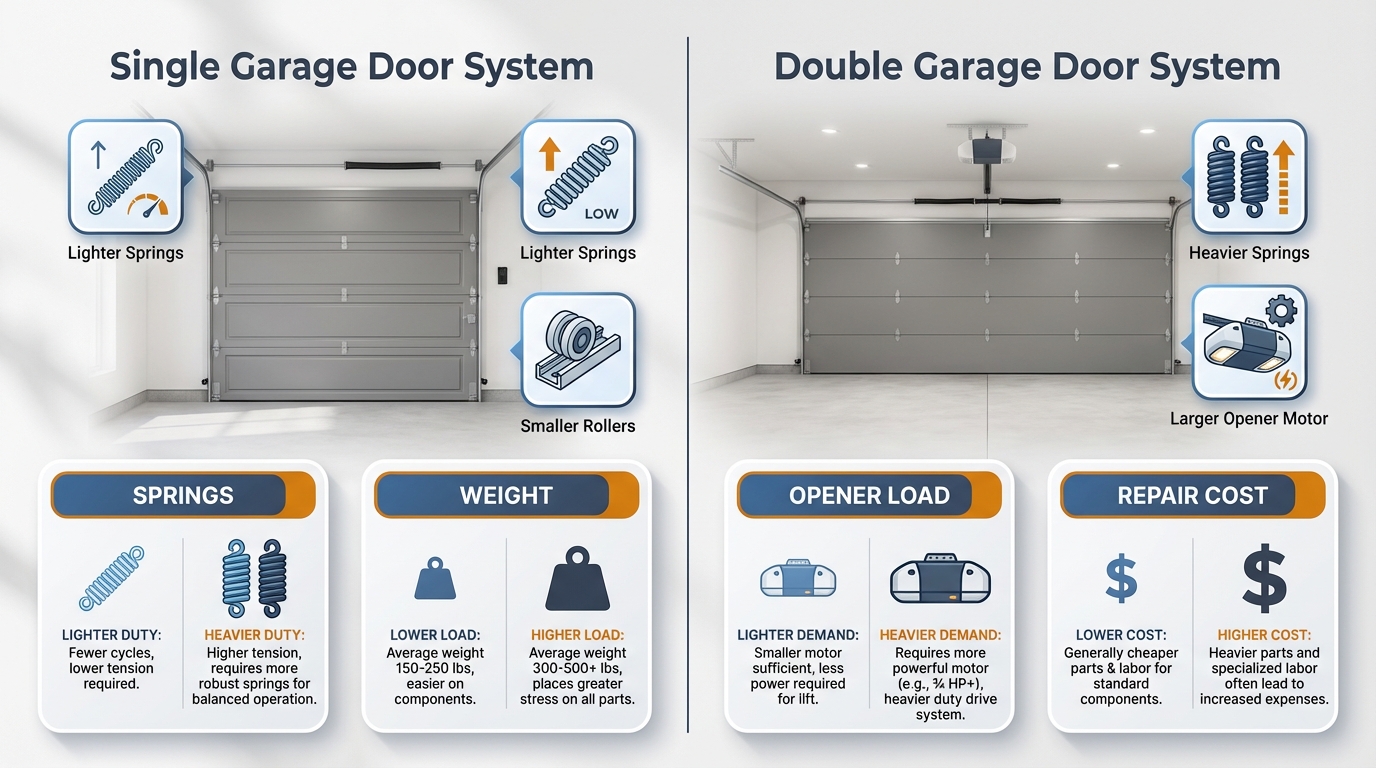
With a double door, you maintain one set of hardware — but that hardware works harder. The springs carry more weight, the opener motor handles a heavier load, and the tracks span a wider distance. When springs fail on a double door (and all springs eventually fail — they are rated by cycle count, not years), the repair cost is typically higher because the springs themselves are larger and the labor involves managing more tension.
With two single doors, you have twice the number of components — two openers, two sets of springs, two sets of rollers — but each component handles a lighter load. Individual repairs tend to be less expensive per incident, and you have the advantage of keeping one side operational while the other is serviced. Texas Pros Garage Doors offers same-day service availability for spring and opener repairs across San Antonio, which helps minimize downtime regardless of your layout.
Ortal Peretz
“Called on a Sunday evening when my opener stopped working. They came out the same night and got everything working again. Outstanding service!”
Frequently Asked Questions
Not Sure Which Layout Fits Your Home?
Every garage is different — ceiling height, framing condition, vehicle mix, and neighborhood guidelines all play a role. Get a free on-site assessment from San Antonio’s trusted garage door professionals.
(210) 469-9003
Schedule Free Consultation
Free Estimates
Licensed & Insured
The most reliable way to find out what works for your specific situation is a professional on-site assessment. Texas Pros Garage Doors provides free estimates for San Antonio homeowners considering a new installation or a layout conversion. Ready to get clarity on your options? Reach out to our team to schedule a measurement and consultation — no pressure, just practical guidance from local garage door professionals.

Recent Comments