
Estimated reading time: 12 minutes
When it comes to protecting your commercial property in San Antonio, few elements play as critical a role as your garage doors. These large openings serve as the gateway for daily operations, security barriers against intrusion, and even contribute to your building’s energy efficiency. Selecting the right commercial garage doors San Antonio businesses rely on requires understanding your specific operational needs, local building codes, and the unique weather challenges our region presents.
Business garage doors differ significantly from their residential counterparts. They must withstand heavier use cycles, accommodate larger vehicles and equipment, and meet stricter safety standards. Whether you operate a warehouse, auto repair shop, fire station, or distribution center, the door you choose directly impacts your daily productivity and long-term operational costs.
Key Takeaways
- Commercial doors face dramatically higher cycle counts than residential doors, requiring specialized engineering for durability and reliability
- Wind load ratings and Texas Windstorm Certification are essential for insurance compliance and structural protection in San Antonio
- UL 325 safety standards mandate specific entrapment protection features that protect employees and equipment
- Professional installation ensures proper alignment, code compliance, and warranty protection for your investment
- Regular preventive maintenance extends door lifespan by years and prevents costly emergency repairs
▼
- Why Commercial Properties Need Specialized Solutions
- Industrial Door Types for Different Operations
- Wind Load Requirements in Texas
- Texas Windstorm Certification Process
- Safety Standards for Commercial Operators
- Professional Installation Process
- When to Repair vs Replace
- Most Common Commercial Door Problems
- Professional Maintenance Schedule
- Loading Dock Safety Risks
- How Insulation Affects Performance
- Access Control Options
- Frequently Asked Questions
Need Commercial Garage Door Service?
Our team specializes in commercial and industrial door installations, repairs, and maintenance throughout San Antonio.
(210) 469-9003
Request Free Estimate
4.8 Star Rating
Licensed & Insured
Why Do Commercial Properties Need Specialized Garage Door Solutions?
Commercial and industrial facilities face demands that residential properties simply never encounter. A typical home garage door might open and close four to six times daily, while a busy loading dock could see dozens of cycles every hour. This fundamental difference in usage intensity requires doors engineered for durability, reliability, and minimal maintenance downtime.
Security considerations also escalate dramatically in commercial settings. Business garage doors must resist forced entry attempts, protect valuable inventory, and often integrate with sophisticated access control systems. Additionally, commercial doors frequently need to accommodate forklifts, delivery trucks, and specialized equipment that would never fit through a standard residential opening.
The aesthetic dimension shouldn’t be overlooked either. Your commercial garage doors contribute to curb appeal and brand perception. A well-maintained, professional-looking entrance signals competence and attention to detail to customers, partners, and employees alike.
What Types of Industrial Doors Suit Different Business Operations?
The commercial door market offers numerous solutions tailored to specific operational requirements. Understanding these options helps you make informed decisions during commercial installation projects.
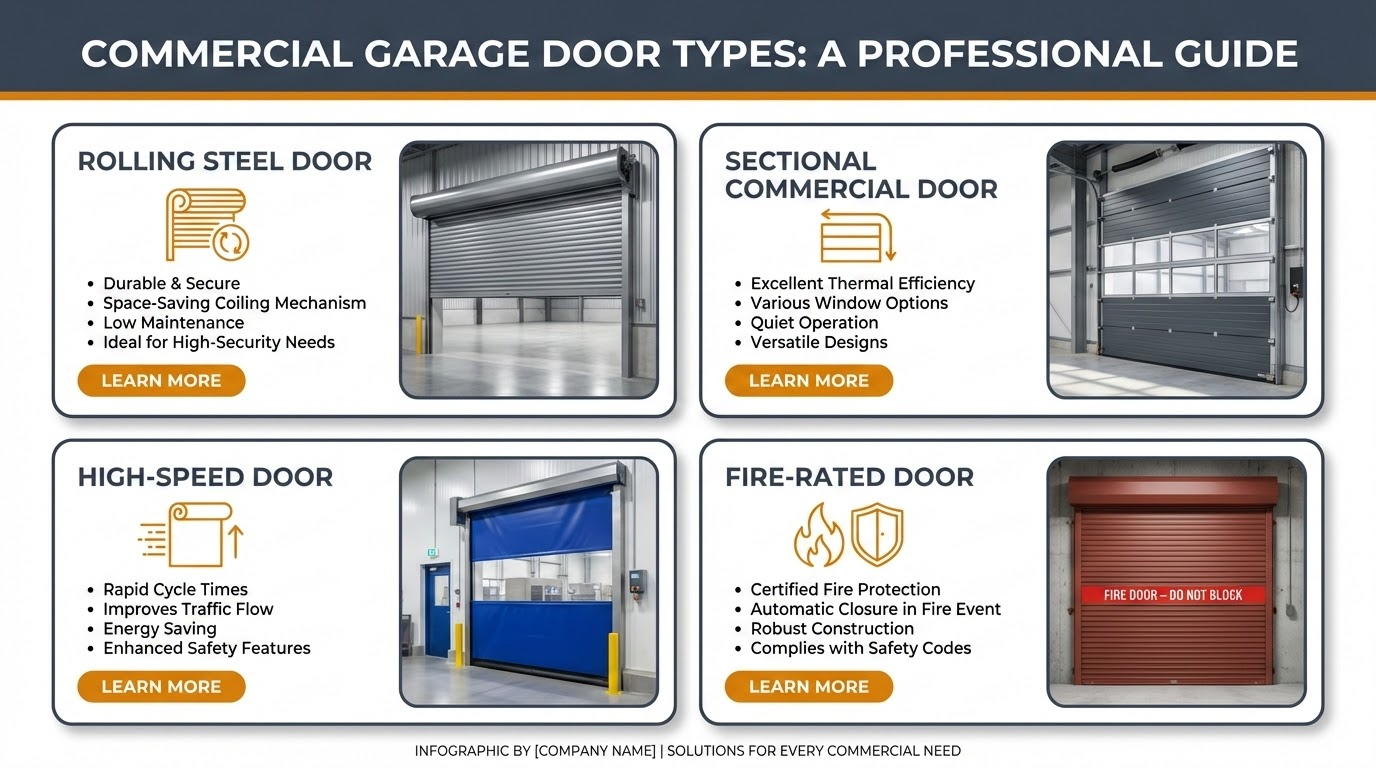
Rolling Steel Doors
These doors coil into a compact barrel above the opening, maximizing ceiling and side clearance. They excel in warehouses, storage facilities, and any location where interior space comes at a premium. Rolling steel doors offer excellent security and can be insulated for climate-controlled environments.
Sectional Commercial Doors
Built from horizontal panels connected by hinges, sectional doors travel along vertical tracks before curving along the ceiling. They provide superior insulation options and accommodate windows for natural light. Many businesses prefer sectional doors when appearance matters or when employees work near the opening.
| Door Type | Best Applications | Key Advantages |
|---|---|---|
| Rolling Steel | Warehouses, storage, security-focused facilities | Space efficiency, durability, security |
| Sectional | Auto service, showrooms, climate-controlled spaces | Insulation, windows, aesthetics |
| High-Speed | Food processing, clean rooms, high-traffic areas | Cycle speed, energy savings, contamination control |
| Fire-Rated | Building code compliance, compartmentalization | Life safety, code compliance |
How Do Wind Load Requirements Affect Commercial Doors in Texas?
San Antonio’s location in South-Central Texas means commercial properties must account for significant wind events. While we may not face direct hurricane impacts as frequently as coastal cities, severe thunderstorms, tornadoes, and tropical system remnants can produce dangerous winds that test building envelope integrity.
The International Residential Code and commercial building codes require garage doors in wind-prone areas to be pressure-rated. According to the Building America Solution Center, testing must follow ASTM E330 or ANSI/DASMA 108 standards. These tests measure how doors perform under both positive pressure (wind pushing against the door) and negative pressure (wind creating suction as it passes).
Wind loads are determined using ASCE 7 methodology, which considers factors like building height, exposure category, and geographic location. The Door and Access Systems Manufacturers Association (DASMA) provides extensive documentation on how manufacturers test and rate doors for specific wind load conditions.
What Does the Texas Windstorm Certification Process Involve?
For properties in designated catastrophe areas, the Texas Department of Insurance administers the Windstorm Program. This program establishes construction standards and inspection requirements that directly impact commercial garage door installations.
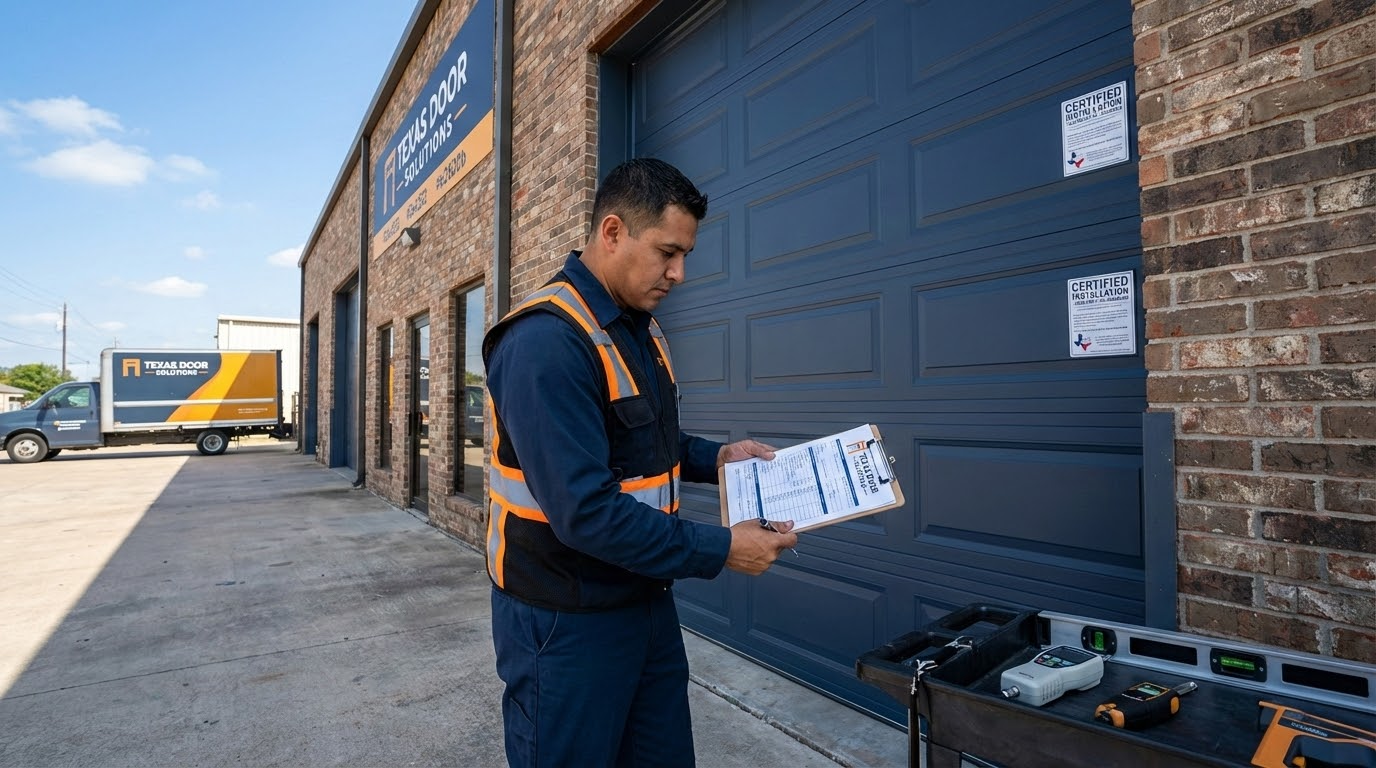
Windstorm inspections occur during construction phases or upon project completion. Inspectors verify that installed products meet required specifications and that installation followed manufacturer guidelines. The TDI maintains records of compliance certificates that property owners and insurers can access to verify protection levels.
Commercial doors must demonstrate testing according to ASTM E 330-14 or ANSI/DASMA 108-17 standards. Before any commercial installation begins, smart business owners ask contractors pointed questions about product testing documentation, certification status, and installation compliance procedures. This due diligence protects your investment and ensures insurance coverage remains valid.
Which Safety Standards Apply to Commercial Garage Door Operators?
Automated commercial doors introduce mechanical forces capable of causing serious injury. Recognizing this hazard, UL 325 has served as the foundational safety standard for garage door and gate operators for over fifty years. This standard mandates specific entrapment protection measures that prevent doors from closing on people, vehicles, or equipment.
Entrapment protection typically includes reversing mechanisms activated by contact with obstructions, photoelectric sensors that detect objects in the door’s path, and edge sensors that trigger reversal upon contact. The UL Standards and Engagement organization continues updating these requirements as technology evolves and new hazards are identified.
Monitored Safety Sensors Explained
Modern commercial installations often incorporate monitored safety devices. Unlike basic sensors that simply send signals when triggered, monitored sensors continuously communicate their operational status to the control system. If a sensor fails, becomes misaligned, or loses power, the system recognizes this condition and restricts door operation to prevent unsafe closing.
Beyond Minimum Requirements
Many commercial operators choose additional safety features that exceed UL 325 minimums. Light curtains create invisible detection fields across door openings. Additional sensor sets at different heights catch hazards that single-sensor configurations might miss. These enhancements prove particularly valuable in high-traffic environments where forklifts, pallet jacks, and personnel constantly move through openings.
What Our Commercial Clients Say
Robert Parshall
“The spring on my garage door broke and they were able to come out within an hour. Very professional service and fair pricing.”
Leon McPherson
“Excellent experience from start to finish. They helped me select the right door design and the installation was completed in one day.”
Alyssa Silva
“My garage door spring broke on a Saturday morning. They came out the same day and fixed it quickly. Great service!”
Adam Mendoza
“Professional commercial garage door repair. They understood the urgency for our business and minimized our downtime.”
What Happens During Professional Commercial Door Installation?
Quality commercial installation follows a structured process that ensures safety, compliance, and long-term reliability. Each phase builds upon the previous one, creating a system that performs as designed for years of demanding service.
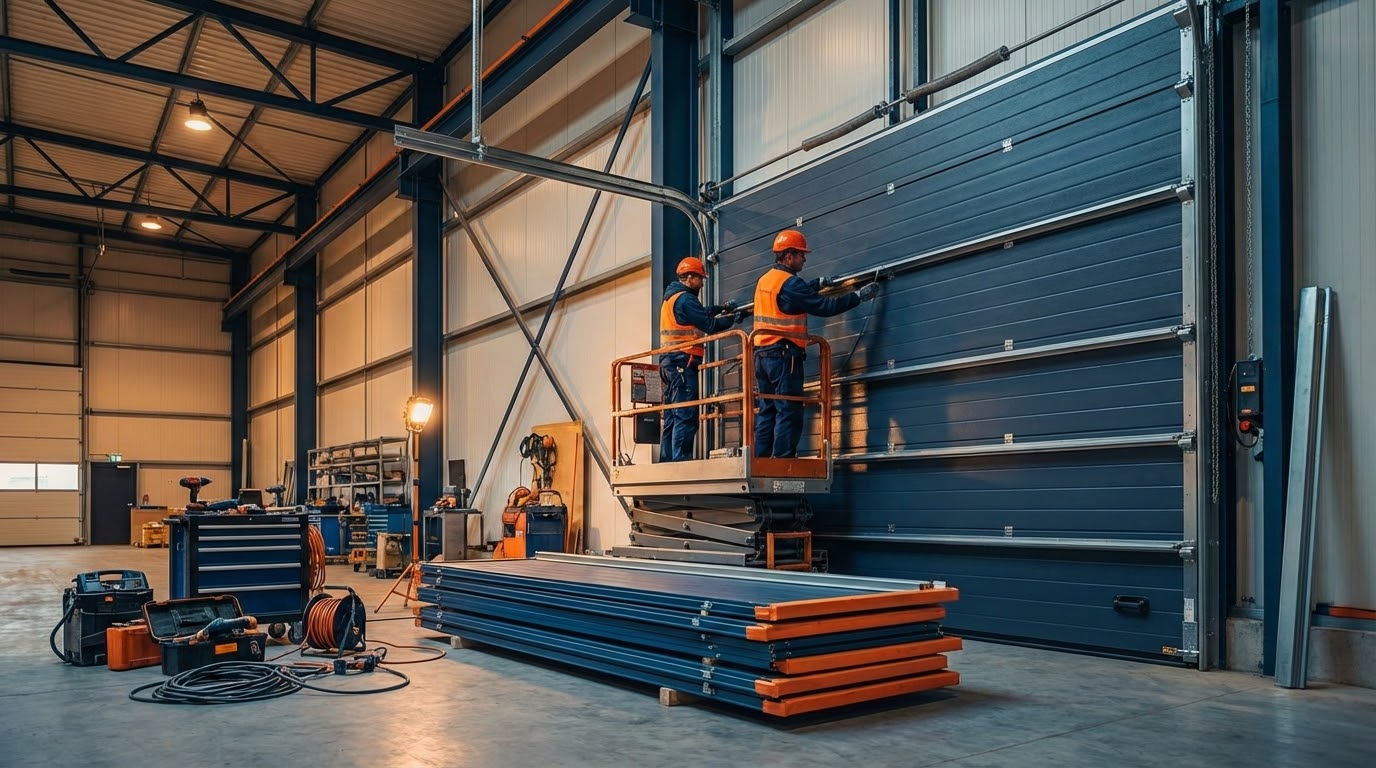
The process begins with thorough site assessment. Technicians measure openings precisely, evaluate structural conditions, verify electrical availability, and identify any obstacles that might complicate installation. This assessment informs product selection and installation planning.
Next comes preparation work. Existing doors are removed, openings are modified if necessary, structural reinforcements are installed, and mounting surfaces are prepared. For new construction, coordination with general contractors ensures proper rough opening dimensions and header support.
| Installation Phase | Key Activities | Quality Checkpoints |
|---|---|---|
| Site Assessment | Measurements, structural evaluation, electrical review | Documentation of existing conditions |
| Preparation | Demo, modifications, reinforcement | Structural adequacy verification |
| Hardware Installation | Tracks, brackets, springs, panels | Level and plumb verification |
| Operator Installation | Motor mounting, wiring, controls | Electrical code compliance |
| Testing and Adjustment | Balance, force settings, safety devices | Functional verification |
How Should Businesses Verify Installation Quality?
Upon completion, professional installers conduct comprehensive testing and provide documentation. DASMA Technical Data Sheet 151 outlines general code inspection guidelines for sectional garage doors, including verification that installation followed manufacturer instructions and that all safety features function correctly.
A proper handover includes demonstration of manual operation, explanation of emergency release procedures, review of maintenance requirements, and provision of warranty documentation. Business owners should receive operating manuals, parts lists, and contact information for service needs.
Texas Pros Garage Doors emphasizes thorough documentation throughout the installation process. This attention to detail ensures compliance verification remains straightforward and that future service technicians can quickly understand system specifications.
Questions About Commercial Door Installation?
Our experienced team can assess your facility and recommend the best solution for your operational needs.
When Does Repairing Make More Sense Than Replacing?
Commercial doors represent significant investments, making repair-versus-replace decisions financially important. Several factors guide this analysis beyond simple age considerations.
Structural integrity serves as the primary criterion. If tracks have bent, panels have cracked, or the door no longer sits square in the opening, repair costs often approach or exceed replacement costs while still leaving an aging system in place. Conversely, replacing a single worn spring or roller on an otherwise sound door makes obvious economic sense.
Safety compliance adds another dimension. Older operators may lack modern entrapment protection features required by current codes. While some systems can be retrofitted, others require complete replacement to meet standards. Business owners must weigh liability exposure against upgrade costs.
Operational requirements evolve as well. A door adequate for previous operations may prove undersized, too slow, or insufficiently insulated for new business needs. In these cases, replacement delivers operational improvements that repair cannot provide.
What Are the Most Common Commercial Door Problems?
Understanding typical failure modes helps business owners recognize developing issues before they cause operational disruptions or safety hazards.
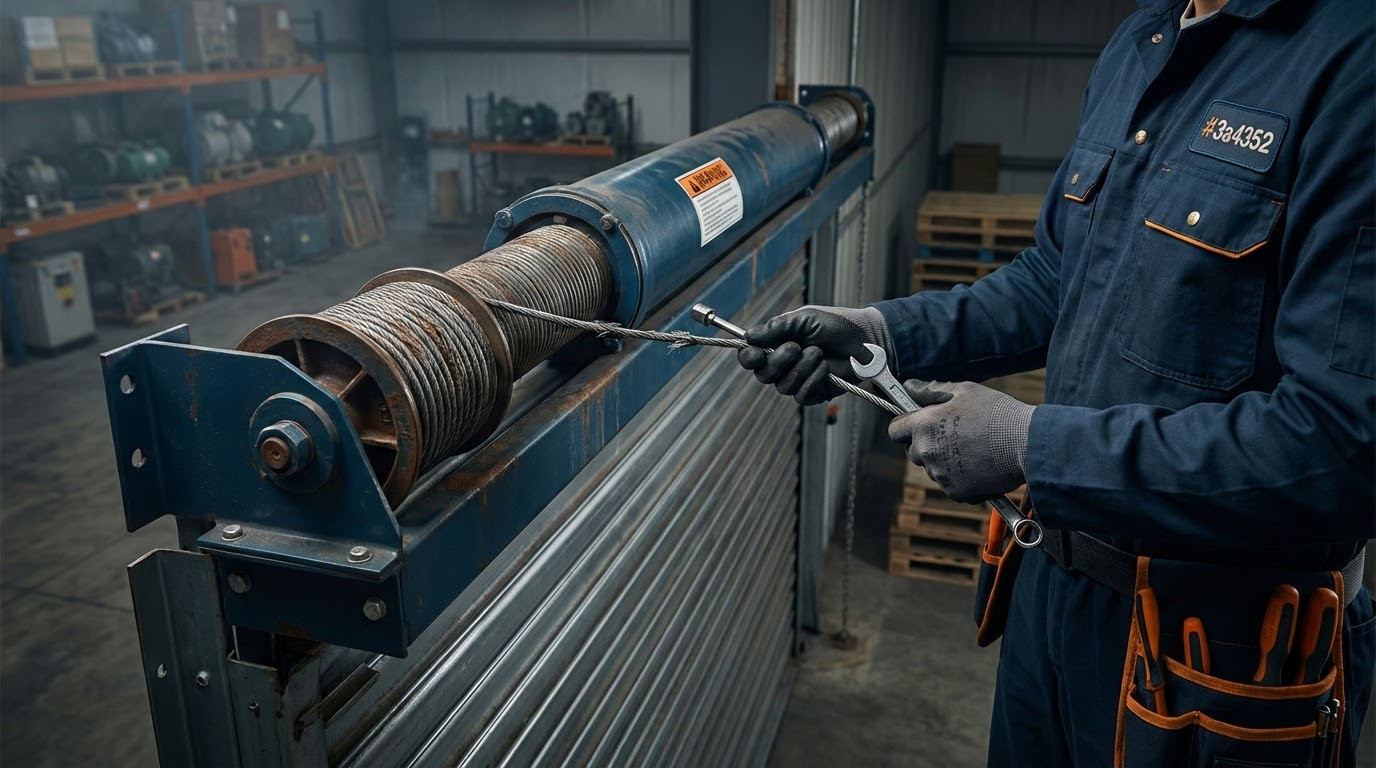
Spring failures rank among the most common and potentially dangerous problems. Commercial doors use either torsion springs mounted above the opening or extension springs along the tracks. Both types store enormous energy and can cause serious injury if they break unexpectedly or are handled improperly. Never attempt spring repairs without proper training and equipment.
Cable and drum issues often accompany spring problems or develop independently. Cables can fray, drums can crack, and improper tension causes uneven door movement. These components work under constant stress and require periodic inspection.
Track misalignment causes doors to bind, scrape, or operate unevenly. Forklift impacts, building settling, and improper installation all contribute to track problems. Early detection prevents minor adjustments from becoming major repairs.
How Often Should Commercial Doors Receive Professional Maintenance?
Preventive maintenance schedules vary based on usage intensity and environmental conditions. High-cycle doors in dusty or corrosive environments need more frequent attention than moderately used doors in clean settings.
General guidelines suggest quarterly inspections for heavily used commercial doors and semi-annual inspections for moderate use. These inspections include lubrication of moving parts, tension adjustments, hardware tightening, and safety device testing. Annual comprehensive inspections should include detailed component evaluation and spring life assessment.
DASMA Technical Data Sheets provide maintenance recommendations specific to door types. Building maintenance supervisors benefit from reviewing these guidelines and establishing inspection protocols appropriate for their facilities.
What Safety Risks Exist in Loading Dock Environments?
Loading zones present unique hazards that compound standard door safety concerns. Forklift traffic, truck movements, pedestrian crossings, and time pressures create conditions where accidents occur despite best intentions.
Door-forklift interactions cause numerous workplace injuries annually. Operators may attempt to drive through partially open doors, misjudge clearances, or strike door components while maneuvering. Proper training, adequate lighting, and door position indicators help reduce these incidents.
According to ISHN industry safety publications, establishing clear traffic patterns, maintaining visual contact with doors during operation, and implementing lockout procedures during loading activities significantly reduce accident rates.
How Does Insulation Affect Commercial Door Performance?
Insulated commercial doors deliver benefits beyond simple temperature control. Understanding these advantages helps justify potentially higher initial costs through long-term operational savings.
Thermal performance directly impacts energy costs in climate-controlled facilities. San Antonio’s hot summers demand significant cooling capacity, and poorly insulated doors allow conditioned air to escape while letting heat infiltrate. Quality insulated doors with proper perimeter sealing reduce HVAC loads substantially.
Insulation also improves structural rigidity. Foam-filled panels resist denting better than hollow sections and maintain their shape under stress. This durability extends door life and maintains appearance longer.
Noise reduction represents another insulation benefit. Industrial operations generate sound that neighbors may find objectionable. Insulated doors dampen noise transmission, helping facilities maintain good community relations and comply with local ordinances.
Ortal Peretz
“Called on a Sunday evening when my opener stopped working. They came out the same night and got everything working again. Outstanding service!”
What Access Control Options Integrate with Commercial Doors?
Modern commercial operations require sophisticated access management that extends to garage door openings. Numerous technologies integrate with door operators to control who can open doors and when.
Keypad entry remains popular for its simplicity and low cost. Users enter codes to trigger door operation. Codes can be changed easily when employees leave or security concerns arise. However, codes can be shared or observed, limiting security effectiveness.
Card readers and proximity fobs provide better access tracking and easier credential management. Each user carries unique credentials that log usage and can be deactivated instantly. Integration with broader building access systems creates unified security management.
Smartphone-based access represents the current technology frontier. Users operate doors from mobile apps, eliminating physical credentials while enabling detailed access scheduling and logging. Remote monitoring capabilities let managers observe door status and receive alerts about unusual activity.
Comparing Commercial Door Features for Different Applications
Selecting appropriate door specifications requires matching features to operational requirements. This comparison helps identify priority features for common commercial applications.
| Application | Priority Features | Secondary Considerations |
|---|---|---|
| Warehouse/Distribution | Durability, speed, security | Insulation, lighting |
| Auto Service | Windows, insulation, appearance | Ventilation, chemical resistance |
| Food Processing | Speed, sanitation, temperature control | Pest exclusion, washdown capability |
| Fire Station | Speed, reliability, emergency operation | Noise, appearance |
| Retail/Showroom | Appearance, windows, quiet operation | Security, insulation |
What Questions Should You Ask Before Hiring an Installer?
Contractor selection significantly impacts installation quality, code compliance, and long-term satisfaction. Asking pointed questions reveals installer qualifications and commitment to proper practices.
Inquire about specific experience with your door type and application. A company skilled in residential installations may lack commercial expertise. Ask for references from similar projects and follow up with those references about their experiences.
Request information about product certifications and testing documentation. Legitimate contractors readily provide this information and explain how products meet applicable codes. Evasive answers suggest corners may be cut.
Discuss warranty coverage in detail. Understand what’s covered, for how long, and what actions void warranty protection. Quality installers stand behind their work with meaningful warranties backed by responsive service.
Texas Pros Garage Doors welcomes these conversations and provides comprehensive documentation for every commercial installation. Transparency builds trust and ensures customers understand exactly what they’re receiving.
How Do Weather Events Impact Commercial Door Longevity?
San Antonio’s climate presents specific challenges that affect commercial door durability and maintenance requirements. Understanding these factors helps property managers anticipate needs and budget appropriately.
Intense summer heat accelerates seal degradation and can affect spring tension over time. UV exposure fades painted surfaces and degrades rubber components. Positioning doors to minimize direct sun exposure and selecting UV-resistant materials extends service life.
Occasional severe weather events test door structural integrity. Post-storm inspections should verify that tracks remain aligned, springs haven’t stretched, and weather seals maintain proper contact. Addressing minor storm damage promptly prevents larger problems.
Humidity and occasional heavy rains promote corrosion on steel components. Quality commercial doors feature galvanized or coated steel that resists rust, but scratches and chips should be touched up before corrosion spreads.
Frequently Asked Questions About Commercial Garage Doors
Most commercial installations complete within one to two days, depending on door size, complexity, and site conditions. Removing existing doors, addressing structural modifications, and installing sophisticated access control systems can extend timelines. Your installer should provide realistic estimates during the proposal phase.
Yes, openings can often be enlarged or reduced to accommodate different doors. Enlargement requires structural analysis to ensure adequate header support. Reduction typically involves framing adjustments and may be simpler. Both modifications should be performed by qualified contractors.
Staff can safely perform visual inspections, lubrication of moving parts with manufacturer-recommended products, and cleaning of tracks and sensors. Spring adjustments, cable repairs, opener servicing, and any work requiring tools beyond basic hand tools should be left to trained technicians.
Review installation documentation for references to UL 325 compliance and applicable building codes. If documentation is unavailable, a qualified inspector can evaluate your system and identify any deficiencies. Doors installed before current code editions may lack required safety features.
Quality commercial doors typically last fifteen to thirty years depending on usage intensity, maintenance quality, and environmental conditions. High-cycle applications may require component replacements (springs, cables, rollers) every few years while the door itself remains serviceable. Regular maintenance significantly extends useful life.
Many commercial door suppliers and installers offer financing programs or can recommend lending partners familiar with equipment financing. Lease options may also be available for businesses preferring to preserve capital. Discuss payment options during the proposal process to identify solutions matching your financial preferences.
Ready to Upgrade Your Commercial Door System?
From initial consultation through final handover and ongoing maintenance support, our team ensures your investment delivers lasting value.
(210) 469-9003
Schedule Free Consultation
Free Estimates
70+ 5-Star Reviews

Our Garage Door Services in San Antonio
Garage Door Repair | New Garage Door Installation | Spring Replacement | Panel Replacement | Rollers Replacement | Openers Service | Fix Broken Cables | Fix Torsion Springs | Fix Bent Track
Contact us or call (210) 469-9003 for a free estimate!
Recent Comments