
Estimated reading time: 12 minutes
Choosing the right garage door affects far more than just the appearance of your home. The garage door is often the largest moving component of a residence, and it plays a critical role in curb appeal, security, energy efficiency, and daily convenience. For homeowners in San Antonio, where temperatures can soar and architectural styles vary widely, understanding the different types of garage doors available is essential before making an investment that will last for decades.
Texas Pros Garage Doors has served the San Antonio area with professional installation and repair services, helping countless homeowners navigate the wide selection of residential garage doors on the market. This comprehensive guide explores every major type of garage door, the materials and styles available, insulation considerations for the Texas climate, and the safety features that protect your family. Whether you are building a new home or replacing an aging door, this information will help you make a confident, informed decision.
Key Takeaways
- Sectional garage doors are the most common type in American homes, offering excellent weather sealing and style versatility
- Insulated garage doors significantly reduce energy costs in San Antonio’s hot climate, with R-values ranging from R-6 to R-18+
- Steel doors provide the best combination of durability, low maintenance, and affordability for most homeowners
- Proper measurements of headroom, sideroom, and backroom are critical before ordering any garage door
- Professional installation ensures safety, proper function, and maintains warranty coverage for your investment
▼
- Main Types of Garage Doors Based on How They Open
- How Sectional Garage Doors Work
- Roll-Up Garage Doors Explained
- Tilt-Up or One-Piece Garage Doors
- Side-Sliding Garage Doors
- Swing-Out Carriage House Doors
- Type vs Style Differences
- Which Style Matches Your Home
- Garage Door Materials
- Insulation Value in San Antonio
- Advanced Features to Consider
- Safety Sensors and Auto-Reverse
- How to Choose the Right Door
- Required Measurements
- Why Professional Installation Matters
- Common Mistakes to Avoid
- Frequently Asked Questions
Need Help Choosing the Right Garage Door?
Our experts provide free consultations and estimates tailored to your home
(210) 469-9003
Get Free Estimate
4.8 Star Rating
24/7 Emergency Service
What Are the Main Types of Garage Doors Based on How They Open?
The operating mechanism of a garage door determines how much space it requires, how it seals against weather, and how it integrates with automatic openers. There are five primary types of garage doors distinguished by their opening systems: sectional, roll-up, tilt-up, side-sliding, and swing-out. Each system has distinct advantages and limitations depending on the layout of your garage and driveway.
Understanding these mechanisms is the first step toward narrowing down your options. The choice you make here influences everything from installation complexity to long-term maintenance requirements. Below, each type is explained in detail so you can determine which operating system best suits your property.
How Does a Sectional Garage Door Work?
Sectional garage doors are the most common type found in American homes. They consist of several horizontal panels, typically four or five, connected by hinges. When the door opens, these panels bend at the hinges and travel along vertical tracks on either side of the opening before curving and running parallel to the garage ceiling on horizontal tracks.
This design offers excellent weather sealing because each panel fits snugly against the frame and the floor. According to This Old House, sectional doors provide strong resistance to wind and rain infiltration, making them ideal for climates with variable weather. The wide variety of available styles, from traditional raised panels to modern flush designs, ensures compatibility with virtually any home exterior. Sectional doors also require minimal external clearance since they move vertically before retracting, which is advantageous for short driveways.
When Might a Sectional Door Not Be the Best Fit?
Sectional doors do require adequate headroom inside the garage. The horizontal tracks need clearance above the opening, typically around 12 to 18 inches depending on the specific hardware. Garages with very low ceilings, storage systems mounted overhead, or unusual architectural features may not accommodate sectional doors without modification. In these cases, alternative operating systems should be considered.
What Is a Roll-Up Garage Door and Who Should Consider One?
Roll-up garage doors, also known as coiling doors, consist of many narrow horizontal slats that wind around a drum or barrel positioned above the garage opening. As described by Wikipedia’s article on roller shutters, this mechanism allows the door to occupy minimal overhead space because the coiled door sits in a compact housing rather than extending along the ceiling.
Roll-up doors are extremely durable and have long been a staple in commercial and industrial settings. However, residential versions are increasingly available for homeowners who need to maximize overhead storage or have garages with limited ceiling depth. The construction tends to be robust, often using steel or aluminum slats, which contributes to security and longevity.
Are Roll-Up Doors Practical for Residential Homes?
While roll-up doors solve space constraints, they come with trade-offs. They often provide less insulation than sectional doors because the thin slats and the gaps between them allow more heat transfer. They can also be more expensive than standard sectional doors. For homeowners who prioritize overhead space and durability over maximum insulation, roll-up doors remain a viable option worth discussing with a professional installer.
What Defines a Tilt-Up or One-Piece Garage Door?
Tilt-up garage doors are made from a single rigid panel that pivots outward at the bottom before swinging up and sliding into the garage ceiling. According to Wikipedia’s overview of garage doors, this mechanism requires significant clear space in front of the garage because the door projects outward during the opening motion before retracting.
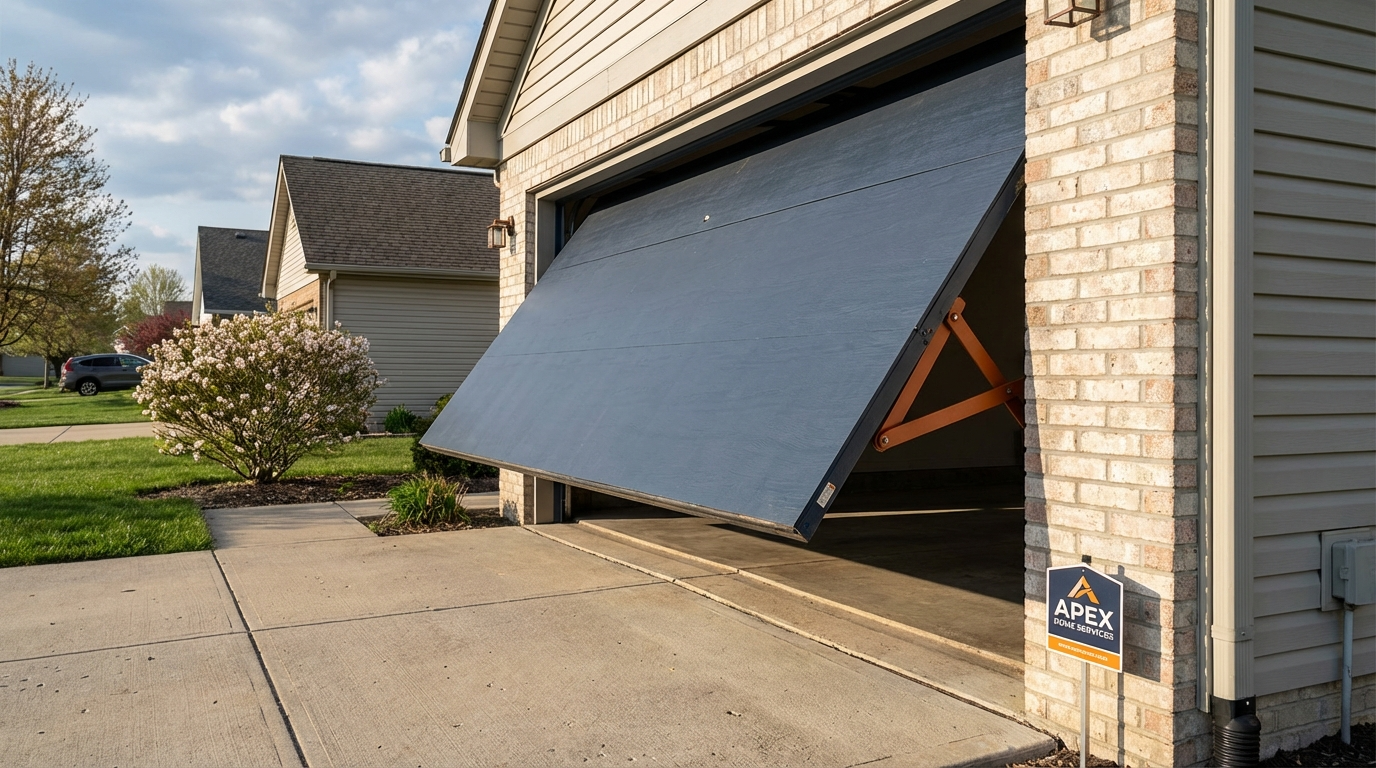
There are two subtypes of tilt-up doors: canopy and retractable. Canopy doors leave part of the door protruding outside when open, while retractable versions slide fully into the garage. The simpler mechanism means fewer moving parts, which can translate to lower initial costs and straightforward repairs. However, the outward swing demands careful consideration of driveway length and vehicle positioning.
Tilt-up doors are less common in new construction today but remain popular for certain applications, particularly where budget constraints are significant or where the architectural style calls for a single-panel appearance. Sealing can be less effective compared to sectional doors, and the weight of the single panel can make manual operation challenging.
How Do Side-Sliding Garage Doors Operate?
Side-sliding garage doors move horizontally along a track mounted on the interior wall of the garage. Instead of rising overhead, the door slides to one side, bending slightly along the wall as it opens. This system is ideal for garages with low headroom or where ceiling-mounted storage, lighting, or mechanical systems prevent the use of overhead doors.
One practical advantage of side-sliding doors is the ability to open them partially, allowing pedestrian access without fully retracting the door. This feature appeals to homeowners who use their garage as a workshop or need frequent foot traffic. The aesthetic is distinctive and can complement certain home designs where a non-traditional door adds character.
The drawback is that side-sliding doors require substantial wall space adjacent to the garage opening. If windows, electrical panels, or shelving occupy that wall, installation becomes problematic. The bottom track can also accumulate debris and require periodic cleaning to ensure smooth operation.
What Are Swing-Out Carriage House Garage Doors?
Swing-out doors operate like traditional barn doors, with two panels hinged on the sides of the frame that swing outward to open. This style evokes the historic charm of carriage houses where horse-drawn vehicles were stored. As noted in the This Old House guide, these doors require ample driveway clearance because they project several feet outward when opening.
Swing-out doors deliver a classic, rustic aesthetic that enhances homes with traditional or craftsman architecture. They do not require overhead tracks, which simplifies the garage interior. However, they are typically operated manually, and adding automatic operation can be complex and less reliable than with other door types. Snow, ice, or debris in front of the door can also obstruct opening, making them less practical in certain climates.
What Is the Difference Between a Garage Door Type and a Garage Door Style?
Homeowners often confuse garage door types with garage door styles, but these terms refer to different attributes. The type describes how the door operates, such as sectional, roll-up, or swing-out. The style refers to the visual design and decorative elements, such as traditional raised-panel, carriage house, modern, or rustic farmhouse.
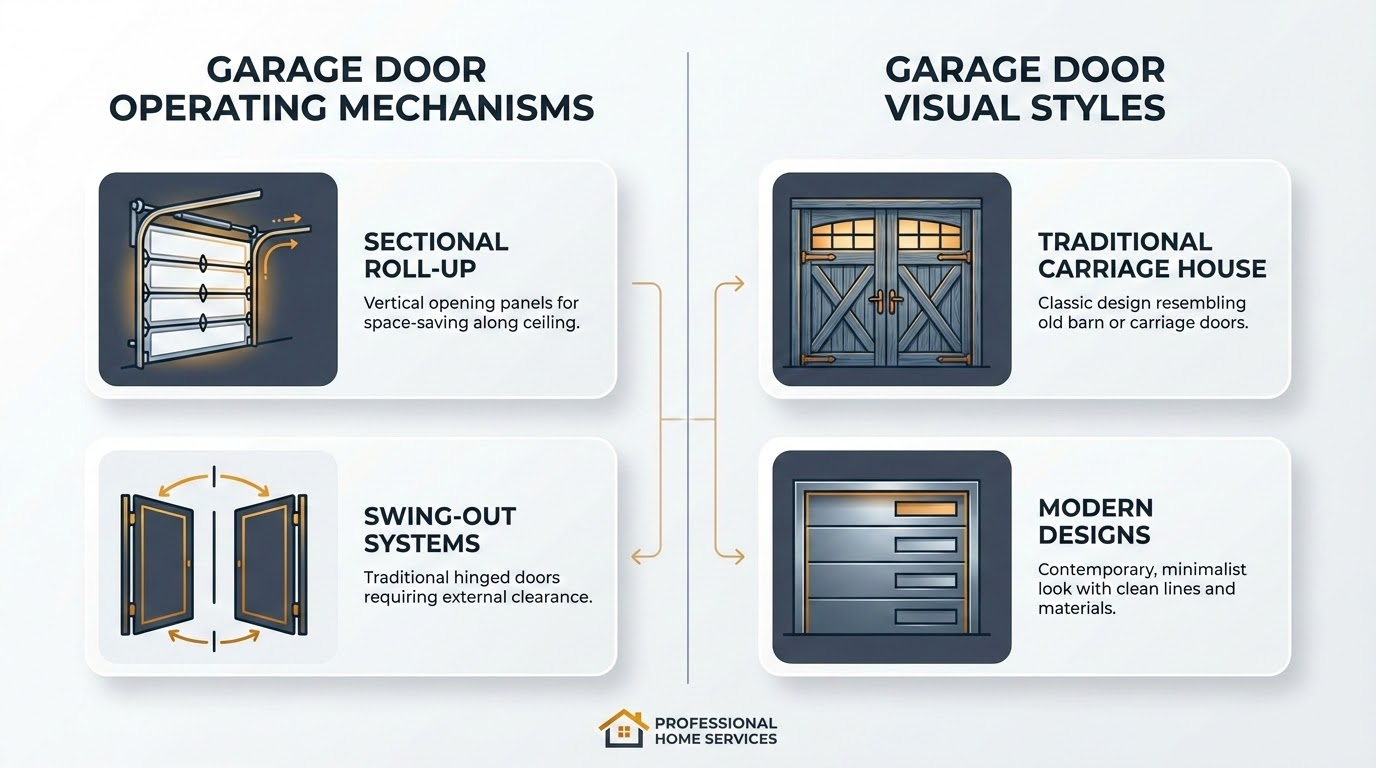
A single style can often be achieved across multiple types. For example, a carriage house style with decorative hardware and a wood-grain finish can be applied to a sectional door that operates overhead, even though it visually resembles a swing-out door. Understanding this distinction helps homeowners prioritize both function and aesthetics without unnecessary compromise.
Which Garage Door Style Matches Your Home?
Selecting a style that complements your home’s architecture ensures visual harmony and can increase property value. The most popular residential garage door styles each bring a distinct character to the facade.
| Style | Characteristics | Best For |
|---|---|---|
| Traditional Raised-Panel | Rectangular panels, clean lines, versatile appearance | Ranch, colonial, suburban homes |
| Carriage House | Decorative hardware, swing-out appearance, wood or composite materials | Craftsman, farmhouse, historic homes |
| Modern/Contemporary | Sleek lines, minimalist design, large glass panels | Modern, mid-century, urban homes |
| Rustic/Farmhouse | Natural wood or wood-look, cross-buck designs, rugged texture | Country, barn-style, rustic homes |
Traditional raised-panel doors remain the most common because of their affordability and broad compatibility. Carriage house doors have surged in popularity due to their ability to add character without sacrificing modern convenience. Modern doors with aluminum frames and glass inserts appeal to homeowners seeking a bold, contemporary statement. Rustic styles work beautifully in rural settings or homes designed to evoke pastoral warmth.
Questions About Which Style Fits Your Home?
Our design experts help you choose the perfect match for your architecture
How Do Garage Door Materials Affect Performance and Appearance?
The material of a garage door influences its durability, maintenance requirements, insulation potential, weight, and cost. Homeowners should weigh these factors against their priorities and the local climate when selecting materials.
Steel is the most popular material for residential garage doors. It is durable, low-maintenance, and available in a wide range of colors and finishes, including wood-grain textures. Steel doors can be insulated with polystyrene or polyurethane cores, making them suitable for energy-conscious homeowners. The main concern is denting, though higher-gauge steel resists damage better.
Wood offers natural beauty and can be customized with stains, paints, and carvings. However, wood requires regular maintenance, including sealing and repainting, to prevent warping, cracking, and rot. Solid wood doors are heavy and often more expensive than other options.
Aluminum is lightweight and resistant to rust, making it a good choice for coastal areas or humid climates. Aluminum is often used in modern designs with glass inserts. It can dent more easily than steel, but its corrosion resistance can outweigh this concern in certain environments.
Fiberglass and Composite materials mimic the appearance of wood while resisting dents, rust, and moisture. These materials require less maintenance than real wood and can be an economical way to achieve a high-end look without the associated upkeep.
Is an Insulated Garage Door Worth the Investment in San Antonio?
San Antonio’s hot summers make temperature control a significant concern for homeowners with attached garages or living spaces above the garage. An insulated garage door can reduce heat transfer, lower energy bills, and create a more comfortable environment inside the garage itself.
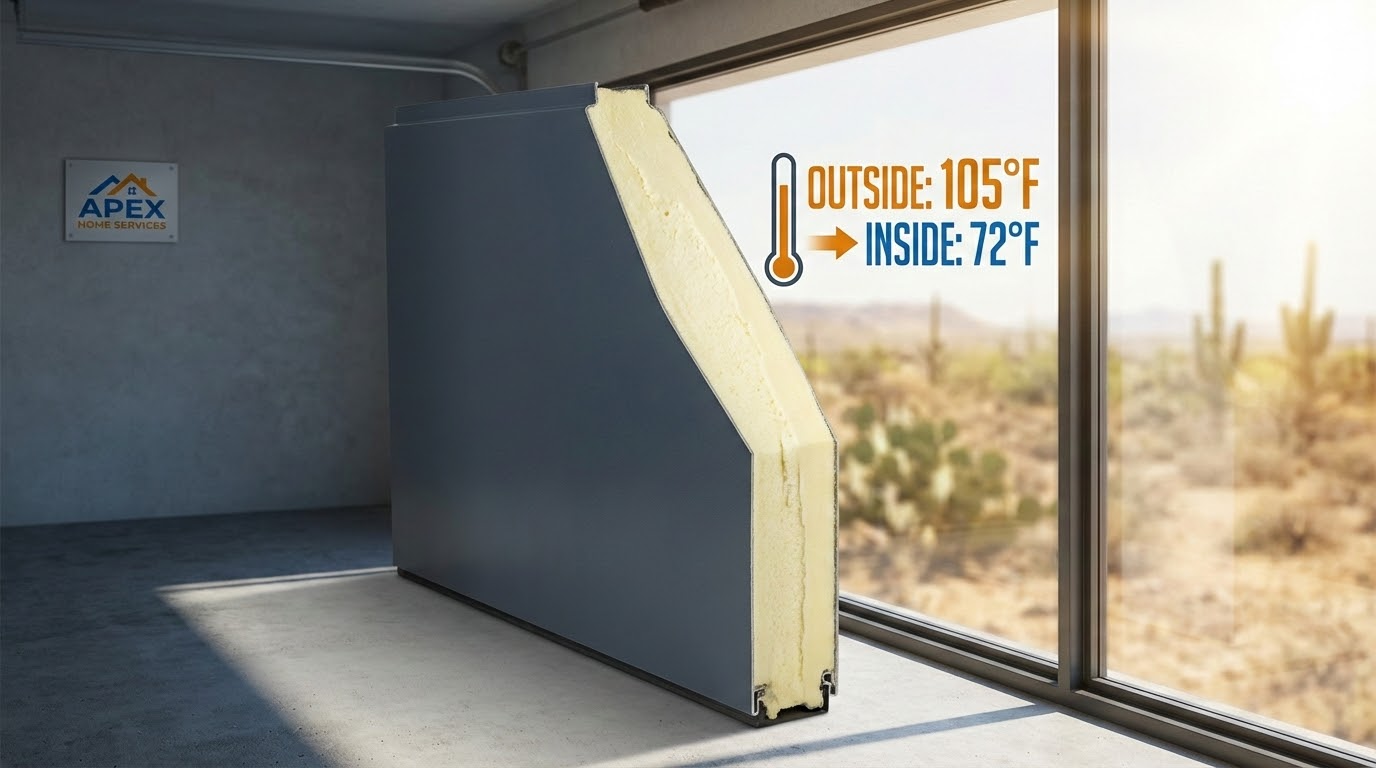
Insulation performance is measured by R-value, which indicates thermal resistance. The U.S. Department of Energy explains that higher R-values mean greater insulating effectiveness. For garage doors, R-values typically range from R-6 for basic insulation to R-18 or higher for premium options. The type of insulation, whether polystyrene or polyurethane, also affects performance, with polyurethane generally providing better thermal resistance per inch of thickness.
What Else Affects Garage Energy Efficiency Beyond R-Value?
R-value alone does not guarantee energy efficiency. The Department of Energy’s weatherstripping guide emphasizes that proper sealing around the door perimeter is equally important. Gaps at the sides, top, and bottom of the door allow air infiltration that undermines insulation. High-quality weatherstripping, bottom seals, and proper installation ensure that the door’s insulation performs as intended.
Windows in the garage door can also affect thermal performance. While they add natural light and visual appeal, windows typically have lower insulation values than solid panels. Choosing insulated or double-pane glass and limiting the number of window panels can help balance aesthetics with efficiency.
What Our Customers Say
Robert Parshall
Google Review
“The spring on my garage door broke and they were able to come out within an hour. Very professional service and fair pricing.”
Leon McPherson
Google Review
“Excellent experience from start to finish. They helped me select the right door design and the installation was completed in one day.”
Alyssa Silva
Google Review
“My garage door spring broke on a Saturday morning. They came out the same day and fixed it quickly. Great service!”
Adam Mendoza
Google Review
“Professional commercial garage door repair. They understood the urgency for our business and minimized our downtime.”
What Advanced Features Should Homeowners Consider?
Modern garage doors and openers offer features that enhance convenience, security, and safety. Homeowners upgrading their garage doors should consider these technologies as part of their investment.
Smart Garage Door Openers allow control via smartphone apps, enabling homeowners to open, close, and monitor their garage door from anywhere. Features like scheduling, activity alerts, and integration with home automation systems add convenience and peace of mind. Some systems even support package delivery, allowing drivers to place items securely inside the garage.
Enhanced Security Features include rolling code technology, which changes the opener’s access code each time it is used, preventing code theft. Automatic deadbolts and multi-point locking systems further reinforce the door against forced entry.
Why Are Safety Sensors and Auto-Reverse Mechanisms Critical?
Federal regulations have required automatic garage door openers to include entrapment protection since 1993. The U.S. Consumer Product Safety Commission mandated that openers must reverse the door if it contacts an obstruction during closing. Photo-eye sensors mounted near the floor detect objects in the door’s path and trigger reversal before contact occurs.
These safety features prevent injuries and fatalities, particularly involving children and pets. Homeowners with older openers that lack these protections should prioritize replacement. Testing the auto-reverse function regularly ensures continued safe operation. Every modern opener should also include an emergency release cord that allows manual operation during power outages.
Texas Pros Garage Doors prioritizes safety in every installation, ensuring that sensors are properly aligned and that all entrapment protection mechanisms function correctly. This commitment to safety reflects the company’s dedication to protecting San Antonio families.
Is Your Garage Door Opener Up to Code?
Our technicians inspect and upgrade safety features to protect your family
(210) 469-9003
Schedule Safety Inspection
Same-Day Service Available
Satisfaction Guaranteed
How Do You Choose the Right Garage Door for Your Home?
Selecting the ideal garage door involves balancing multiple factors. Start by considering your home’s architectural style and choosing a door that complements the overall aesthetic. A mismatched door can detract from curb appeal, while a harmonious choice enhances the property’s appearance and value.
Evaluate your budget, including both the upfront cost and long-term maintenance expenses. A wood door may have a higher initial price and require ongoing care, while a steel door offers lower maintenance at a moderate cost. Insulation adds to the price but can reduce energy expenses over time.
Practical needs matter as well. If your garage is attached to your home or you use it as a workspace, insulation and weatherstripping become more important. If you desire natural light, consider doors with window panels, keeping in mind the potential impact on privacy and thermal performance. Security features should align with your neighborhood and personal preferences.
Finally, measure your garage opening and assess the available headroom and sidewall space. These measurements determine which operating systems and hardware configurations will fit. Consulting with local experts ensures accurate assessment and proper installation.
What Measurements Are Needed Before Ordering a Garage Door?
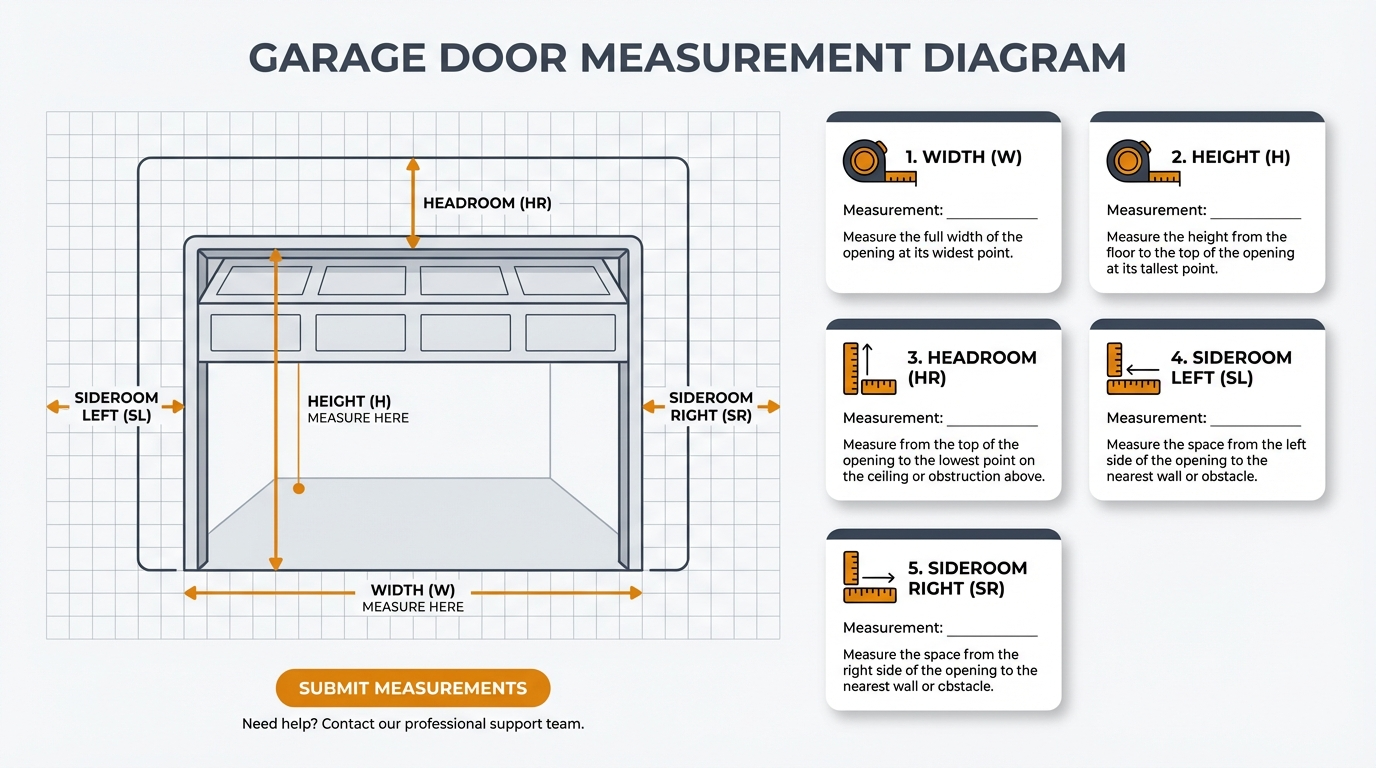
Accurate measurements prevent costly errors and ensure smooth installation. The key dimensions to record include the width and height of the garage opening, the headroom (vertical space between the top of the opening and the ceiling), and the sideroom (horizontal space on each side of the opening for vertical tracks).
| Measurement | Why It Matters | Typical Requirement |
|---|---|---|
| Opening Width | Determines door size | Standard: 8, 9, 10, 12, 16 feet |
| Opening Height | Determines door size and panel count | Standard: 7 or 8 feet |
| Headroom | Allows for horizontal tracks and opener | Minimum 12-18 inches |
| Sideroom | Accommodates vertical tracks | Minimum 3.5-4 inches per side |
| Backroom | Depth needed for door when open | Opening height plus 18 inches |
Non-standard openings or limited clearances may require special hardware, low-headroom kits, or alternative door types. A professional assessment identifies these needs before ordering, preventing delays and additional expenses.
Why Does Professional Installation Matter for Garage Doors?
Garage door installation involves heavy components, high-tension springs, and precise alignment. Improper installation can result in premature wear, poor sealing, noisy operation, and safety hazards. Springs under tension store significant energy and can cause serious injury if mishandled.
Texas Pros Garage Doors provides expert installation for all types of garage doors, ensuring that each component is correctly assembled, balanced, and tested. Proper installation maximizes the door’s lifespan, maintains warranty coverage, and ensures safe operation from day one.
Regular maintenance extends the life of your garage door and prevents unexpected failures. Lubricating moving parts, inspecting springs and cables, testing the balance, and checking safety sensors should be performed periodically. For issues beyond routine maintenance, Texas Pros Garage Doors also offers dedicated garage door repair services to restore your door to optimal condition.
Ortal Peretz
Google Review
“Called on a Sunday evening when my opener stopped working. They came out the same night and got everything working again. Outstanding service!”
What Mistakes Do Homeowners Commonly Make When Choosing Garage Doors?
Several common errors can lead to dissatisfaction or unnecessary expense. Focusing solely on price without considering long-term maintenance costs often results in choosing a door that requires frequent repairs or replacement. Ignoring insulation in an attached garage leads to higher energy bills and uncomfortable interior temperatures. Selecting a style that clashes with the home’s architecture diminishes curb appeal.
Another frequent mistake is underestimating the importance of professional installation. Attempting a DIY installation to save money can result in improper spring tension, misaligned tracks, and voided warranties. Similarly, neglecting to verify measurements before ordering can cause delays and require costly modifications.
Finally, overlooking safety features on older openers puts families at risk. If your opener lacks photo-eye sensors or auto-reverse functionality, upgrading is not merely a convenience but a necessary safety measure.
Frequently Asked Questions About Types of Garage Doors
Ready to Find Your Ideal Garage Door?
With so many types of garage doors, styles, materials, and features available, the decision can feel overwhelming. However, understanding your home’s requirements and priorities simplifies the process considerably. Whether you need maximum insulation for a climate-controlled garage, a carriage house style to complement your craftsman home, or a space-saving roll-up door for a compact garage, the right solution exists.
Have you evaluated your garage’s headroom, assessed your insulation needs, and considered which style enhances your home’s curb appeal? Texas Pros Garage Doors is ready to help San Antonio homeowners navigate these decisions with personalized guidance and professional installation. Contact the team today through the contact page to schedule a consultation and receive an estimate tailored to your home.
Transform Your Home’s Curb Appeal Today
Expert installation, premium products, and unmatched service since 2006
(210) 469-9003
Get Your Free Quote
Available 24/7
70+ 5-Star Reviews

Our Garage Door Services in San Antonio
Garage Door Repair | New Garage Door Installation | Spring Replacement | Panel Replacement | Rollers Replacement | Openers Service | Fix Broken Cables | Fix Torsion Springs | Fix Bent Track
Contact us or call (210) 469-9003 for a free estimate!
Recent Comments