
Estimated reading time: 12 minutes
Commercial properties across Texas are shifting toward aluminum garage doors at a rapid pace, and for good reason. When a business needs a door that looks sharp, operates smoothly under heavy daily cycling, and resists the punishing humidity of the Gulf Coast corridor, aluminum stands out as a material that checks every practical box. Whether the property is a trendy restaurant with a roll-up storefront, a climate-controlled warehouse, or an auto dealership showcase, the right aluminum door transforms function and curb appeal in one move.
The team at Texas Pros Garage Doors works with commercial clients throughout the San Antonio region to match each opening to the exact performance profile the building demands. That means evaluating weight limits, insulation needs, wind-load codes, and finish durability before a single bracket is mounted. The following sections break down everything a property owner or facility manager should know before investing in aluminum garage doors for a commercial space.
Key Takeaways
- Aluminum garage doors do not rust, making them ideal for humid Texas climates and coastal commercial properties where steel would corrode.
- Lightweight construction reduces wear on springs, rollers, and openers, lowering maintenance costs and extending hardware life for high-cycle commercial use.
- Thermal breaks and insulated glass are critical for energy efficiency; an uninsulated aluminum door will undermine climate control in any conditioned space.
- Modular aluminum frame design allows individual damaged panels to be replaced quickly without removing the entire door, minimizing business downtime.
- Wind-load compliance is not optional in Texas; always verify that your aluminum door assembly is tested, labeled, and code-compliant before installation.
▼
- Why Are So Many Businesses Switching to Lightweight Garage Doors?
- What Is an Aluminum Frame Door and How Does It Differ?
- Do Aluminum Garage Doors Really Qualify as Rust Resistant?
- How Do Finish Options Protect Aluminum Even Further?
- A Common Mistake: Assuming All Aluminum Doors Perform the Same
- What Is a Thermal Break and Why Is It Critical?
- How Do Weatherstripping and Seals Affect Performance?
- Aluminum vs. Steel: Which Material Serves a Business Better?
- Do Aluminum Garage Doors Dent Easily?
- What Factors Drive the Installed Cost?
- Wind-Load Ratings: Is Your Door Code-Compliant?
- Scenario: Choosing the Right Door for a Restaurant Patio
- How to Evaluate a Commercial Aluminum Door Quote
- Frequently Asked Questions
Need an Aluminum Garage Door for Your Business?
Our commercial team provides free on-site assessments with detailed, transparent proposals. Serving San Antonio and surrounding areas 24/7.
(210) 469-9003
Schedule Free Consultation
4.8-Star Google Rating
70+ Verified Reviews
Why Are So Many Businesses Switching to Lightweight Garage Doors?
A standard steel commercial door can weigh significantly more than an aluminum counterpart of the same dimensions. That extra weight translates directly into faster wear on torsion springs, rollers, hinges, and the opener motor itself. For businesses that cycle their doors dozens of times each day—loading docks, fire stations, service bays—every pound matters.
Lightweight garage doors made from aluminum reduce mechanical stress across the entire operating system. Springs maintain proper tension longer. Rollers glide rather than grind. And the opener draws less current per cycle, which adds up on a utility bill over thousands of openings per year. The practical result is a quieter, smoother operation and a maintenance schedule that stretches further between service calls.
Large commercial openings amplify these benefits even more. A 16-foot-wide by 14-foot-tall bay door in aluminum can be engineered to perform reliably without the heavy-duty (and expensive) hardware that the same door in steel would require. That difference in upfront hardware cost, combined with longer component life, makes aluminum a compelling long-term investment for high-traffic facilities.
What Exactly Is an Aluminum Frame Door and How Does It Differ from a Full-Panel Design?
The term aluminum frame doors refers to a construction method where the structural skeleton of each section is extruded aluminum, and the panels between the frame rails are filled with glass, acrylic, insulated composite, or solid aluminum sheet. This modular approach gives designers and property owners tremendous flexibility.
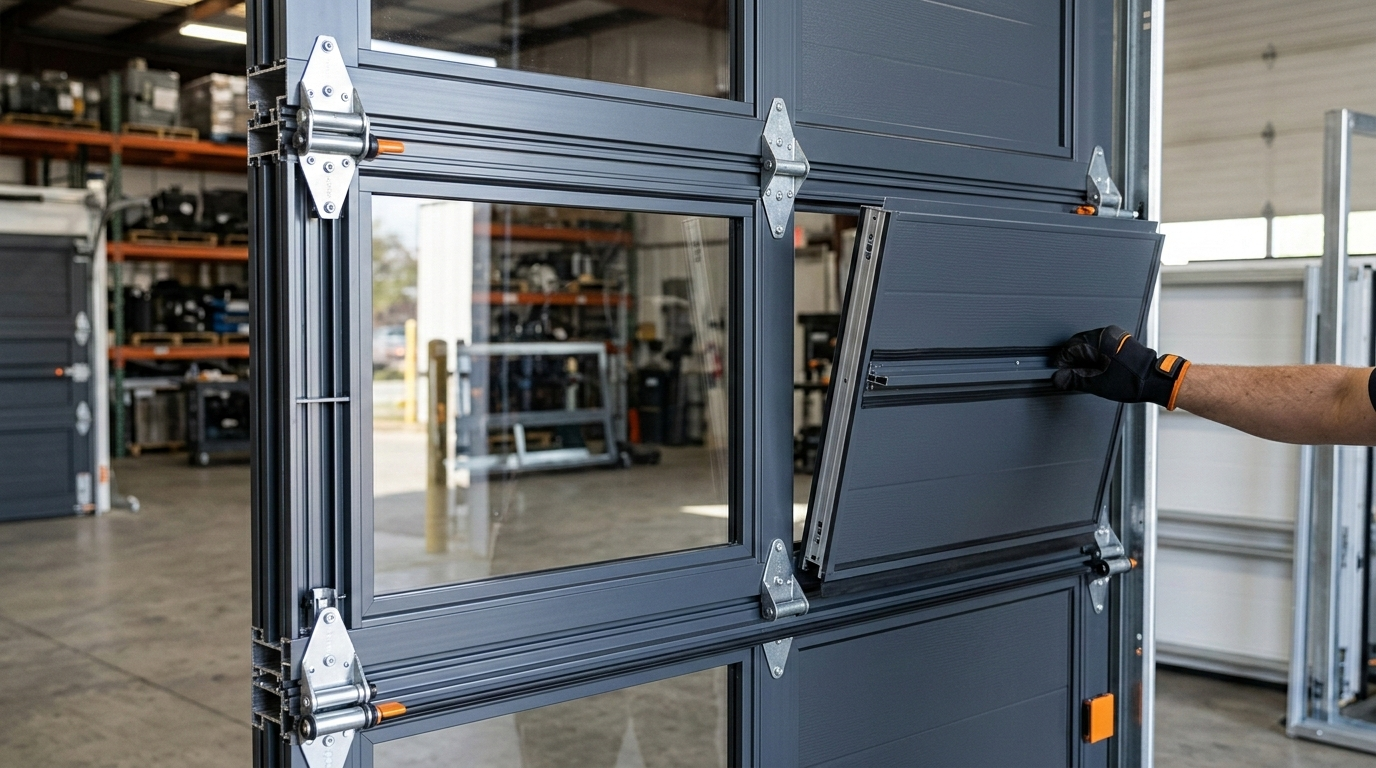
A full-view configuration uses tempered or insulated glass in every opening, flooding the interior with natural light and creating an inviting storefront aesthetic. A mixed configuration might place glass in the upper sections for visibility and solid insulated panels in the lower sections for impact protection. A fully solid aluminum panel door, meanwhile, offers a sleek industrial look without any glass at all.
The critical advantage of the frame-based system is that individual panels can be replaced without removing the entire door. If a forklift clips the bottom section, a technician can swap that one panel instead of ordering a complete replacement—saving significant time and money. Texas Pros Garage Doors keeps common panel profiles and glass types accessible so that commercial clients experience minimal downtime after damage.
Do Aluminum Garage Doors Really Qualify as Rust Resistant Doors?
Yes. Aluminum does not rust. Rust is iron oxide, and since aluminum contains no iron, the corrosive process that eats through unprotected steel simply does not apply. According to research documented by NASA’s Technical Reports Server, aluminum naturally forms a thin but tenacious oxide layer on its surface that acts as a barrier against further degradation. This self-healing oxide is what makes aluminum inherently suitable for environments where moisture, salt spray, and chemical exposure are constant threats.
It is important, however, to distinguish between “rust” and “corrosion.” While aluminum does not produce the flaky red-brown oxide associated with steel, it can experience white powdery oxidation or pitting corrosion under certain extreme conditions—prolonged exposure to highly acidic or alkaline substances, for example. Proper finishing virtually eliminates this concern for commercial garage doors.
How Do Finish Options Protect Aluminum Even Further?
Three primary finish categories dominate the commercial market. Powder coating applies a durable, color-matched layer that resists UV fading, chalking, and surface scratching. Anodizing thickens the natural oxide layer through an electrochemical process, producing a harder surface with excellent abrasion resistance. As noted in NASA’s contamination engineering guidelines, hard-anodized aluminum is considered suitable for environments where corrosion resistance is a priority. Kynar (PVDF) coatings, used on higher-end architectural projects, deliver exceptional color retention even under intense Texas sun.
For businesses near the coast or in areas with heavy industrial fallout, pairing a quality finish with periodic rinse-downs keeps rust resistant doors looking new for decades. Texas Pros Garage Doors advises commercial clients on the finish best suited to their specific exposure, ensuring the investment holds its value well beyond the warranty period.
A Common Mistake: Assuming All Aluminum Doors Perform the Same in Heat
One of the most frequent miscalculations business owners make is selecting an aluminum garage door based solely on appearance without evaluating its thermal performance. An uninsulated, single-layer aluminum door will conduct heat rapidly—turning a climate-controlled warehouse into an oven the moment the Texas summer sun hits the exterior face.
Commercial aluminum doors designed for energy efficiency incorporate insulated cores—typically polyurethane or polystyrene—sandwiched between interior and exterior aluminum skins. The insulation value alone, however, does not tell the whole story. Without a thermal break, the aluminum frame itself acts as a bridge, conducting heat around the insulation and undermining its effectiveness.
What Is a Thermal Break and Why Is It Critical for Commercial Aluminum Doors?
A thermal break is a strip or section of low-conductivity material—usually a reinforced polymer—placed between the interior and exterior halves of an aluminum frame member. Its purpose is to interrupt the metal-to-metal pathway that would otherwise allow heat or cold to transfer straight through the frame.
The U.S. Department of Energy notes that modern glass doors with metal frames frequently incorporate a thermal break as a plastic insulator between inner and outer frame parts to reduce energy loss. In a commercial garage door, this detail can mean the difference between a comfortable, efficient interior and one that forces HVAC systems to run continuously.
| Thermal Metric | What It Measures | Better Performance Means |
|---|---|---|
| R-Value | Resistance to heat flow through a material | Higher number |
| U-Factor | Rate of non-solar heat transfer through an assembly | Lower number |
| Air Infiltration (cfm/ft²) | Volume of air leaking through the closed door | Lower number |
When evaluating insulated aluminum garage doors, request the tested U-factor for the complete assembly—not just the panel R-value. A door with an impressive panel R-value but no thermal break and poor weatherstripping will underperform a door with a moderate R-value but a true thermal break and tight seals. Texas Pros Garage Doors reviews third-party test data with commercial clients to ensure the installed door meets both code requirements and real-world energy goals.
How Do Weatherstripping and Seals Affect Real-World Performance?
Even the best-insulated aluminum frame door will lose efficiency if air leaks around its perimeter. Bottom astragals, side seals, and header weatherstripping form the critical barrier between a controlled interior environment and the outdoors. As the Department of Energy’s energy performance guide emphasizes, air leakage is one of the most significant factors in overall door performance.
Commercial doors face additional challenges: wider openings mean longer seal runs, higher wind pressures can compress or dislodge seals, and frequent cycling accelerates wear. Inspecting and replacing seals on a regular schedule is one of the simplest ways to protect the energy savings that an insulated aluminum door is designed to deliver.
Aluminum vs. Steel Garage Doors: Which Material Serves a Business Better?
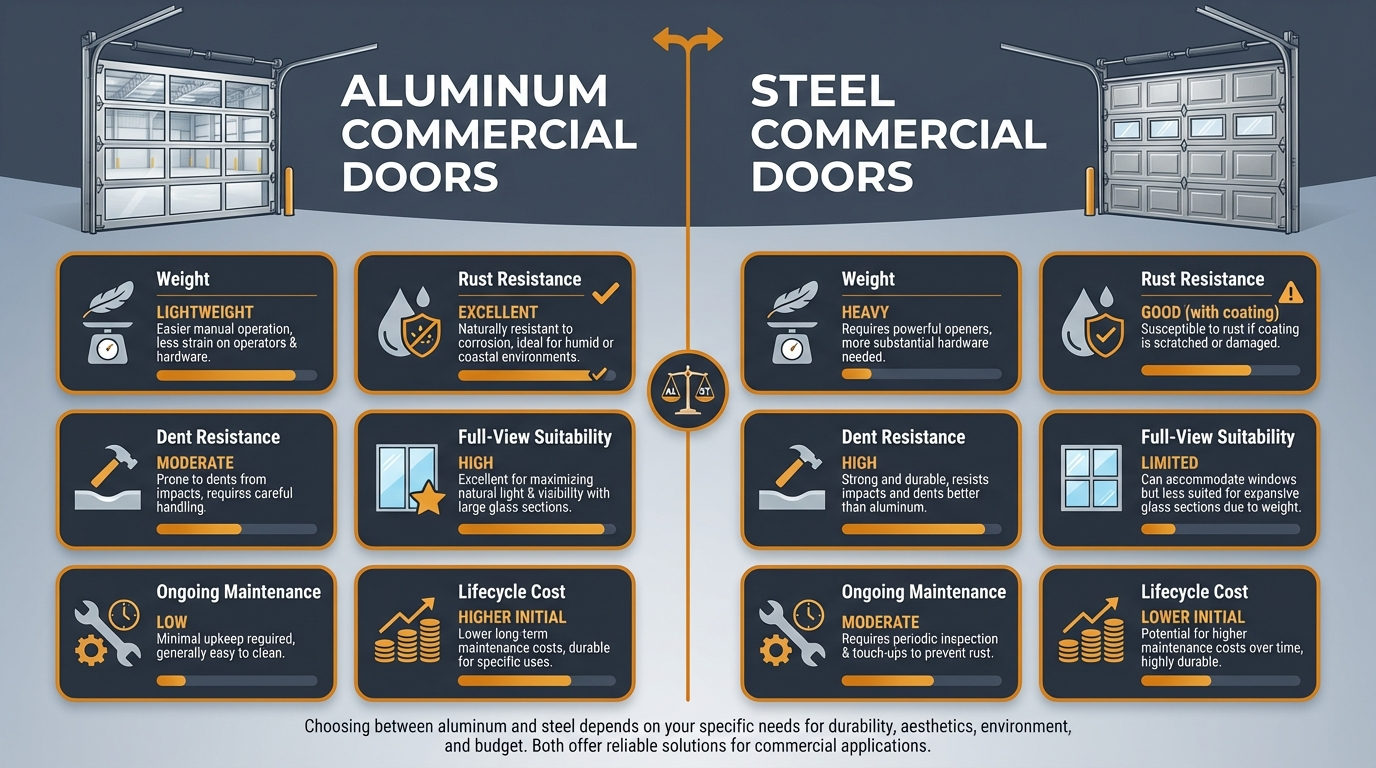
This comparison comes up in nearly every commercial consultation. Neither material is universally “better”—the right choice depends on the facility’s priorities, budget, and operating environment. The table below maps the most common decision criteria.
| Criterion | Aluminum | Steel |
|---|---|---|
| Weight | Significantly lighter | Heavier; requires stronger hardware |
| Rust Resistance | Excellent; does not rust | Depends on coating and maintenance |
| Dent Resistance | Moderate; profile-dependent | Generally higher in heavier gauges |
| Full-View Suitability | Excellent; natural fit for glass frames | Available but typically bulkier frames |
| Ongoing Maintenance | Low; rinse and inspect seals | Medium; monitor for chips, scratches, rust |
| Insulation Potential | Good with thermal break | Very good in foam-filled sandwich panels |
| Initial Cost (basic models) | Often higher per square foot | Often lower per square foot |
| Lifecycle Cost (15+ years) | Competitive due to lower maintenance | Can increase if corrosion requires panel replacement |
For businesses prioritizing a modern full-view aesthetic, coastal corrosion resistance, or reduced mechanical wear on high-cycle systems, aluminum typically wins. For facilities where impact resistance from heavy equipment is the overriding concern and visual presentation is secondary, steel may be the more practical choice—though reinforced aluminum profiles can close that gap considerably.
Not Sure Which Material Is Right for Your Facility?
Our commercial specialists evaluate your specific operating environment, traffic patterns, and budget to recommend the ideal door configuration. No guesswork, no pressure.
Do Aluminum Garage Doors Dent Easily, and What Can Be Done About It?
This question appears constantly in online forums and buyer discussions, and the answer is nuanced. A thin residential-grade aluminum panel will dent more readily than a heavy-gauge steel panel. However, commercial-grade aluminum doors are engineered with thicker extrusions, internal stiffeners, and reinforced lower sections specifically to resist the kind of impacts encountered in busy service environments.
Most denting occurs on the bottom two panels, typically from equipment, carts, or vehicle bumpers. Specifying a solid, thicker-gauge bottom section—even on an otherwise full-view door—provides a practical buffer zone. Bollards or rubber bumper guards mounted near the door opening add another layer of protection at minimal cost.
When dents do occur, the modular panel construction of most aluminum frame doors allows a technician to replace the damaged section without disturbing the rest of the door. This repairability is one of the material’s underappreciated advantages in a commercial setting.
What Factors Drive the Installed Cost of Commercial Aluminum Garage Doors?
Pricing for commercial aluminum garage doors varies widely because so many variables feed into the final number. Understanding those variables helps business owners evaluate quotes accurately and avoid surprises.
Door dimensions are the starting point—a 20-foot-wide by 16-foot-tall opening requires substantially more material and heavier hardware than a standard 10-by-10 bay. Glass type is the next major cost driver: clear tempered glass is the baseline, while insulated glass units, frosted or tinted options, and impact-rated laminates each add to the price. Insulation with a genuine thermal break costs more than an uninsulated configuration but pays for itself in energy savings.
Hardware matters just as much as the door itself. High-cycle torsion springs rated for 50,000 or 100,000 cycles, commercial-grade track systems (vertical lift, high lift, or follow-the-roof), and appropriately powered operators all factor into the installed cost. Wind-load reinforcement, when required by local code, adds stiffeners and heavier track that increase both material and labor totals.
Texas Pros Garage Doors provides itemized commercial quotes that separate the door specification, hardware, and installation labor so clients can see exactly where each dollar goes. That transparency makes it straightforward to compare options and adjust specifications to fit the project budget without sacrificing performance where it counts.
Wind-Load Ratings: Is Your Aluminum Door Code-Compliant in Texas?
Texas building codes in many jurisdictions require garage doors to carry a tested and certified wind-load rating. According to the International Code Council, garage doors must be tested per ASTM E330 or ANSI/DASMA 108 and permanently labeled with their design wind-pressure rating. This is not optional—a door without the proper label can trigger code violations during inspection and create serious liability exposure if it fails during a storm.
Wind-load compliance for aluminum garage doors typically involves internal stiffeners (wind bars or struts) mounted horizontally across each section, heavier-gauge track, and reinforced brackets. The opener must also be rated to hold the door in place under negative pressure loads. All of these components must be specified together as a tested assembly; mixing hardware from different systems can void the rating.
For properties in designated high-velocity hurricane zones or coastal areas, additional requirements may apply. FEMA guidance notes that standard garage doors generally do not satisfy National Flood Insurance Program requirements for flood openings, meaning coastal commercial buildings may need supplementary engineering beyond the door itself.
A Scenario: Choosing the Right Aluminum Door for a Restaurant Patio Facade
Consider a restaurant in the San Antonio area that wants to open its dining room to an outdoor patio using a full-view aluminum garage door. The door needs to look elegant, allow natural light when closed, provide reasonable thermal performance for the HVAC system, and meet local building code for wind pressure.

The specification might start with an aluminum frame door featuring insulated glass units (dual-pane, Low-E coated) for thermal performance and UV filtering. A thermal break in the frame prevents condensation on the interior during humid evenings. The bottom section is specified in solid insulated aluminum for kick protection. Powder-coat finish in a color that matches the restaurant’s branding completes the visual package.
Hardware includes a jackshaft operator mounted to the side of the opening to preserve ceiling space for lighting and HVAC ductwork, plus high-cycle springs rated for the projected number of daily openings. Weatherstripping rated for air infiltration below 1.0 cfm/ft² ensures the HVAC system is not fighting the door. The entire assembly is tested and labeled for the local design wind pressure.
Texas Pros Garage Doors handles every element of this type of project—from initial site measurement and code research through final commissioning and operator programming—so the restaurant owner receives a turnkey solution rather than a collection of parts.
What Our Commercial Clients Say
“The spring on my garage door broke and they were able to come out within an hour. Very professional service and fair pricing.”
“Excellent experience from start to finish. They helped me select the right door design and the installation was completed in one day.”
“My garage door spring broke on a Saturday morning. They came out the same day and fixed it quickly. Great service!”
“Professional commercial garage door repair. They understood the urgency for our business and minimized our downtime.”
Benchmarks and Checks: How to Evaluate a Commercial Aluminum Door Quote
| Item to Verify | What to Look For | Red Flag if Missing |
|---|---|---|
| Door Specification Sheet | Alloy grade, gauge, panel construction, finish type | Generic “aluminum door” with no detail |
| Glass Specification | Tempered, insulated, Low-E, impact-rated, thickness | No glass type mentioned in a full-view quote |
| Thermal Performance Data | Tested U-factor for the complete assembly | Only panel R-value listed |
| Wind-Load Documentation | Test report number, design pressure, labeled assembly | “We can add wind bars later” |
| Spring Cycle Rating | 10,000 / 25,000 / 50,000 / 100,000 cycles | No cycle count specified |
| Operator Rating | HP or equivalent, duty cycle, safety features | Residential-grade opener on a commercial door |
| Warranty Breakdown | Separate terms for panels, hardware, finish, labor | Single vague “limited warranty” statement |
A thorough quote should read like an engineering document, not a one-line estimate. If a vendor cannot produce the details listed above, the bid deserves scrutiny. The commercial division at Texas Pros Garage Doors includes all specification documents, test reports, and warranty terms in every proposal as standard practice.
“Called on a Sunday evening when my opener stopped working. They came out the same night and got everything working again. Outstanding service!”
Frequently Asked Questions About Aluminum Garage Doors
With proper maintenance and a quality finish, commercial aluminum garage doors routinely perform for 20 to 30 years. The door panels themselves often outlast the hardware, which is why specifying high-cycle springs and commercial-grade operators from the start is so important. Regular seal replacement and periodic cleaning extend both appearance and function.
In most cases, yes. The opening dimensions remain the same, but the track, springs, and brackets will likely need to be resized because aluminum doors are lighter. A qualified installer will calculate the new spring tension, verify track compatibility, and confirm that the operator is properly matched to the reduced door weight.
Insulated aluminum doors with a thermal break and high-quality perimeter seals can serve mildly controlled environments effectively. For true cold-storage applications where interior temperatures must stay near or below freezing, specialized insulated doors with higher R-values and vapor barriers are generally recommended. An experienced installer can evaluate the specific temperature differential and recommend the right product.
Maintenance is actually simpler. There is no risk of rust, so the periodic touch-up painting required for steel doors is unnecessary. The recommended routine includes rinsing the door with mild soap and water, inspecting weatherstripping and bottom seals, lubricating moving hardware, and checking spring tension. Most commercial facilities can handle this on a quarterly cycle.
Powder-coat finishes are available in virtually any RAL or custom color, allowing businesses to match corporate branding precisely. Anodized finishes offer a more metallic, architectural look in shades from clear silver to dark bronze. Some manufacturers also offer wood-grain laminates applied over the aluminum for a warm aesthetic without the maintenance demands of real wood.
It depends on the opener’s specifications. Because aluminum doors are lighter, the opener may need its force and travel limits recalibrated. If the existing opener is a residential model or is nearing the end of its service life, upgrading to a commercial-duty operator at the time of door replacement is the most cost-effective approach. Texas Pros Garage Doors assesses existing operators during every site visit and provides a clear recommendation.
Ready to Specify the Right Aluminum Door for Your Property?
Choosing between frame styles, glass types, insulation levels, finishes, and hardware configurations can feel overwhelming without expert guidance. Our commercial team brings site-specific knowledge directly into the specification conversation—local wind-load requirements, climate considerations, and operational demands included.
(210) 469-9003
Request Your Free Commercial Quote
24/7 Emergency Service
Transparent Itemized Proposals

Recent Comments