
Estimated reading time: 12 minutes
Few home upgrades deliver the dramatic visual impact of carriage house garage doors. Across San Antonio, Austin, and the greater Texas Hill Country, homeowners are discovering that these doors blend historical charm with thoroughly modern engineering. Whether you are building a new home or replacing an aging garage door, understanding what carriage house doors offer — and what pitfalls to avoid — can save you thousands of dollars and years of frustration. This guide walks you through design options, material choices, insulation, wind-load requirements, and the practical details that matter most in the Texas climate.
Key Takeaways
- Most carriage house garage doors use standard overhead track mechanisms despite their swing-out appearance, making them compatible with any automatic opener.
- Overlay construction delivers dramatically richer curb appeal than stamped panels, but adds weight that requires spring recalibration and potentially a stronger opener.
- Texas wind-load requirements and TDI approval are mandatory in designated catastrophe areas — choosing a non-rated door can void your windstorm insurance.
- Polyurethane-insulated carriage doors (R-10 to R-18+) provide the best thermal performance for attached garages in the intense Texas heat.
- Professional installation with spring calibration, hardware placement checks, and code verification prevents the most common and costly carriage door problems.
▼
- What Exactly Are Carriage House Garage Doors?
- Do Carriage House Doors Actually Swing Out?
- Carriage Style vs. Swing Out Garage Doors
- Headroom and Track Clearance
- Overlay Construction vs. Stamped Panels
- Best Materials for Texas
- Common Mistakes When Choosing
- Barn Style vs. Carriage House
- Wind-Load Requirements in Texas
- Insulation Performance and R-Value
- Perimeter Seals
- Do They Increase Home Value?
- Best Windows for Carriage House Design
- Practical Checklist Before You Buy
- Why Local Expertise Matters
- Frequently Asked Questions
What Exactly Are Carriage House Garage Doors?
The term “carriage house” traces back to 19th-century outbuildings where horse-drawn carriages were stored. Those original doors swung outward on large hinges. Today, most carriage house garage doors are actually sectional overhead doors engineered to roll up along a track — just like a standard garage door — while their exterior panels, windows, and decorative hardware recreate the look of those historic swing doors. According to Fine Homebuilding, the modern carriage door became popular precisely because it marries nostalgic aesthetics with push-button convenience.
Two broad families exist in the market. The first, and by far the most common, places a carriage-style facade on a standard overhead mechanism. The second is a true swing-out (side-hinged) door that opens outward like the originals. Both carry the “carriage house” label, which is why confusion persists among buyers.
Do Carriage House Doors Actually Swing Out?
Not necessarily. While the visual cues — strap hinges, vertical stiles, crossbuck panels — suggest a door that swings open, the vast majority of carriage house garage doors sold in Texas operate on an overhead track with torsion springs. True swing out garage doors do exist, but they require adequate driveway clearance in front of the opening and are less compatible with standard automatic openers. In neighborhoods with short driveways or shared easements, an overhead carriage-style door is almost always the practical choice.
How Carriage Style Doors Differ from Swing Out Garage Doors
“Carriage style” describes an appearance. “Swing out” describes a mechanism. You can have both at once, but you do not have to. Homeowners who want the authentic experience of pulling open heavy wooden doors should understand the trade-offs: swing-out doors need manual latches or specialty operators, careful weatherstripping, and periodic hinge adjustment. Overhead carriage style doors, on the other hand, accept any standard opener and require no extra driveway space. The decision often comes down to one question: do you prioritize full authenticity, or do you want the classic look without changing your daily routine?
A Scenario Most Buyers Overlook: Headroom and Track Clearance
Before falling in love with a specific carriage house design, measure the space above and behind your garage opening. Carriage house panels tend to be thicker — especially overlay models — which can reduce the clearance between the top of the door and the ceiling. If your garage has low headroom, a standard-lift track may not work, and you could need a low-headroom conversion kit or a different mounting style altogether. Texas Pros Garage Doors routinely performs pre-installation assessments that account for headroom, side room, and rear clearance, helping homeowners avoid costly surprises after the door has already been ordered.
Free Carriage House Door Consultation
Get expert guidance on design, materials, and wind-load compliance — tailored to your San Antonio home. Same-day assessments available.
(210) 469-9003
Schedule Free Consultation
Since 2006
70+ Verified Reviews
Comparing Overlay Construction to Stamped Panels
Two manufacturing methods dominate the carriage house market. Understanding the difference prevents buyer regret.
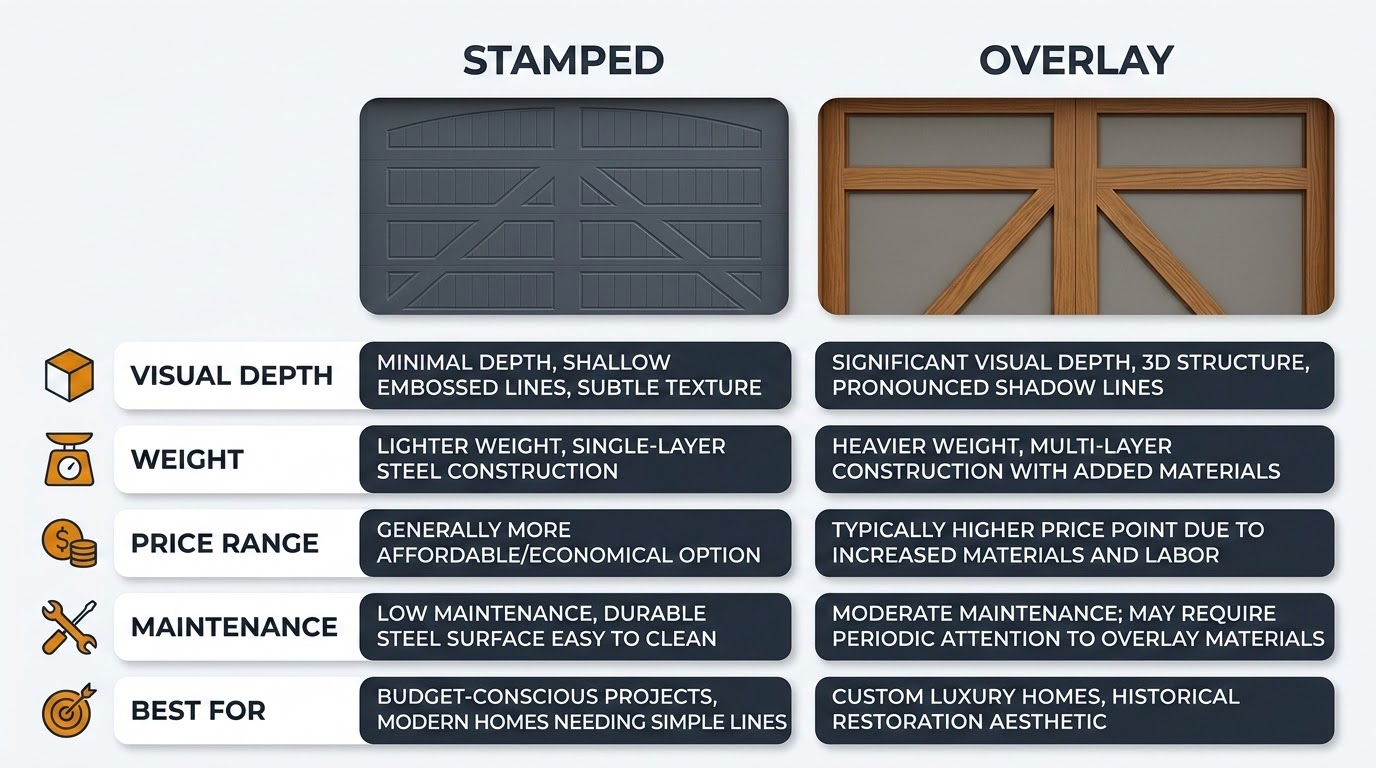
| Feature | Stamped (Embossed) | Overlay (Applied Frames) |
|---|---|---|
| Visual Depth | Shallow relief pressed into steel | Raised frames create genuine three-dimensional shadow lines |
| Weight | Lighter — single layer of steel | Heavier — additional composite or wood layer |
| Price Range | Budget-friendly to mid-range | Mid-range to premium |
| Maintenance | Low — fewer joints to inspect | Moderate — check adhesive bond and expansion gaps |
| Best For | Homeowners wanting a subtle carriage look at lower cost | Homeowners wanting a high-end, custom appearance |
Stamped doors suit many homes perfectly, but if your goal is to replicate the depth and texture of real wood joinery, an overlay panel delivers a dramatically richer street presence.
What Materials Work Best for Carriage House Garage Doors in Texas?
Texas heat, UV exposure, and occasional hail demand materials that can take a beating without losing their charm. Real wood — cedar, mahogany, hemlock — offers unmatched warmth but requires staining or sealing every two to three years. Steel doors with a wood-grain finish provide excellent durability and minimal maintenance; most resist denting better than entry-level alternatives. Composite and fiberglass options sit in between: lighter than steel, resistant to moisture, and available in convincing wood tones. For homes in areas prone to severe weather, reinforced steel with polyurethane core insulation tends to deliver the best combination of strength, thermal performance, and long-term value.
Common Mistakes When Choosing Carriage House Doors
Experienced installers see the same errors repeatedly. First, homeowners select a door purely on appearance without verifying its wind-load rating — a critical oversight in coastal and high-wind Texas counties. Second, decorative hardware is sometimes installed incorrectly, interfering with the door’s travel path or seal contact. Third, buyers underestimate the weight of premium overlay or solid-wood doors, leading to underpowered openers and premature spring fatigue. Each of these mistakes is preventable with a thorough site evaluation before ordering. The team at Texas Pros Garage Doors includes hardware compatibility and spring-system sizing as standard steps in every consultation, reducing the risk of post-installation problems.
Barn Style Garage Doors Versus Carriage House: Which Suits Your Home?
The two terms overlap, but they are not interchangeable. Barn style garage doors lean into rustic farmhouse aesthetics — vertical tongue-and-groove planks, iron straps, and simple crossbuck patterns. Carriage house doors tend toward a more refined, elegant look with arched windows, symmetrical panels, and ornamental hinges. In practice, a Modern Farmhouse may pair better with a barn-style door, while a Traditional or Colonial home often benefits from the classic carriage house silhouette. Choosing professional garage door installation ensures that whichever style you pick, the heavy decorative panels are balanced and aligned correctly from day one.
How Wind-Load Requirements Affect Your Door Selection in Texas
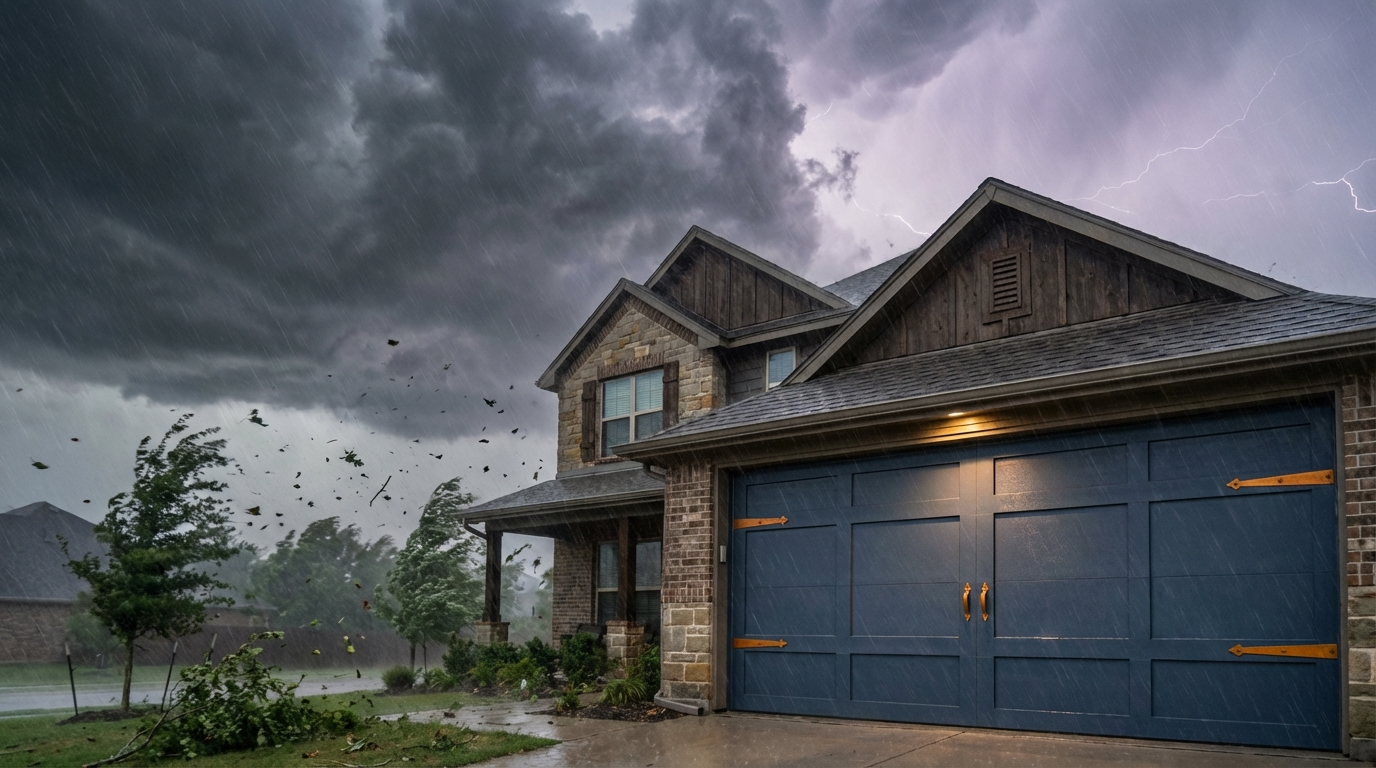
Texas is one of the few states that enforces specific windstorm product evaluations for garage doors. The Texas Department of Insurance (TDI) requires garage doors in designated catastrophe areas to be tested according to ASTM E330 or ANSI/DASMA 108 standards. These tests simulate sustained wind pressure to ensure the door will not buckle inward or blow out during a storm. Research from the Insurance Institute for Business and Home Safety (IBHS) demonstrates that when a garage door fails, internal pressure can build rapidly, leading to roof uplift and structural collapse — a “cascade of damage” that is far more expensive to repair than the door itself.
What About Windows in High-Wind Zones?
Carriage house doors frequently feature decorative glass panels. In wind-borne debris regions, those windows may need impact-rated glazing or approved protective coverings. Failing to address this requirement can void your windstorm insurance certificate. Always confirm the glazing specification with your installer before committing to a window layout.
Concerned About Wind-Load Compliance?
Our team verifies TDI requirements for your specific county and ensures your new carriage house door meets every code — before it’s ordered.
Measuring Insulation Performance: R-Value and Why It Matters
If your garage is attached to your home — or if you use it as a workshop, gym, or storage area — insulation is not optional. The R-value measures thermal resistance: the higher the number, the better the barrier against heat transfer. Carriage house garage doors are available in non-insulated, polystyrene-insulated, and polyurethane-insulated configurations.
| Insulation Type | Typical R-Value Range | Characteristics |
|---|---|---|
| None (single layer) | 0 – 2 | Lightweight, lowest cost, minimal thermal benefit |
| Polystyrene (EPS/XPS) | 4 – 8 | Rigid foam boards inserted between layers; moderate performance |
| Polyurethane (closed-cell) | 10 – 18+ | Sprayed or injected foam bonds to skins; excellent thermal and structural performance |
The U.S. Department of Energy notes that polyurethane insulation provides one of the highest R-values per inch of any commercially available material, making it the preferred choice for homeowners who want to keep summer heat out of an attached garage.
Perimeter Seals Can Matter as Much as the Insulation Itself
Even a door with an R-18 core loses effectiveness if hot air leaks around the edges. Bottom seals, side weatherstripping, and header seals work together to create a continuous thermal envelope. Over time, Texas heat causes rubber and vinyl seals to crack and shrink. When a door starts feeling drafty or you notice dust and insects entering the garage, worn seals are usually the culprit. Scheduling routine garage door repair services to replace degraded seals preserves both energy efficiency and indoor comfort — especially when a bedroom or living space sits directly above the garage.
Do Carriage House Garage Doors Increase Home Value?
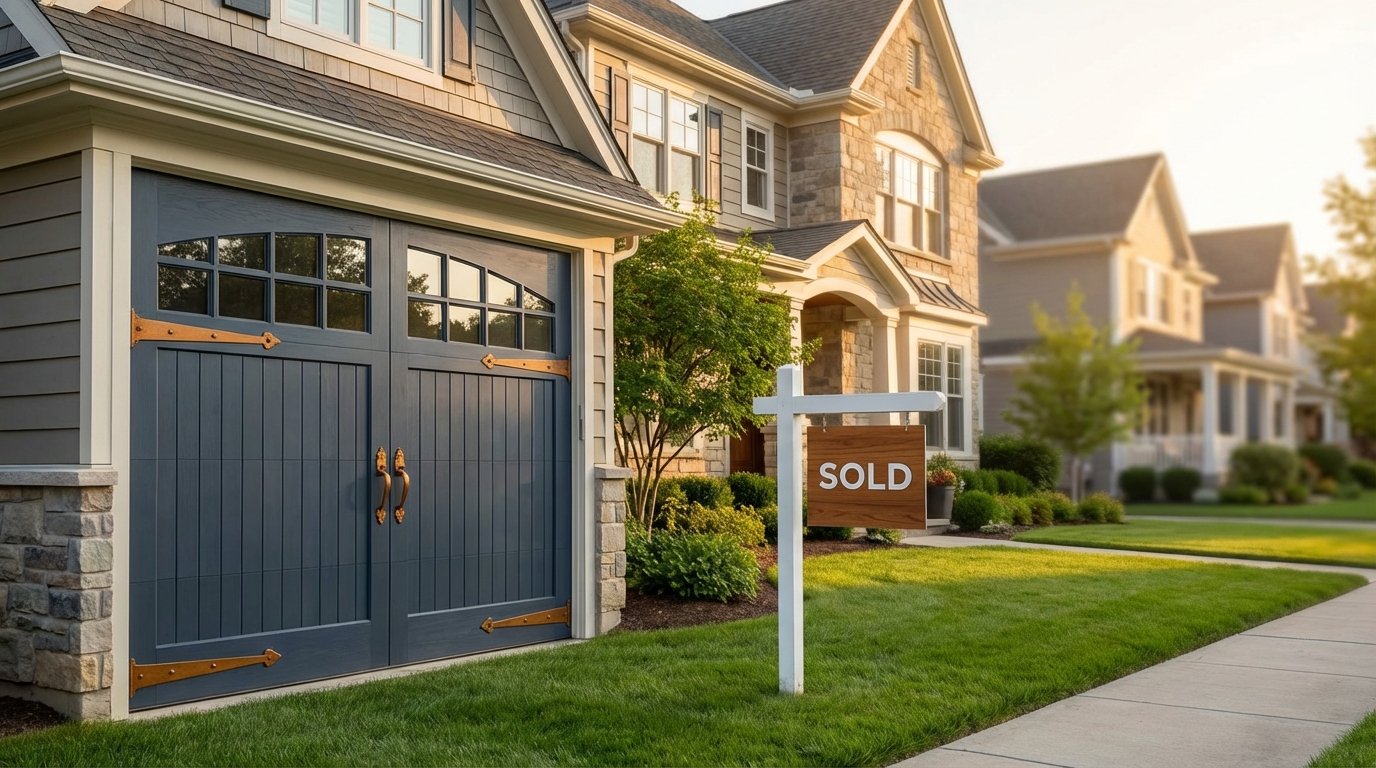
Multiple industry studies consistently rank garage door replacement among the highest-ROI exterior upgrades. Because the garage door can account for up to 30 percent of a home’s visible facade, upgrading from a plain raised-panel door to a carriage house design creates an immediate visual transformation. The payoff is strongest when the door style, color, and window pattern are coordinated with the home’s architectural language. A Mediterranean revival home benefits from arched windows and iron-look hardware; a Craftsman bungalow pairs well with square-pane windows and simple stile-and-rail patterns. Mismatched styles, on the other hand, can actually hurt curb appeal.
What San Antonio Homeowners Are Saying
“The spring on my garage door broke and they were able to come out within an hour. Very professional service and fair pricing.”
“Excellent experience from start to finish. They helped me select the right door design and the installation was completed in one day.”
“My garage door spring broke on a Saturday morning. They came out the same day and fixed it quickly. Great service!”
“Professional commercial garage door repair. They understood the urgency for our business and minimized our downtime.”
Which Windows Best Complement a Carriage House Design?
Window placement typically follows the top section of the door, mimicking the transom windows found on historical carriage houses. Popular glazing choices include clear glass for maximum light, frosted glass for privacy, and seeded (wavy) glass for a period-authentic look. Divided-light grilles — either true or snap-in — add character. In Texas, consider low-E coated glass to reduce solar heat gain without sacrificing natural light. If your garage faces west or south, the UV load through uncoated glass can heat the interior significantly and fade stored items.
A Practical Checklist Before You Buy
| Decision Point | Question to Answer | Why It Matters |
|---|---|---|
| Mechanism | Overhead or swing-out? | Determines driveway clearance needs and opener compatibility |
| Material | Steel, wood, composite, or fiberglass? | Affects maintenance frequency, weight, and cost |
| Insulation | What R-value does your climate and usage demand? | Impacts energy bills and garage comfort |
| Wind Rating | Does your county require TDI-approved products? | Affects insurance eligibility and storm safety |
| Windows | Decorative glass, frosted, or impact-rated? | Balances aesthetics, privacy, and code compliance |
| Hardware | Functional hinges or decorative-only? | Wrong placement can block panel movement |
| Budget | Stamped or overlay construction? | Determines visual depth and long-term maintenance |
Why Local Expertise Matters for Carriage House Installations
A carriage house garage door is heavier, more complex, and more design-sensitive than a basic raised-panel door. Proper installation requires precise spring calibration to handle the added weight, correct alignment of decorative hardware so it clears the weatherseal, and verification that the chosen model meets local building codes and wind-load requirements. Texas Pros Garage Doors brings hands-on familiarity with regional conditions — from the intense UV exposure in the Hill Country to the high-wind mandates along the Gulf Coast. That local knowledge translates into doors that look right, function reliably, and stay compliant with TDI standards for years after installation.
“Called on a Sunday evening when my opener stopped working. They came out the same night and got everything working again. Outstanding service!”
Frequently Asked Questions
Ready to Transform Your Home’s First Impression?
Which carriage house style would bring out the best in your home — a rustic barn-inspired design, an elegant overlay with arched windows, or a clean modern take on the classic? The right answer depends on your architecture, your budget, and the specific demands of your Texas location.
(210) 469-9003
Schedule Your Free Consultation
Serving San Antonio Since 2006
Free No-Obligation Estimates

Recent Comments