
Estimated reading time: 12 minutes
Your garage door can account for up to 40 percent of your home’s visible facade. That single surface shapes how neighbors, visitors, and potential buyers perceive the entire property. When a builder-grade door starts to fade, dent, or simply look dated, the impact goes far beyond aesthetics — it affects curb appeal, insulation performance, and even home security. For San Antonio homeowners who want more than a catalog pick, custom garage doors offer a practical path to a door that fits the exact opening, matches the architectural style, and performs in South Texas heat. This guide walks through materials, pricing factors, design options, insulation choices, safety standards, and the full installation process so you can make a confident decision before requesting a quote.
Key Takeaways
- Custom garage doors are engineered to fit non-standard openings and match your home’s architectural style, providing superior aesthetics and performance over stock units.
- Material selection is critical in San Antonio’s heat — insulated steel and composite options offer the best value-to-performance ratio with minimal maintenance.
- Insulation with proper weatherstripping dramatically reduces heat transfer, road noise, and energy costs for garages adjacent to living spaces.
- Professional measurement, spring calibration, and safety sensor alignment are essential for safe operation — especially with heavier custom doors.
- Planning six to eight weeks ahead of your target date ensures time for design consultation, manufacturing, and stress-free installation.
▼
- What Exactly Makes a Garage Door “Custom”?
- How Much Do Custom Garage Doors Cost in San Antonio?
- Are Custom Garage Doors Really Worth the Investment?
- Which Material Performs Best in San Antonio’s Heat and Humidity?
- A Common Mistake: Ignoring Annual Maintenance by Material
- Insulated vs. Non-Insulated: Which One Makes Sense Here?
- What R-Value Should You Look For?
- Scenario: Your Opening Is Oversized or Non-Standard
- Windows in a Custom Door: Do They Help or Hurt?
- Five Mistakes That Drive Up Cost and Delay Your Custom Project
- How the Design Process Works
- Which Design Styles Are Most Requested Right Now?
- Your Pre-Order Checklist
- From Measurement to Final Test: Professional Installation
- Safety and Structural Standards
- How Long Should You Expect the Process to Take?
- Frequently Asked Questions
What Exactly Makes a Garage Door “Custom”?
A custom garage door is built or configured to your specifications rather than pulled off a warehouse shelf in a standard size and color. The customization can be as simple as choosing a non-standard width or as involved as selecting the wood species, panel profile, window layout, hardware finish, and insulation core. The result is a bespoke garage door engineered to fit a specific architectural opening and style preference — something a mass-produced unit cannot guarantee.
Custom made doors matter most when the opening is an unusual dimension, when the home’s design calls for a unique garage design that echoes Spanish Colonial arches or sleek mid-century lines, or when performance requirements such as heavy insulation or wind-load resistance exceed what off-the-shelf models deliver. In every case, the goal is a balance between artistic expression and structural integrity.
How Much Do Custom Garage Doors Cost in San Antonio?
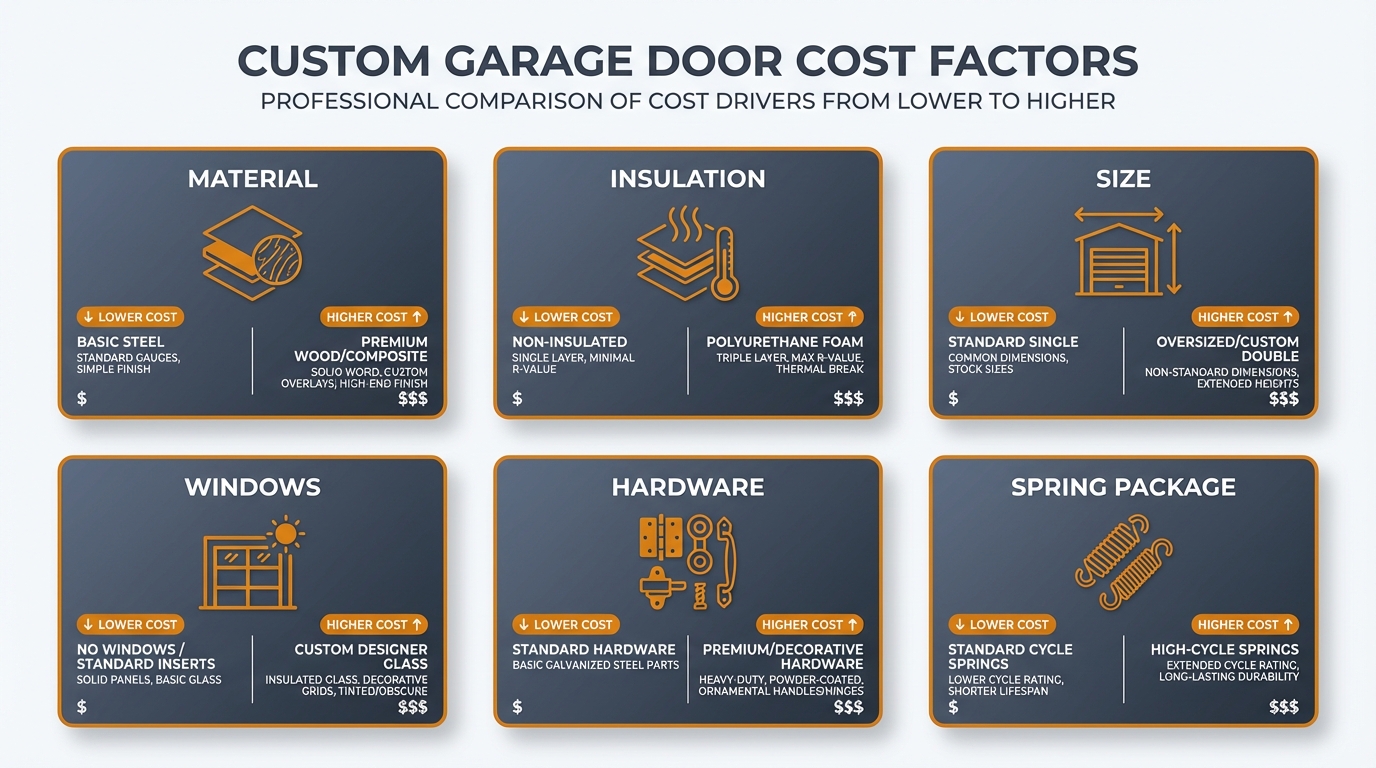
Pricing for custom garage doors in San Antonio varies widely because every project combines different variables. A basic steel door with a single custom color and standard insulation sits at the lower end, while a full solid-wood carriage house door with hand-forged hardware, insulated glass windows, and a high-cycle spring package sits at the upper end. Rather than quoting a single number that may not apply to your project, it helps to understand which factors move the price the most.
What Drives the Final Number Up or Down?
| Cost Factor | Lower-Cost Choice | Higher-Cost Choice |
|---|---|---|
| Material | Steel with vinyl overlay | Solid cedar or mahogany |
| Insulation | Polystyrene (R-6 to R-9) | Injected polyurethane (R-12 to R-18+) |
| Size | Standard single or double | Oversized, extra-tall, or RV-width |
| Windows | No windows | Multiple insulated, frosted, or decorative panels |
| Hardware | Basic hinges and handles | Hand-forged clavos, decorative straps |
| Spring Package | Standard-cycle torsion springs | High-cycle (25,000+) rated springs |
| Opener Compatibility | Existing opener works | New heavy-duty or wall-mount opener needed |
The most reliable way to get an accurate number is to schedule a free on-site estimate where a technician measures, reviews your opener and track setup, discusses style preferences, and provides a transparent, itemized quote — no guessing required. Texas Pros Garage Doors offers exactly that kind of detailed assessment for San Antonio homeowners considering bespoke garage doors.
Get Your Free Custom Garage Door Estimate
Our design specialists measure, consult, and quote on-site at no charge. See exactly what your dream door will cost before committing.
(210) 469-9003
Schedule Free Estimate
4.8 Rating on Google
Licensed & Insured
24/7 Availability
Are Custom Garage Doors Really Worth the Investment?
The honest answer depends on your priorities. If the property is a high-value home where curb appeal directly influences resale price, a unique garage design that matches the architecture can return a significant portion of the investment at sale. Industry data consistently ranks garage door replacement among the highest-ROI exterior projects a homeowner can undertake. Beyond resale, a well-fitted custom door eliminates drafts, reduces road noise, keeps the garage cooler during San Antonio summers, and operates more quietly than a loose-fitting stock unit.
Where custom may not make sense is a rental property or a situation where the existing opening already matches standard sizes and the homeowner simply wants a functional replacement at the lowest possible price. In that scenario, a quality stock door installed professionally may be the smarter move. The key is matching the solution to the actual need rather than defaulting to the cheapest or the most expensive option.
Which Material Performs Best in San Antonio’s Heat and Humidity?
San Antonio’s climate — with average summer highs well above 90 °F, intense UV exposure, and periodic humidity spikes — puts garage door materials to a serious test. Choosing the wrong material leads to warping, fading, peeling, or excessive heat transfer into the garage. Here is how the most common materials compare for bespoke garage doors in this region.
| Material | Heat/UV Resistance | Maintenance | Weight | Best For |
|---|---|---|---|---|
| Insulated Steel | High (with quality finish) | Low | Moderate | Most homes; best value-to-performance ratio |
| Steel with Wood-Grain Overlay | High | Low | Moderate | Wood look without the upkeep |
| Natural Wood (Cedar/Mahogany) | Moderate (needs finish protection) | High (re-stain every 2–3 years) | Heavy | High-end unique garage designs |
| Composite/Faux Wood | High | Low to moderate | Moderate-heavy | Authentic look plus climate resistance |
| Aluminum and Glass | High (anodized frame) | Low | Light | Modern/industrial aesthetic |
The U.S. Department of Energy notes that weatherstripping and air sealing around doors play a critical role in preventing conditioned air from escaping, which means even the best material underperforms if the perimeter seals are neglected (energy.gov). When Texas Pros Garage Doors installs a custom door, the process includes verifying that bottom seals, side seals, and header seals are properly fitted — because the envelope matters as much as the panel itself.
A Common Mistake: Ignoring Annual Maintenance by Material
Many homeowners invest in a beautiful custom made door and then skip basic upkeep, which shortens the door’s life and voids some warranties. Wood doors need periodic re-staining or re-sealing to prevent moisture intrusion. Steel doors benefit from a rinse and wax coat to protect the finish from UV breakdown. Aluminum-and-glass doors require cleaning of the glass and inspection of the rubber gaskets. Regardless of material, lubricating rollers, hinges, and springs once or twice a year keeps the system quiet and reduces wear on the opener.
Insulated vs. Non-Insulated: Which One Makes Sense Here?
In a mild northern climate, skipping insulation might be an acceptable trade-off. In San Antonio, the calculus tilts heavily toward insulated doors for most situations. An insulated door reduces heat transfer into the garage, which matters if there is a bedroom or living space above or adjacent to the garage. It also adds structural rigidity — a steel door with a polyurethane core is far more dent-resistant than a single-layer panel. And the noise reduction is noticeable, especially for homes on busy streets.
A non-insulated door may still be appropriate for a detached workshop or a property where the garage is never connected to conditioned space and the homeowner prioritizes budget. Even then, the price difference between a basic insulated panel and a non-insulated one is often modest enough that most San Antonio homeowners choose insulation.
Why Seals and Weatherstripping Matter as Much as the Core
A door rated at R-16 still leaks energy if the bottom seal is cracked, the side jamb seals are missing, or the header seal has compressed over time. The Department of Energy emphasizes that air sealing should accompany any insulation effort for meaningful results (FTC – Home Insulation Guide). During every installation, Texas Pros technicians inspect and replace weatherstripping as needed so the insulation value printed on the spec sheet actually translates to real-world performance inside the garage.
What R-Value Should You Look For?
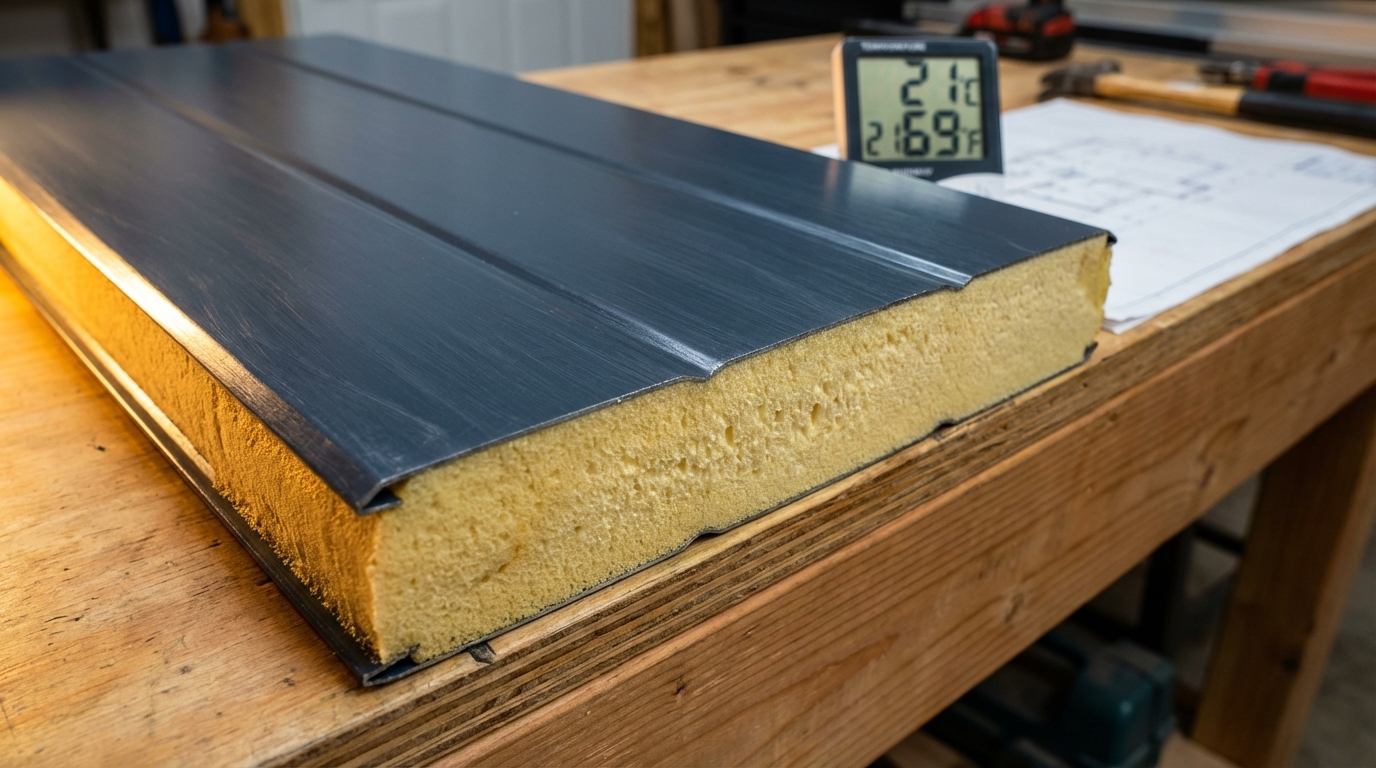
There is no universal “magic number.” The right R-value depends on how the garage is used and whether conditioned spaces share walls or ceilings with it. A garage that serves only as vehicle parking with no shared walls may do fine with R-8 to R-12. A garage with a bonus room above, a home office adjacent, or one that doubles as a workshop benefits from R-12 to R-18. Going beyond R-18 delivers diminishing returns unless the garage is fully climate-controlled.
Be cautious when comparing R-values across brochures. Some manufacturers test only the insulation core, while others test the entire door assembly, which includes the steel skins and thermal breaks. The FTC’s R-Value Rule requires honest disclosure, but the context of the test matters. Ask your installer whether the stated value is for the core alone or the full section — a small detail that changes the comparison significantly.
Not Sure Which Insulation Level You Need?
Our technicians evaluate your garage layout, shared walls, and usage to recommend the right R-value — no upselling, just honest guidance.
Scenario: Your Opening Is Oversized or Non-Standard — Now What?
RV bays, historic carriage houses, and commercial-style residential buildings often have openings that exceed standard garage door dimensions. A custom garage door handles this, but the engineering goes deeper than just cutting a bigger panel. A wider door needs internal bracing — called struts — to prevent wind flex and sagging. A taller door requires longer vertical tracks and may demand a different spring configuration to manage the additional weight safely.
Spring calibration for oversized doors is a high-risk task that involves components under extreme tension. This is not a DIY project. Professional measurement, correct spring sizing, and a post-installation balance test are essential to ensure the door lifts evenly and the opener is not strained. DASMA (the Door & Access Systems Manufacturers Association) publishes standards including ANSI/DASMA 108 for wind-load testing that apply to doors of all sizes, and compliance becomes even more critical as door area increases (DASMA – Codes and Wind Loads).
Windows in a Custom Door: Do They Help or Hurt?
Adding windows transforms a flat garage door into an architectural feature and brings natural light into an otherwise dark space. However, glass is a weaker insulator than a solid panel, and clear windows at eye level can compromise privacy. The practical solution is positioning windows in the top row of panels, choosing insulated glass units, and selecting frosted or tinted glazing for privacy without sacrificing light.
Tempered or impact-rated glass is recommended for security and safety. Decorative grille inserts — either between the glass panes or applied on the surface — add character while reinforcing the glass against breakage. When specifying windows for custom garage doors in San Antonio, balance the amount of glass with the door’s overall thermal and security performance rather than adding windows in every panel simply because you can.
Five Mistakes That Drive Up Cost and Delay Your Custom Project
Ordering a custom door without proper preparation leads to avoidable headaches. The first mistake is skipping a professional measurement and relying on rough dimensions — even half an inch matters for fit and seal. Second, overlooking headroom and side-room clearance means the chosen track configuration may not work in the existing garage structure. Third, choosing a heavy material like solid hardwood without confirming that the opener has enough horsepower to lift it safely creates a mismatch that requires a costly opener upgrade after the fact.
Fourth, forgetting to ask about lead time leaves homeowners frustrated when the door takes weeks longer than expected because a custom finish or glass type is on backorder. Fifth, neglecting to verify whether a building permit is required wastes time and can result in fines. In San Antonio, structural changes may trigger a permit requirement through the Development Services Department, and neighboring municipalities like Alamo Heights have their own rules (Alamo Heights Permits).
How the Design Process Works — From Inspiration to Final Selection
Creating a unique garage design starts with context: what does the house look like, what style are you drawn to, and what functional requirements must the door meet? A Tuscan-style home in the Dominion might call for a carriage house door with arched windows and wrought-iron clavos. A modern Hill Country build in Boerne might suit a flush aluminum-and-glass panel with clean horizontal lines. A traditional ranch-style home in Helotes might look best with a raised-panel steel door in a warm wood-grain finish.
The customization options break into several layers. Panel configuration sets the overall aesthetic — carriage house, flush, or recessed. Window placement and glass type control light and privacy. Decorative hardware adds hand-crafted detail. Color and finish tie the door to the rest of the exterior palette. Reviewing premium overhead garage door styles is a helpful starting point for understanding how different panel layouts and mechanisms affect both appearance and function.
Which Design Styles Are Most Requested Right Now?
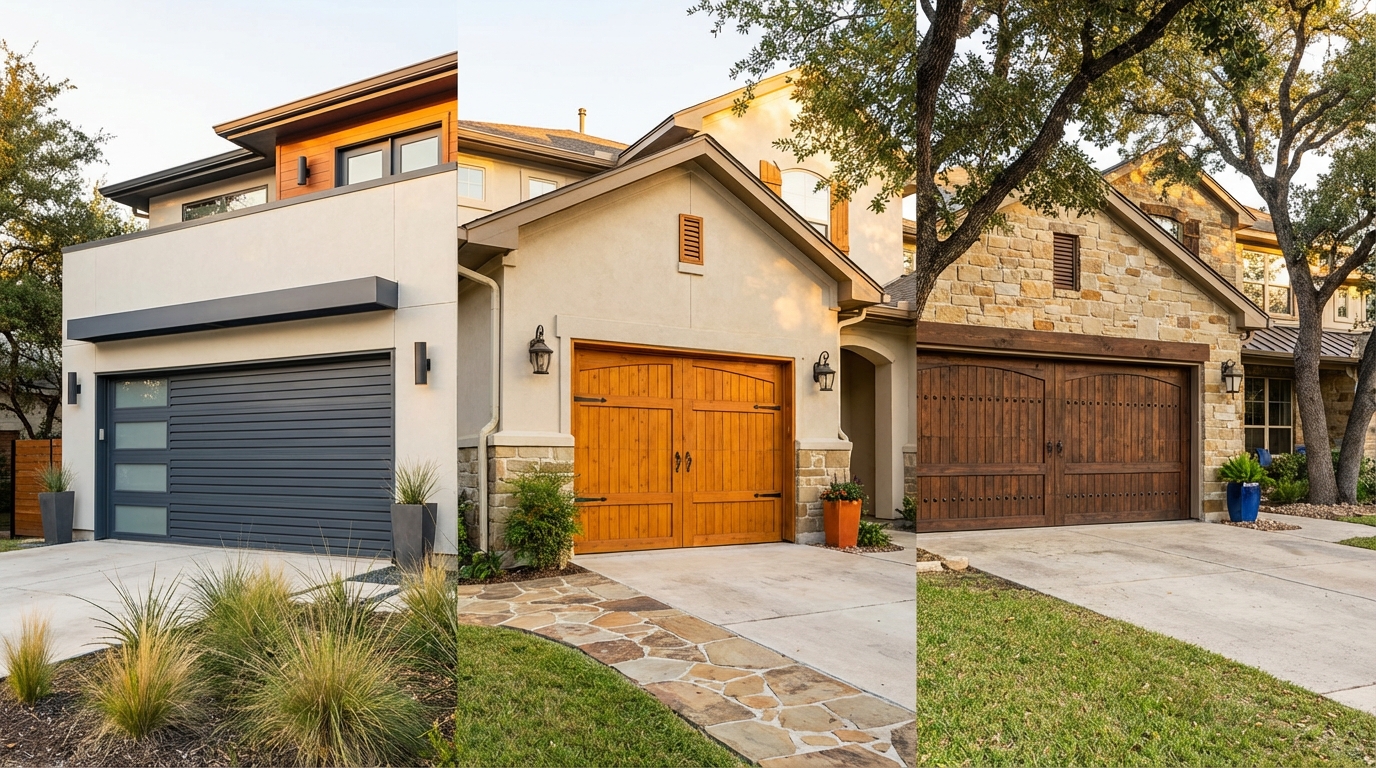
Across the San Antonio market, three broad categories dominate requests for bespoke garage doors. Modern contemporary — characterized by clean lines, horizontal slat patterns, and glass sections — continues to grow in popularity alongside the modern farmhouse and transitional home trends. Carriage house style remains a strong choice for homeowners who want warmth and tradition, especially in established neighborhoods. And “Texas rustic,” which blends stained wood textures with black iron hardware, appeals to Hill Country properties where the home is meant to complement the natural landscape.
What matters more than trend-chasing is coherence. A door that clashes with the home’s roofline, stone, or trim looks worse than a simpler door that fits. A professional designer or experienced installer can spot mismatches early and suggest adjustments before materials are ordered.
Your Pre-Order Checklist: What to Verify Before Committing
Before signing off on a custom garage door order, confirm these critical items. Measure the opening width and height precisely, and note the headroom (distance from the top of the opening to the ceiling) and side room on each side. Determine whether the ceiling has obstructions — lights, HVAC ducts, storage platforms — that affect track routing. Decide on the intended use of the garage: pure parking, workshop, home gym, or living-adjacent storage. Clarify your insulation requirement based on shared walls or rooms above. Check whether your current opener can handle the new door’s weight; if not, factor in a new opener.
Ask the installer about licensing, insurance, and warranty terms. The FTC advises consumers to verify contractor credentials and get written estimates before any home improvement project to avoid scams (FTC – Avoiding Home Improvement Scams). A custom door often requires a powerful, high-quality opener, so plan ahead for future garage door opener repair and maintenance to keep the entire system running smoothly for years.
From Measurement to Final Test: What a Professional Installation Looks Like
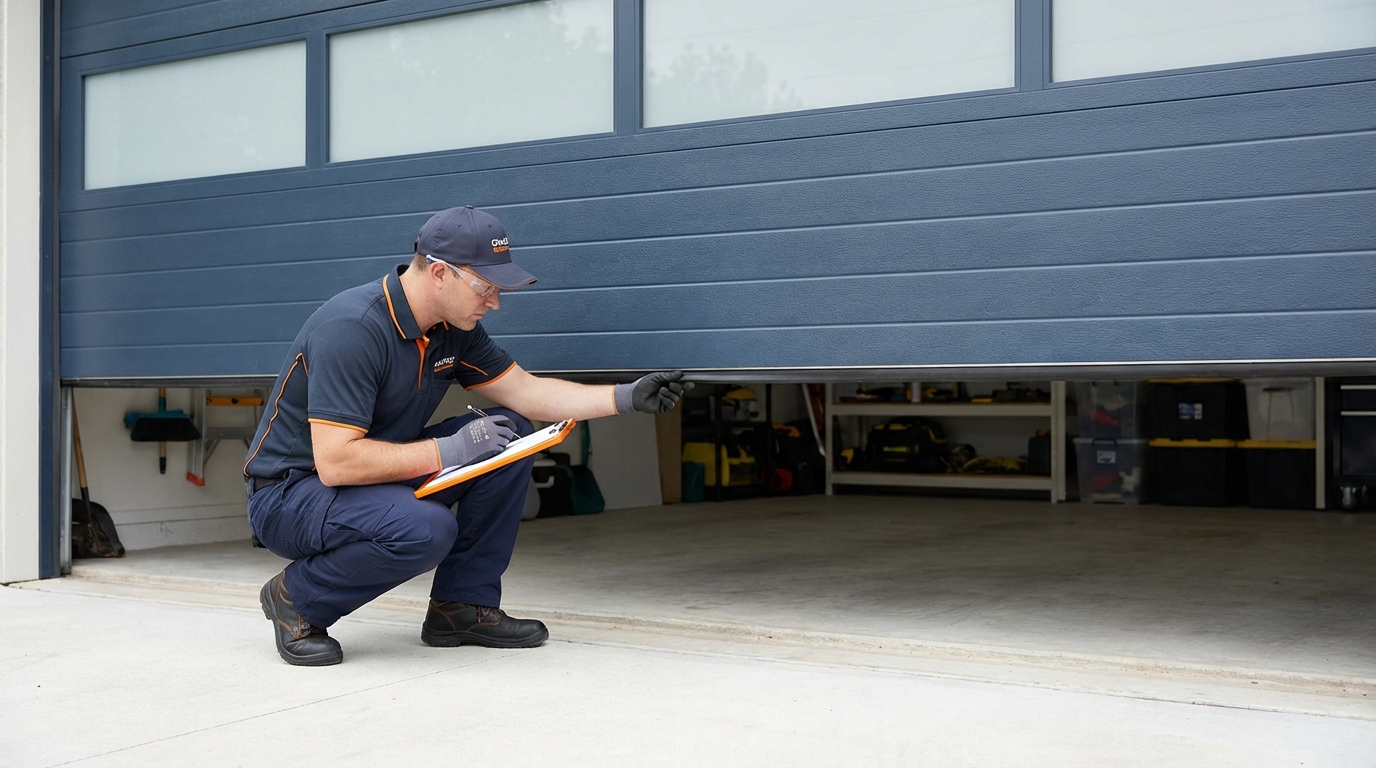
A proper custom garage door installation follows a structured sequence. It begins with an on-site measurement visit where the technician records exact dimensions, inspects the existing framing, and reviews opener compatibility. Next comes a design consultation where materials, colors, windows, hardware, and insulation are selected and priced. After the order is placed, a lead time of several weeks is typical depending on the manufacturer, material, and finish complexity.
On installation day, the crew removes the old door and hardware, inspects and repairs the framing if needed, installs new tracks, mounts the panels section by section, attaches springs, cables, and the opener rail, and then performs a full balance test. Safety sensors are aligned and tested to confirm the door reverses when it contacts an obstruction — a federal safety requirement enforced by the CPSC. The final step is a complete operation test: open, close, manual release, re-engage, and a visual check of all seals and hardware. This is the standard that professional garage door installation services should follow on every job.
What San Antonio Homeowners Say
“The spring on my garage door broke and they were able to come out within an hour. Very professional service and fair pricing.”
“Excellent experience from start to finish. They helped me select the right door design and the installation was completed in one day.”
“My garage door spring broke on a Saturday morning. They came out the same day and fixed it quickly. Great service!”
“Professional commercial garage door repair. They understood the urgency for our business and minimized our downtime.”
Safety and Structural Standards That Apply to Every Custom Door
Custom made doors are not exempt from safety regulations simply because they are unique. Every garage door installed in Texas must comply with entrapment protection standards that require the door to reverse automatically if it contacts a person or object. Additionally, doors in wind-prone zones may need to meet ANSI/DASMA 108 wind-load performance standards, which test how the door withstands static pressure from severe weather. Heavier custom doors demand precisely calibrated torsion springs — a high-tension component that should only be handled by a trained technician.
Texas Pros Garage Doors builds safety verification into every installation, including spring balance testing, sensor alignment, and manual-release operation checks. For homeowners in San Antonio and surrounding areas like New Braunfels, Cibolo, and Selma, this level of thoroughness provides peace of mind that a beautiful door is also a safe one.
How Long Should You Expect the Process to Take?
From first consultation to a fully operational custom garage door, the timeline typically breaks down as follows. The measurement and design consultation can happen within a few days of your initial call. Order and manufacturing lead times range from two to six weeks depending on the material, finish, and complexity — solid wood and specialty glass tend to take longer than insulated steel with a factory finish. The installation itself is usually completed in a single day for a standard residential project, though oversized or multi-door jobs may require two days.
Planning ahead reduces stress. If you know a home sale, HOA deadline, or renovation timeline is approaching, starting the consultation process six to eight weeks in advance gives comfortable margin for design decisions, manufacturing, and scheduling.
“Called on a Sunday evening when my opener stopped working. They came out the same night and got everything working again. Outstanding service!”
Frequently Asked Questions
In some cases, yes. Certain steel and aluminum doors accept aftermarket window inserts in specific panel sections. However, cutting into an existing panel can compromise structural integrity and void the warranty. A professional assessment determines whether a window retrofit is feasible or whether a new custom door with factory-installed windows is the safer and more attractive option.
A straightforward same-size replacement typically does not require a permit, but any structural modification to the opening — widening, raising, or adding a new bay — usually does. San Antonio’s Development Services Department and surrounding cities like Alamo Heights each have their own requirements, so confirm with local authorities or ask your installer to verify before work begins.
A significantly heavier door can strain an undersized opener, leading to premature motor failure. During the design phase, a good installer calculates the new door’s weight and compares it to the opener’s rated capacity. If the opener cannot handle the load, upgrading to a higher-horsepower or wall-mount unit is recommended before or during installation.
Natural wood requires re-staining or re-sealing every two to three years to protect against UV damage and moisture. Between refinishing cycles, inspect for cracks, peeling finish, and swelling at the bottom rail where water contact is most likely. Keep the bottom seal intact and ensure sprinklers are not spraying the door directly.
Polyurethane is injected as a foam that bonds to the steel skins, creating a rigid, high-R-value panel with excellent structural strength. Polystyrene is a pre-formed board inserted between the skins; it provides decent insulation but does not bond to the steel, resulting in a lighter but less rigid panel. For San Antonio’s heat, polyurethane is the preferred choice when performance and durability are priorities.
Yes. During the design consultation, homeowners can specify a color match to their existing trim, stone, or siding. Many manufacturers offer custom color programs where the door is factory-finished in a chosen hue, ensuring a durable and even coating that outlasts field-applied paint.
Ready to Start Designing Your Custom Garage Door?
Choosing a custom garage door is one of the most visible improvements you can make to your San Antonio home — but it starts with the right measurements, the right materials for this climate, and an installer who treats safety and precision as non-negotiable. What would the ideal door look like on your home, and what performance features matter most for the way you actually use your garage? Texas Pros Garage Doors is ready to help you answer those questions with a free, no-pressure on-site consultation. Reach out today to schedule your estimate and take the first step toward a garage door built exactly for your home.
Your Custom Garage Door Starts with a Free Consultation
From material selection to final installation, our team handles every detail. Call now or schedule online to get started with a no-obligation on-site estimate.
(210) 469-9003
Schedule Free Consultation
70+ Five-Star Reviews
Free On-Site Estimates
24/7 Emergency Service

Recent Comments