
Estimated reading time: 12 minutes
Faux wood garage doors give San Antonio homeowners the warm, classic appearance of real wood without the relentless upkeep that Texas heat and humidity demand. Whether your home is a Hill Country limestone ranch, a modern build in Helotes, or a Craftsman-style bungalow near Alamo Heights, upgrading to a wood look garage door can transform your curb appeal and boost your property’s perceived value overnight. The challenge is understanding what you’re actually buying—materials, insulation levels, finishes, and installation requirements all vary widely. This guide walks you through every decision point so you can request an accurate quote, compare options confidently, and end up with a door that looks stunning and performs reliably for years in the San Antonio climate.
Key Takeaways
- Faux wood garage doors deliver realistic wood-grain aesthetics using steel-core or composite materials that resist UV fading, moisture damage, and warping far better than natural wood in San Antonio’s climate.
- Insulated multi-layer options improve energy efficiency, reduce operating noise, and may require upgraded torsion springs and a higher-horsepower opener for safe long-term performance.
- Comparing quotes requires matching specifications line by line—door size, layer count, R-value, finish quality, hardware, and spring/opener compatibility all affect total installed cost.
- High-quality UV-resistant topcoats significantly slow color change, but periodic soft-brush washing and mechanical inspections keep your door looking and functioning like new.
- Professional installation ensures proper spring tension, track alignment, safety sensor function, and structural attachment—critical for both daily safety and wind-load performance.
▼
- The Aesthetic Appeal of Faux Wood Garage Doors
- What Are Faux Wood Garage Doors Made Of?
- Composite Wood vs. Natural Wood Comparison
- Do Faux Wood Garage Doors Really Look Like Wood?
- Common Shopping Mistakes to Avoid
- Durability and Performance in San Antonio
- How Much Do Faux Wood Garage Doors Cost?
- Your Neighbor’s Door Looks Amazing—Now What?
- Insulation and Noise Reduction
- Does a Heavier Door Need a New Opener?
- Will the Finish Fade in Texas Sun?
- Can You Paint or Refinish Faux Wood Doors?
- Safety and Standards
- How Long Do Faux Wood Garage Doors Last?
- Choosing the Right Style for Your Property
- Frequently Asked Questions
Ready to Upgrade to a Stunning Wood-Look Garage Door?
Get a transparent, itemized quote from San Antonio’s trusted garage door experts. Same-day consultations available for most neighborhoods.
(210) 469-9003
Schedule Your Free Estimate
70+ Verified Reviews
Serving San Antonio Since 2006
The Aesthetic Appeal of Faux Wood Garage Doors for Texas Homes
Your garage door can account for up to 40 percent of a home’s front-facing exterior. When that surface mimics the rich grain and warmth of oak, mahogany, or walnut, the visual impact is immediate. Faux wood garage doors achieve this through textured overlays, embossed steel panels, or composite skins that replicate real wood grain down to the knot patterns and color variation between planks.
For San Antonio homes specifically, material choice is critical. Full sun exposure in Texas can raise the effective heat index on exterior surfaces by up to 15 °F compared to shaded areas, according to the CDC/NIOSH Heat Safety Tool. That constant thermal stress accelerates fading and warping in organic materials—which is exactly why so many local homeowners are moving away from natural wood. When you’re ready to make the switch, professional garage door installation services ensure the new door is properly aligned, balanced, and sealed from day one.
What Exactly Are Faux Wood Garage Doors Made Of?
The term “faux wood” is broad. It covers several distinct construction methods, each with different trade-offs in weight, durability, insulation, and cost. Understanding the base material helps you compare quotes accurately and avoid paying for features you don’t need—or missing features you do.
Steel-Core Doors with a Wood-Grain Finish
The most common type uses a galvanized steel base panel that’s been embossed or laminated with a wood-grain texture and then coated with a protective finish. These doors are relatively lightweight, resistant to denting in thicker gauges, and available in single-layer, double-layer, or insulated triple-layer configurations. The realistic wood finish comes from either a high-resolution printed film or a physical texture pressed into the surface during manufacturing.
Composite Wood Doors
Composite wood doors use a core of engineered materials—sometimes including recycled wood fibers bonded with polymers—covered with a durable outer skin. Because the overlay is often molded from actual wood pieces, the texture can be remarkably convincing up close. Composite construction resists moisture penetration, which means less risk of swelling, cracking, or rot compared to solid wood panels.
How Do Composite Wood Doors Compare to Natural Wood?
Natural wood garage doors are undeniably beautiful, but they face serious challenges in the Texas climate. Research from the U.S. Forest Service demonstrates that even visible violet light—not just UV—causes photodegradation in natural wood fibers, breaking down lignin and cellulose and leading to graying, structural weakening, and surface erosion over time. In San Antonio, where doors can face direct southern or western sun exposure for hours each day, that degradation is accelerated dramatically.
Composite and steel-based faux wood doors address this by using polymer coatings engineered to resist UV weathering and oxidation. A study published by the Forest Service on wood-plastic composites with protective cap layers shows that a well-formulated outer layer significantly slows color change and surface oxidation under prolonged UV exposure. The practical result for homeowners is a realistic wood finish that holds its color and depth far longer than bare or stained natural wood.
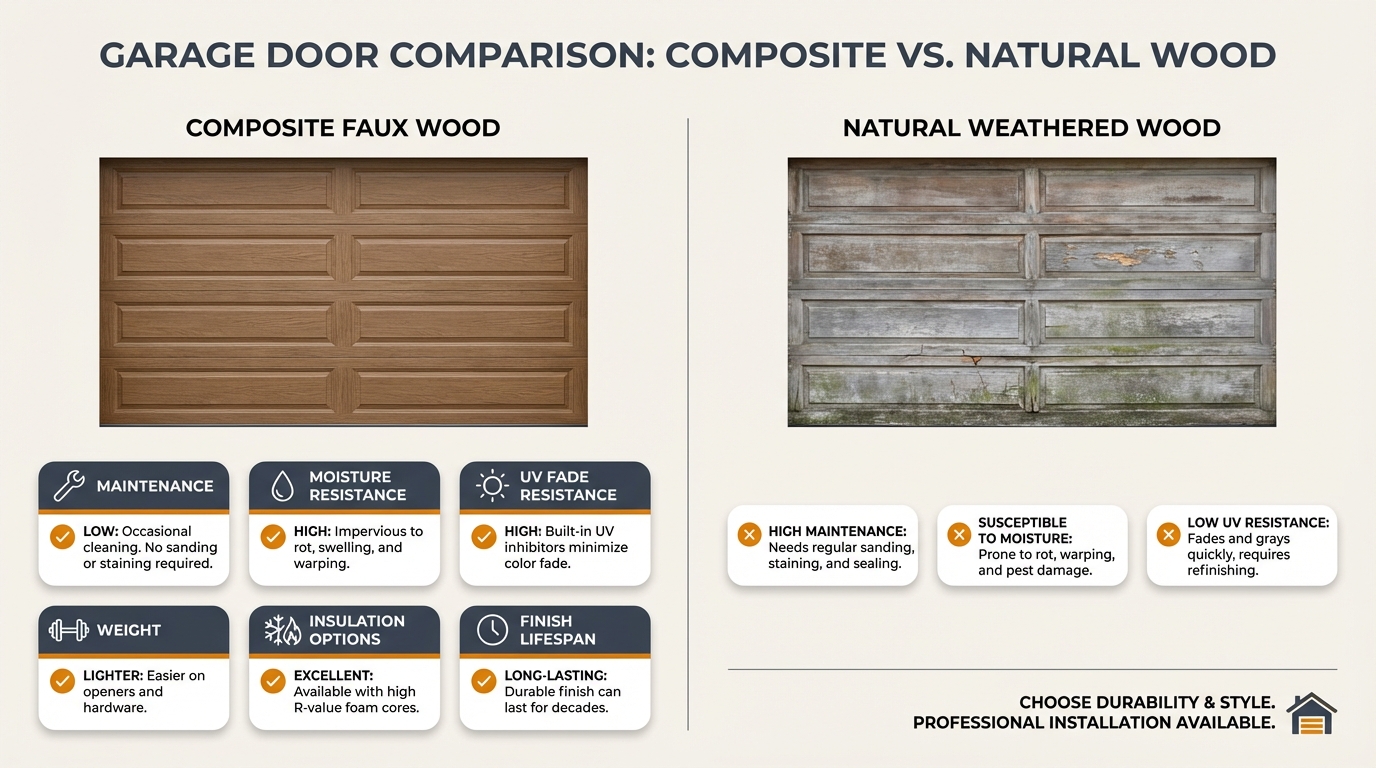
| Feature | Faux Wood (Steel/Composite) | Natural Wood |
|---|---|---|
| Routine maintenance | Soap-and-water wash, occasional hardware check | Sand, stain, and seal every 1–3 years |
| Moisture/rot resistance | High—polymer or steel core does not absorb water | Low to moderate—requires sealant to prevent swelling and rot |
| UV fade resistance | Good to excellent with quality coatings | Poor without frequent re-staining |
| Weight | Moderate (depends on insulation layers) | Heavy—requires robust springs and opener |
| Insulation options | Available in multiple R-value tiers | Limited unless custom-built with insulated core |
| Typical lifespan of finish | Long-term with minimal touch-up | Requires periodic refinishing to maintain appearance |
Do Faux Wood Garage Doors Really Look Like Wood?
This is the question homeowners ask most often, and the honest answer is: it depends on the quality tier you choose. Entry-level wood-grain finishes use a flat printed pattern that can look convincing from the street but may appear artificial up close. Mid-range and premium options use deep embossing—sometimes molded directly from real wood planks—combined with multi-tone color applications that mimic the natural variation you see in genuine hardwood.
When evaluating samples or showroom panels, look for three things. First, check the depth of the grain texture by running your hand across the surface; real wood has irregular grooves, and good faux wood replicates that irregularity. Second, examine color variation between panels—uniform coloring across every plank is a giveaway that the finish is synthetic. Third, ask about the topcoat or clear-coat layer, because that protective finish is what prevents the color from chalking or fading within the first few years of Texas sun exposure.
What Mistakes Do Homeowners Make When Shopping for Wood Look Garage Doors?
The most common mistake is comparing prices without matching specifications. A quote for a single-layer, non-insulated steel door with a printed wood finish will be dramatically lower than a quote for a triple-layer insulated composite wood door with decorative hardware and windows—but those are fundamentally different products. Another frequent error is ignoring spring and opener compatibility. Heavier insulated doors require correctly rated torsion springs and a motor with sufficient horsepower, and skipping that assessment leads to premature wear on every moving part in the system.
A third mistake is assuming “low maintenance” means “no maintenance.” Even faux wood garage doors need periodic attention: weatherstripping wears out, rollers need lubrication, and hardware loosens with daily cycling. Texas Pros Garage Doors helps San Antonio homeowners avoid these pitfalls by walking through the full specification during the estimate process—door size, layer count, insulation R-value, window configuration, hardware style, and spring/opener requirements—so you know exactly what you’re getting before any work begins.
Durability and Performance in the San Antonio Climate
San Antonio’s climate is defined by intense summer heat, periodic high humidity, occasional severe storms, and UV exposure that ranks among the highest in the continental United States. A garage door that performs well here needs to handle thermal expansion and contraction without warping, resist moisture without corroding, and in some cases meet specific wind-load standards.
For homes in designated catastrophe areas or high-wind zones in Texas, garage doors may need to meet ANSI/DASMA 108 standards for structural performance under air pressure differentials, as outlined by the Texas Department of Insurance windstorm program. Even if your San Antonio home isn’t in a coastal catastrophe zone, choosing a door rated for higher wind loads adds a margin of safety during the severe thunderstorms and occasional straight-line wind events common in south-central Texas.
Insulation also plays a larger role than many homeowners expect. According to the U.S. Department of Energy, proper weatherstripping and air sealing around exterior openings are essential for controlling energy loss—and the garage door is typically the largest single opening in any home. An insulated faux wood door with intact bottom and side seals reduces the heat load on your HVAC system and keeps the garage itself more comfortable for daily use. If you notice gaps, worn seals, or increased dust inside your garage, scheduling a checkup for garage door repair in San Antonio can catch small issues before they become expensive energy drains.
How Much Do Faux Wood Garage Doors Cost Installed?
Pricing varies significantly based on a handful of key variables. Rather than quoting a single dollar figure that may not reflect your specific situation, it’s more useful to understand the factors that move the price up or down so you can request and compare estimates intelligently.
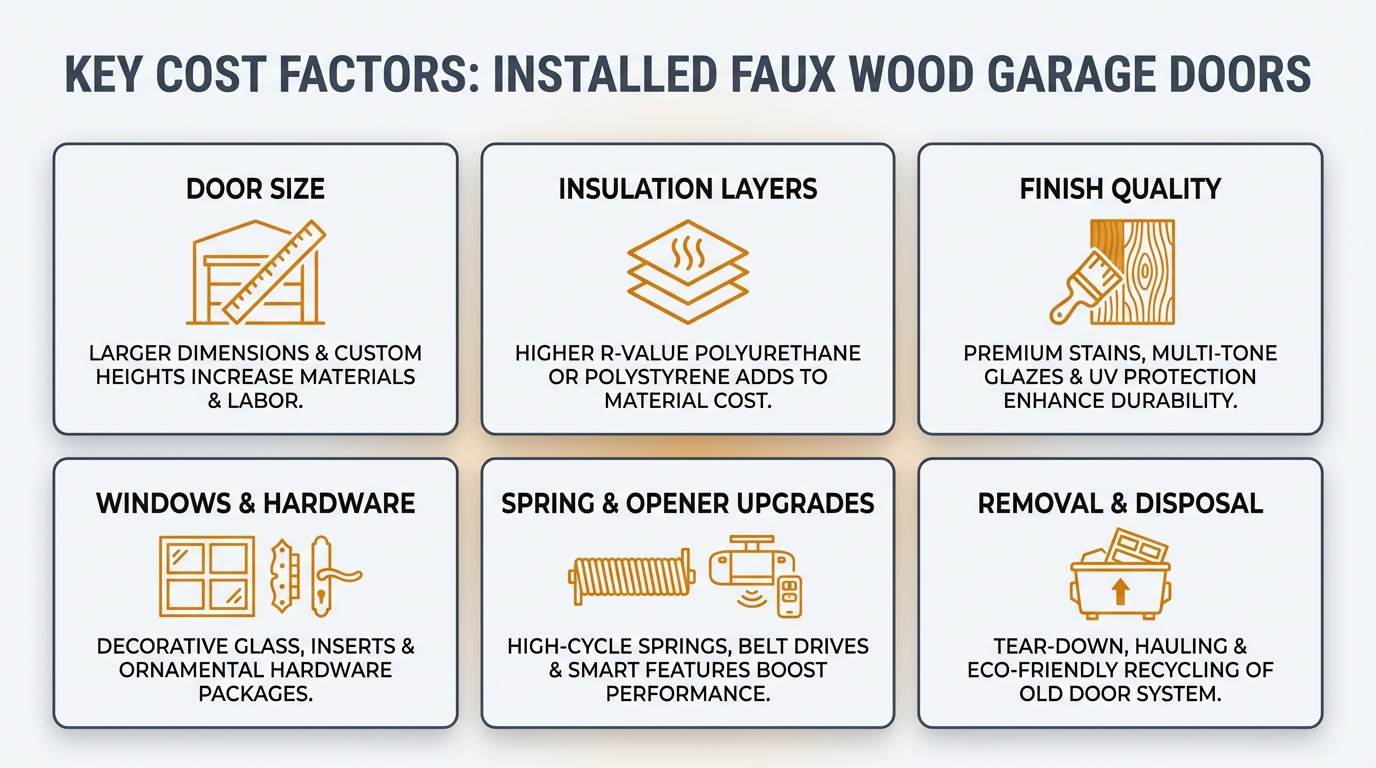
| Cost Factor | How It Affects Price | What to Ask the Installer |
|---|---|---|
| Door size (single vs. double) | Double-wide doors require more material, heavier springs, and a stronger opener | Confirm exact rough opening measurements before quoting |
| Number of layers / insulation | Triple-layer insulated doors cost more but improve energy efficiency and quiet operation | Ask for the R-value and whether polystyrene or polyurethane insulation is used |
| Finish quality | Deep-embossed, multi-tone finishes cost more than flat printed films | Request a physical sample panel, not just a photo |
| Windows and decorative hardware | Each window insert, hinge plate, and handle adds cost | Get pricing with and without windows to see the real difference |
| Spring and opener upgrades | A heavier door may require new torsion springs and a higher-HP opener | Confirm whether the quote includes spring/opener assessment and replacement if needed |
| Removal and disposal of old door | Some quotes exclude this; it can add to the total | Ask if haul-away is included in the installation price |
When comparing quotes from different providers, make sure every line item is apples-to-apples. If one quote includes spring replacement and another doesn’t, the “cheaper” quote may actually cost more once the hidden extras are added. Texas Pros Garage Doors provides transparent, itemized estimates that list every component so homeowners can make a clear-eyed comparison.
Need Help Comparing Your Options?
Our team walks you through every specification and cost factor so there are no surprises. Get a transparent, itemized estimate for your San Antonio home.
A Common Scenario: Your Neighbor’s New Door Looks Amazing—Now What?
You’ve seen a stunning wood-grain door on a house down the street and you want the same look. Before calling for a quote, take a few minutes to gather basic information that will make the process faster and more accurate. Measure your garage opening width and height. Note how many cars the garage holds. Check whether your garage is attached to the house or detached, because that affects insulation recommendations. Look at the direction the garage faces—south- and west-facing doors take the most sun punishment. Finally, decide whether you want windows and what level of privacy you need, because frosted, tinted, and clear glass inserts each have different price points.
Armed with those details, you’ll get a more precise estimate and waste less time on back-and-forth. This kind of prepared approach is something the team at Texas Pros Garage Doors encourages because it leads to better-matched recommendations and fewer surprises on installation day.
Are Faux Wood Garage Doors Insulated and Quieter?
Insulated faux wood doors are available in a range of R-values. The insulation core—typically polystyrene (rigid board) or polyurethane (injected foam)—sits between the outer decorative face and an inner backing panel. Polyurethane fills the entire cavity and bonds to both skins, which adds structural rigidity and reduces vibration noise during operation. Polystyrene boards are effective but don’t bond to the skins, so the door may feel slightly less solid.
For a garage attached to a living space—especially if there’s a bedroom, office, or bonus room above—insulation isn’t just about temperature. It dampens the sound of the door cycling, reduces the “tin can” resonance that single-layer steel doors produce, and minimizes heat transfer into the conditioned envelope. The U.S. Department of Energy notes that insulating and sealing between a garage and conditioned space can meaningfully improve both comfort and indoor air quality.
Does a Heavier Door Mean You Need a New Opener?
Possibly. Multi-layer insulated faux wood doors can weigh considerably more than a basic single-skin steel panel. If your existing opener was sized for a lightweight door, adding a heavier replacement without upgrading the motor and springs is a safety and longevity risk. The opener strains under the extra load, cycles shorten, and the torsion springs—already under extreme tension—can fail prematurely.
A professional installation should always include a spring calculation and opener assessment matched to the new door’s weight and size. If the opener needs upgrading, that’s also an opportunity to move to a quieter belt-drive unit with modern safety features. For questions about whether your current system is compatible, garage door opener maintenance from a qualified technician can provide a clear answer before the new door arrives.
Will the Finish Fade in the Texas Sun?
Some degree of color change over many years is normal for any exterior surface, but the rate and severity depend on the quality of the protective topcoat. High-quality faux wood finishes include UV-stabilized coatings that dramatically slow the photodegradation process. Lower-cost finishes may begin to show noticeable lightening or chalking within a few years of unshielded southern exposure.
To minimize fading, choose a door with a documented UV-resistant topcoat. Avoid cleaning with abrasive chemicals or pressure washers set too high, because stripping the clear coat accelerates degradation. A gentle wash with mild detergent and a soft brush once or twice a year removes dust and pollen buildup that can trap moisture against the finish. If your home allows, even partial shading from a porch overhang or mature tree canopy on the west side of the garage can reduce direct sun hours and extend the finish’s appearance significantly.
Can You Paint or Refinish Faux Wood Garage Doors?
In many cases, yes—but check the manufacturer’s guidance first. Some composite doors accept exterior-grade latex paint well, allowing you to change color or touch up chips. Steel-based doors with a factory-applied film may not bond well with standard paint unless the surface is properly prepared. Applying the wrong product can cause peeling, bubbling, or uneven adhesion that looks worse than the original wear.
If you want the option to refresh the color years down the road, ask about paintability before purchasing. A door that accepts touch-up paint gives you longer usable life from the same panels, which is a practical advantage in a high-UV environment like San Antonio.
What San Antonio Homeowners Say
Google Review
“The spring on my garage door broke and they were able to come out within an hour. Very professional service and fair pricing.”
Google Review
“Excellent experience from start to finish. They helped me select the right door design and the installation was completed in one day.”
Google Review
“My garage door spring broke on a Saturday morning. They came out the same day and fixed it quickly. Great service!”
Google Review
“Professional commercial garage door repair. They understood the urgency for our business and minimized our downtime.”
Safety and Standards for Your New Garage Door
A garage door is the largest moving object in most homes, and a faux wood door—especially an insulated multi-layer model—can weigh several hundred pounds. Professional installation isn’t a luxury; it’s a safety requirement. Torsion springs store enough energy to cause serious injury if handled improperly. Track alignment must be precise to prevent binding or derailment. And federal safety standards require that every automatic opener include photo-eye sensors that reverse the door if an obstruction is detected in the doorway, as noted by the U.S. Consumer Product Safety Commission.
Proper attachment of the door jambs to the building frame is also essential for wind-load performance and long-term structural integrity. DASMA technical data sheets emphasize that the connection between the door assembly and the wall framing is a critical link in the load path during high-wind events. When Texas Pros Garage Doors installs a new door, the process includes verifying that the header, jambs, tracks, springs, opener, and safety sensors all function as an integrated system—not just swapping panels and walking away.
How Long Do Faux Wood Garage Doors Last?
The decorative panels on a quality faux wood door can last decades without structural failure. What typically wears out first are the mechanical components: torsion springs (rated for a finite number of cycles), rollers, hinges, weatherstripping, and opener gears. A homeowner who invests in a premium door but neglects routine mechanical maintenance may end up with a beautiful door that doesn’t operate smoothly or safely.
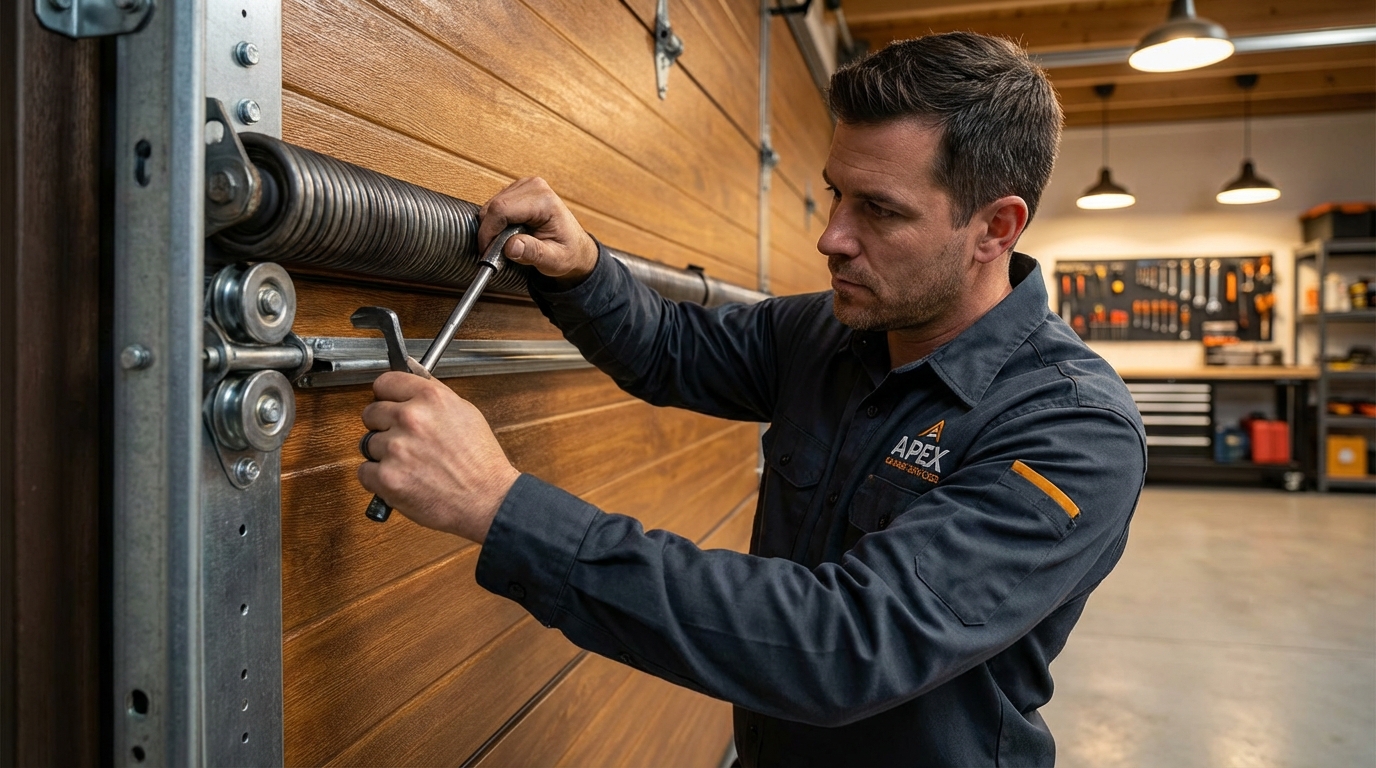
The practical takeaway is that door longevity is a combination of material quality and ongoing care. Annual or biannual inspections of springs, cables, rollers, and seals keep the system operating quietly and safely. Texas Pros Garage Doors offers maintenance-focused service calls that address these wear items before they cause a breakdown—helping San Antonio homeowners protect their investment in a door that looks and works like new for the long haul.
Choosing the Right Style for Your Texas Property
Selecting a faux wood garage door involves matching the door’s design language to your home’s architecture. A few practical guidelines make the decision easier. If your home features warm-toned stone, brick, or stucco, deeper wood tones like walnut or mahogany tend to complement the facade naturally. For modern or transitional homes with clean lines, horizontal plank patterns in lighter tones—or even a weathered gray driftwood finish—create a contemporary feel while still offering that wood-look warmth.
Hardware choices matter too. Decorative strap hinges and ring handles add a carriage-house character that suits traditional and rustic styles. Minimalist homes often look best with flush panels and no visible hardware. Windows introduce natural light into the garage and add architectural interest, but they reduce privacy and may slightly lower insulation performance depending on the glass type. Frosted or obscured glass inserts offer a middle ground between light and privacy.
| Home Style | Recommended Panel Pattern | Suggested Finish Tone | Hardware Style |
|---|---|---|---|
| Hill Country / Ranch | Vertical plank or carriage house | Medium walnut or cedar | Decorative strap hinges and handles |
| Modern / Contemporary | Horizontal flush plank | Light oak, driftwood gray, or dark espresso | Minimal or concealed |
| Craftsman / Bungalow | Recessed panel with window row | Warm mahogany or cherry | Square plate hinges and ring pulls |
| Mediterranean / Stucco | Arched top or carriage overlay | Dark walnut or rustic pecan | Iron-look decorative hardware |
Google Review
“Called on a Sunday evening when my opener stopped working. They came out the same night and got everything working again. Outstanding service!”
Frequently Asked Questions About Faux Wood Garage Doors
“Wood look” describes the visual finish—any door designed to mimic the appearance of real wood. “Composite wood” describes the construction material itself, a blend of wood fibers and polymers. A composite wood door will have a wood look, but not every wood look door is composite; some use embossed steel with a printed or laminated finish instead.
For homeowners who value curb appeal and want reduced long-term maintenance compared to real wood, the premium over a basic steel door is generally justified. The gap narrows further when you factor in the staining, sealing, and repair costs that natural wood demands every few years in a climate like San Antonio’s.
Yes, though it’s minimal. A soft-brush wash with mild soap twice a year removes grime and prevents buildup that can trap moisture. You should also inspect weatherstripping, rollers, and hinges seasonally, and listen for unusual noises that may indicate a spring or balance issue.
Some door models support after-market window inserts in designated panel sections. However, cutting into a panel that wasn’t designed for windows can compromise structural integrity and void the warranty. It’s best to specify windows at the time of purchase.
A qualified technician can test your opener’s lifting capacity and evaluate whether the existing torsion springs are rated for the new door’s weight. If either component is undersized, upgrading before or during installation prevents premature failure and safety hazards.
Garage door replacement consistently ranks among the highest-ROI home improvement projects in national remodeling cost-vs-value studies. A realistic wood finish elevates the perceived quality of the home’s exterior, which can positively influence buyer impressions and appraisal outcomes.
Ready to See How a Wood-Look Door Would Transform Your Home?
Choosing the right faux wood garage door involves balancing aesthetics, performance, insulation, and budget—and the best way to get clarity is a professional on-site assessment tailored to your home’s dimensions, sun exposure, and architectural style. Have you measured your opening, considered your insulation needs, and thought about which wood tone complements your facade? If so, the next step is a conversation with a local team that can walk you through samples, specifications, and transparent pricing. Reach out to Texas Pros Garage Doors today to request a free estimate and see what’s possible for your San Antonio home—get in touch here.
Transform Your Curb Appeal With a Faux Wood Garage Door
San Antonio homeowners trust Texas Pros Garage Doors for transparent pricing, expert installation, and doors that look incredible for years. Call now or schedule online.
(210) 469-9003
Get Your Free Estimate Today
Serving San Antonio Since 2006
24/7 Emergency Service

Recent Comments