
Estimated reading time: 12 minutes
When a warehouse loading dock in San Antonio takes a direct hit from a severe thunderstorm, the weakest point in the building envelope is often the garage door. That single opening can determine whether inventory stays dry and operations resume in the morning — or whether structural damage cascades through the entire facility. For commercial property owners across Texas, steel garage doors represent far more than an entry point; they are a critical line of defense against weather, theft, and energy loss. Understanding the engineering, compliance standards, and maintenance demands behind these systems is essential before committing to any purchase or installation.
Key Takeaways
- Steel gauge directly affects dent resistance and maximum span width — choose 22-gauge or heavier for high-traffic commercial bays with forklift activity.
- Texas wind-load compliance (TDI and DASMA 108) is mandatory in designated zones and can void insurance if ignored.
- U-factor provides a more accurate measure of real-world thermal performance than R-value alone when comparing insulated steel doors.
- High-cycle spring ratings (50,000+) dramatically reduce long-term maintenance costs for busy loading docks cycling 30-50 times daily.
- Quarterly corrosion inspections and bottom-seal replacement are the simplest ways to extend the lifespan of commercial steel garage doors by years.
▼
- Why Are Steel Garage Doors the Preferred Choice?
- What Does Steel Gauge Actually Mean?
- Sectional Steel Panels vs. Roll-Up Coiling Doors
- Ignoring Wind-Load Compliance in Texas
- Insulated vs. Non-Insulated Steel Doors
- Why U-Factor Is More Reliable Than R-Value
- Polyurethane vs. Polystyrene Insulation
- How Cycle Rating Determines Your Maintenance Budget
- Do Steel Garage Doors Rust?
- Safety Standards Every Texas Business Owner Should Verify
- Finish Options for Commercial Metal Garage Doors
- Preparing Before Requesting a Quote
- Frequently Asked Questions
Need a Commercial Steel Garage Door Installed or Repaired?
Texas Pros Garage Doors provides expert commercial garage door solutions across San Antonio. Same-day service available for urgent situations.
(210) 469-9003
Get a Free Quote Today
70+ Verified Reviews
Since 2006
Why Are Steel Garage Doors the Preferred Choice for Commercial Facilities?
Steel delivers a strength-to-weight ratio that few other materials can match in a commercial garage door application. Compared to wood or aluminum, metal garage doors resist denting from forklifts and pallet jacks, tolerate UV exposure without warping, and accept a wide range of finishes that maintain a professional appearance over years of daily cycling. The material also supports modular panel construction, meaning individual damaged sections can be replaced without scrapping the entire door — a practical advantage that directly reduces total cost of ownership.
Modern steel panel doors have evolved well beyond bare metal slabs. Today’s commercial offerings include embossed textures, powder-coated color matching, and vision-panel inserts that bring natural light into work bays. The transition from traditional materials to engineered metal garage doors has accelerated in Texas specifically because these doors can be manufactured to meet strict regional wind-load codes while still offering aesthetic flexibility for storefronts and mixed-use developments.
Even the most durable garage doors, however, depend on consistent maintenance. Springs fatigue, seals degrade, and hardware loosens under vibration. Businesses that pair quality steel doors with access to professional commercial garage door repair services protect their investment and minimize unplanned downtime that disrupts logistics schedules.
What Does Steel Gauge Actually Mean — and Which Thickness Do You Need?
Steel gauge is an inverse measurement: the lower the number, the thicker the sheet. A 24-gauge panel is thinner and lighter than a 22-gauge panel, which is in turn thinner than a 20-gauge panel. In commercial applications, gauge selection directly affects dent resistance, maximum span width, and the door’s ability to carry insulation weight without sagging over time. The DASMA 102 standard provides a reference chart that maps gauge numbers to minimum steel thickness for sectional overhead doors.
Matching Gauge to Your Operational Environment
A retail storefront with a single daily opening cycle can function well with a standard 25-gauge door. A busy distribution center where forklifts pass through dozens of times per shift needs 22-gauge or heavier to resist mechanical impact. Auto service bays often fall somewhere in between, but the proximity of moving vehicles makes a thicker gauge a worthwhile investment. The table below outlines general guidance.
| Facility Type | Recommended Gauge Range | Key Consideration |
|---|---|---|
| Retail / Storefront | 25 – 24 ga | Appearance, light duty cycling |
| Auto Service Bay | 24 – 22 ga | Vehicle proximity, moderate cycling |
| Warehouse / Loading Dock | 22 – 20 ga | Forklift traffic, wide spans |
| Industrial / Heavy Use | 20 ga or lower | Impact resistance, high wind zones |
Sectional Steel Panels vs. Roll-Up Coiling Doors — A Practical Comparison
Not every steel garage door operates the same way. Sectional doors consist of horizontal steel panel doors connected by hinges that travel along vertical and curved tracks before resting parallel to the ceiling. Roll-up (coiling) doors wind around a barrel above the opening. Each design serves different operational needs, and choosing incorrectly can result in clearance problems, higher maintenance costs, or inadequate insulation.
| Criteria | Sectional Steel Door | Roll-Up Coiling Door |
|---|---|---|
| Headroom Required | 12 – 18 inches minimum | Often less than 12 inches |
| Insulation Options | Polystyrene or polyurethane fill | Limited; typically uninsulated or curtain-type |
| Window / Vision Panels | Wide variety of sizes and placements | Limited or unavailable |
| Best For | Climate-controlled bays, customer-facing openings | Tight-ceiling spaces, high-cycle utility bays |
| Maintenance Access | Individual panels replaceable | Curtain or slat replacement may need full retraction |
When headroom is tight — common in older Texas commercial buildings — a roll-up door may be the only practical option. But when insulation, appearance, or window placement matters, sectional steel panel doors consistently offer more flexibility.
A Common Mistake: Ignoring Wind-Load Compliance in Texas
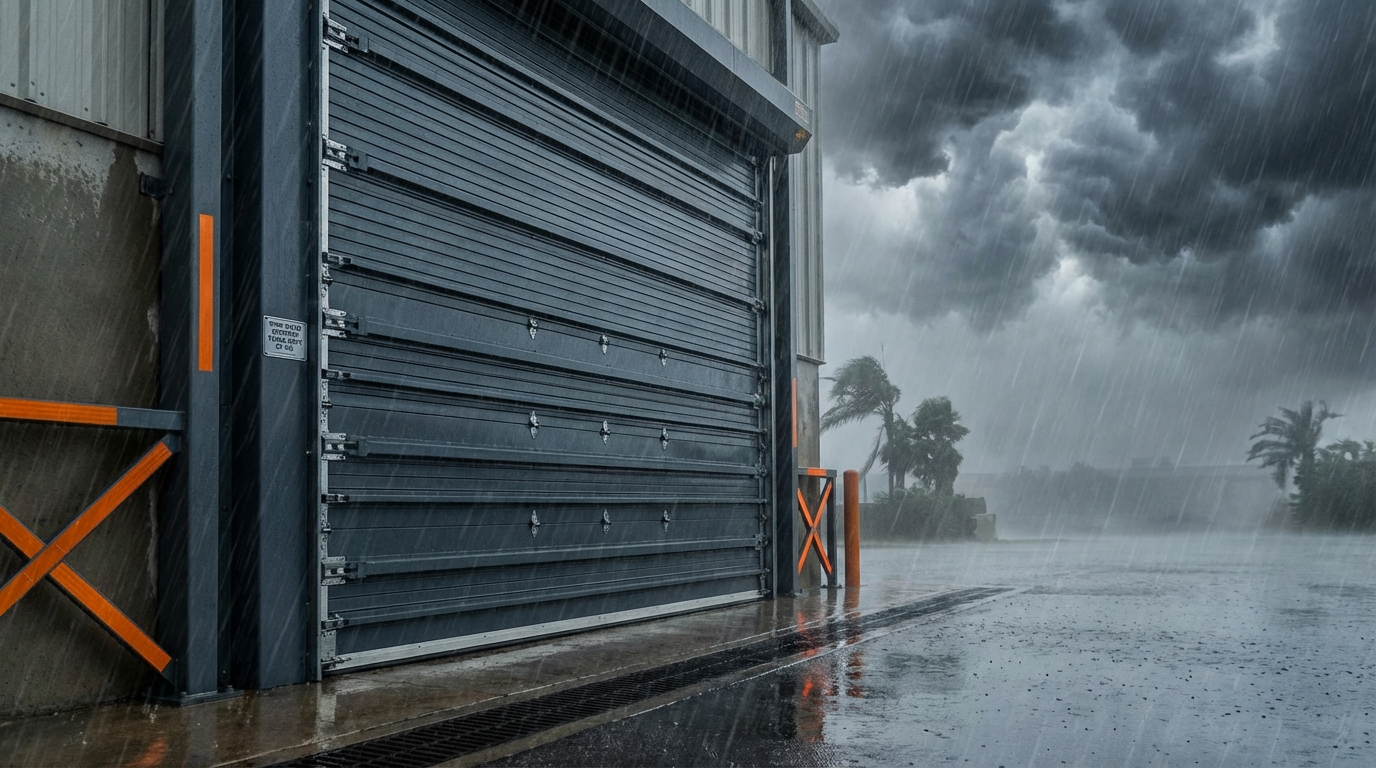
Texas building codes require garage doors in designated wind zones to carry verified Design Pressure (DP) ratings. This is not optional. The International Residential Code (IRC) mandates testing per ASTM E 330 or ANSI/DASMA 108, and the Texas Department of Insurance (TDI) enforces product evaluation for windstorm certification in coastal and inland-wind counties. A door without proper labeling can void insurance coverage and expose the building to catastrophic failure during a storm.
Wind loads are determined using ASCE 7 calculations, which factor in building height, exposure category, topography, and the size of the opening. As the Door and Access Systems Manufacturers Association explains, ANSI/DASMA 108 then documents how the specific door model performs against those calculated pressures. Property owners should confirm that the wind-rating label on any steel garage door lists the correct DP value, exposure category, and applicable test standard before installation proceeds.
Wind-rated doors are heavier than standard models, which places additional strain on motors, springs, and track hardware. Reinforced steel garage doors paired with undersized or aging openers are a frequent source of service calls. Businesses operating in high-wind zones benefit from having reliable access to heavy-duty garage door opener repair to address motor or drive failures before they cascade into door damage.
Insulated vs. Non-Insulated Steel Doors — When Does It Actually Matter?
If the space behind the door is air-conditioned, heated, or houses temperature-sensitive goods, insulation is not a luxury — it is a functional requirement. Insulated steel panel doors reduce thermal transfer, dampen noise from street traffic or adjacent bays, and add structural rigidity to each panel section. In contrast, a non-insulated single-skin door may be perfectly adequate for an open-air storage yard or a parking structure where climate control is irrelevant.
Texas Pros Garage Doors helps businesses evaluate their actual thermal needs during on-site consultations. Rather than defaulting to the highest insulation tier, the team assesses factors like bay orientation (south-facing walls absorb more heat), operational hours, and the building’s overall envelope performance. This approach avoids unnecessary spending while ensuring that insulated doors are specified where they genuinely reduce energy costs.
Commercial Steel Door Questions? Talk to a Specialist.
Our team has been helping San Antonio businesses choose and maintain commercial garage doors since 2006. Get honest advice — no pressure.
Why U-Factor Is More Reliable Than R-Value Alone
R-value measures the insulation core’s resistance to heat flow — but it does not account for the steel skins, thermal bridging at panel joints, or air leakage around the door perimeter. U-factor, by contrast, is tested on the complete installed assembly, giving a far more accurate picture of real-world thermal performance. The DASMA Thermal Performance Verification Program was created specifically to provide standardized U-factor testing for garage doors, and certified results are publicly available for verified models.
Business owners comparing metal garage doors should request U-factor data rather than relying solely on advertised R-values. A door with a high R-value insulation core but poor perimeter sealing and unbroken metal-to-metal contact at the stiles may perform worse in practice than a lower-R-value door with proper thermal breaks and quality weatherstripping. Texas climate-zone envelope requirements provide additional context for setting minimum performance thresholds.
Polyurethane vs. Polystyrene Insulation — Picking the Right Core
Polyurethane foam is injected between the steel skins and expands to fill every cavity, bonding to the metal and adding measurable rigidity to each panel. This “sandwich” construction creates a stiffer, quieter door with higher insulation value per inch of thickness. Polystyrene, on the other hand, is a pre-formed board inserted between skins. It is lighter, less expensive, and adequate for many standard commercial applications where extreme thermal resistance is not required.
Cost, climate, and daily cycling frequency should guide the decision. A climate-controlled auto body shop running HVAC systems twelve hours a day benefits significantly from polyurethane’s tighter thermal envelope. A seasonal agricultural storage building may not justify the price premium. Neither option is universally “better” — only more or less appropriate for a given scenario.
How Cycle Rating Determines Your Maintenance Budget
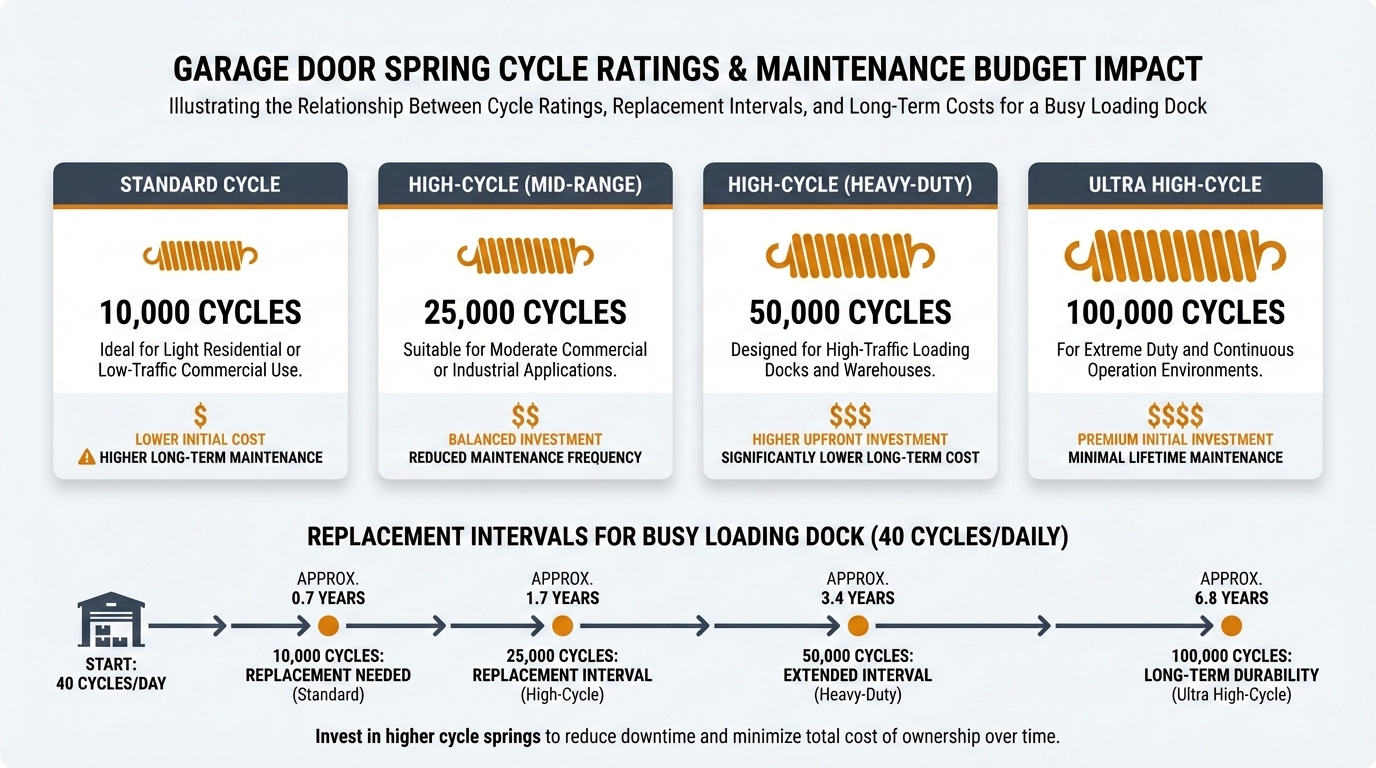
Every garage door spring is manufactured to endure a specific number of open-close cycles before fatigue causes failure. Standard residential springs are rated for roughly 10,000 cycles, which can last years in a home. A busy commercial loading dock that cycles 30 to 50 times per day will exhaust that same spring in under a year. High-cycle springs rated for 50,000 or even 100,000 cycles cost more upfront but dramatically reduce the frequency — and cost — of emergency service calls.
Estimating Your Daily Cycle Count
Track the number of times each bay door opens and closes during a typical business day. Multiply by operating days per year. That annual figure determines the minimum spring cycle rating needed to avoid mid-year failures. A dock that cycles 40 times daily over 260 working days accumulates 10,400 cycles annually. A 25,000-cycle spring in that environment lasts roughly two and a half years; a 50,000-cycle spring extends the interval to nearly five years — cutting both parts and labor costs in half over a decade.
What San Antonio Businesses Are Saying
“The spring on my garage door broke and they were able to come out within an hour. Very professional service and fair pricing.”
“Excellent experience from start to finish. They helped me select the right door design and the installation was completed in one day.”
“My garage door spring broke on a Saturday morning. They came out the same day and fixed it quickly. Great service!”
“Professional commercial garage door repair. They understood the urgency for our business and minimized our downtime.”
Do Steel Garage Doors Rust? Preventing Corrosion in Coastal and Humid Areas
Steel can corrode when its protective finish is compromised. In Texas Gulf Coast counties, salt air accelerates this process. Inland, humidity and chemical exposure (fertilizers, solvents, road salt runoff) pose similar risks. The primary defense is the factory-applied coating — galvanized or galvalume substrates topped with primer and baked-on polyester or silicone-modified polyester paint. When that coating is scratched by impact or worn by friction, moisture reaches bare steel and oxidation begins.
Prevention is straightforward: inspect the bottom section and panel edges quarterly, clean accumulated grime with mild detergent, and apply touch-up paint to any chips or scratches before rust gains a foothold. Replacing the bottom weatherstrip seal when it cracks prevents standing water contact — the single most common trigger for corrosion along the door’s lower rail. These tasks are simple, but skipping them can shorten the life of even the most durable garage doors by years.
Safety Standards Every Texas Business Owner Should Verify
Commercial garage door operators in the United States must comply with UL 325, which addresses entrapment hazards through requirements for photo-eye sensors, sensing edges, and automatic reversal mechanisms. The Consumer Product Safety Commission has issued multiple alerts emphasizing that non-reversing garage door openers present a serious hazard, particularly in facilities where personnel regularly walk or drive through active door zones.
Professional installation is not just a convenience — it is a liability shield. Incorrectly adjusted force settings, misaligned photo-eyes, or missing sensing edges can result in injury claims and regulatory penalties. Durable garage doors installed without proper safety device calibration create a false sense of security. Verification of UL 325 compliance should be documented and retained as part of the facility’s safety records.
What Finish Options Exist for Commercial Metal Garage Doors?
Modern steel garage doors are available in a broad palette of factory-applied colors, woodgrain laminates, and custom powder-coat finishes that align with corporate branding or architectural guidelines. Flush panels create a sleek, contemporary appearance suited to customer-facing storefronts. Ribbed or raised-panel profiles add shadow lines that visually break up large door spans on warehouse facades.
Vision panels — tempered glass or polycarbonate inserts — serve both functional and aesthetic purposes. They admit daylight to reduce interior lighting costs and allow drivers to see activity on the other side of the door before opening, reducing collision risk. Frame color, glass tint, and insert pattern can all be specified to match the building’s design language. Texas Pros Garage Doors maintains access to a wide range of finish and glazing options, enabling property managers to achieve a cohesive look across multi-bay commercial facilities without sacrificing structural performance.
“Called on a Sunday evening when my opener stopped working. They came out the same night and got everything working again. Outstanding service!”
What Information Should You Prepare Before Requesting a Quote?
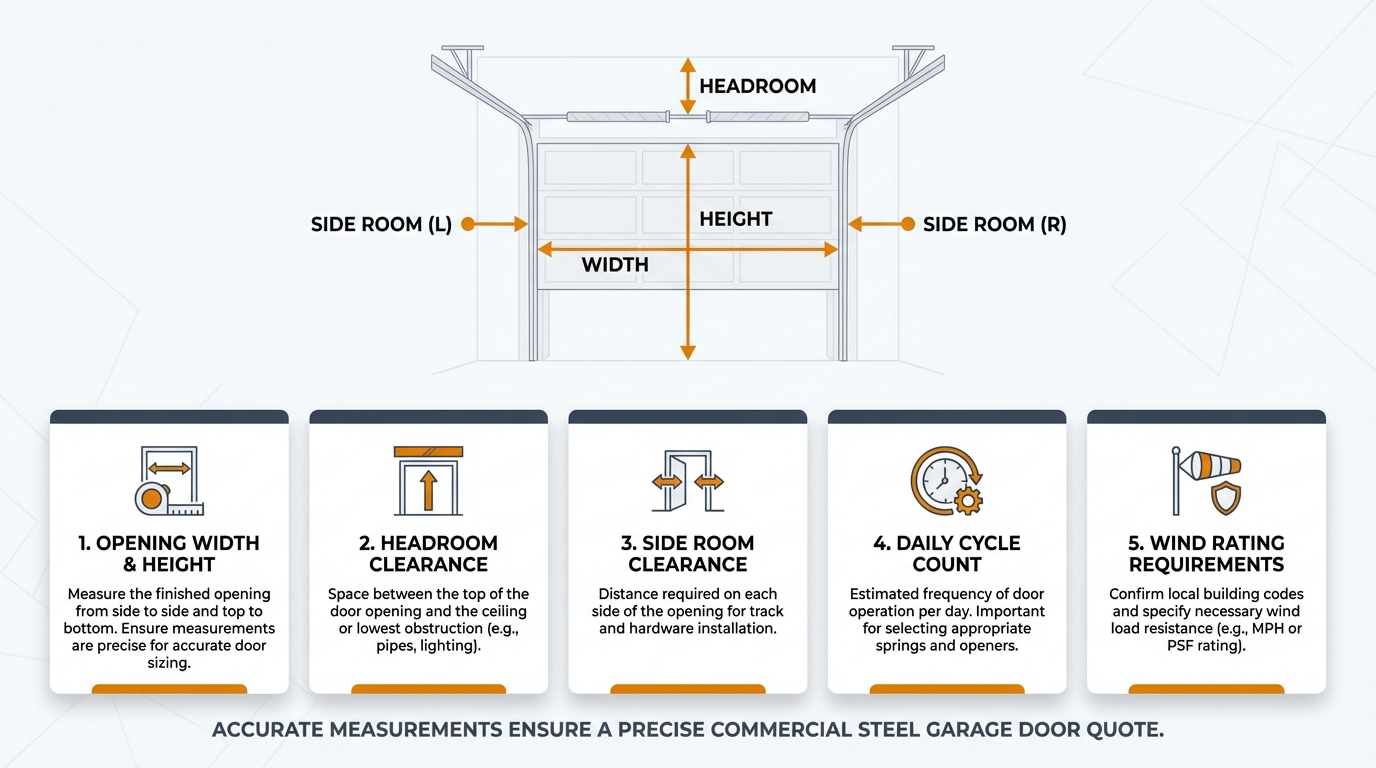
Accurate quotes depend on accurate data. Before contacting any installer, gather the following for each opening: rough opening width and height, available headroom (distance from the top of the opening to the ceiling or nearest obstruction), side-room clearance, and back-room depth. Note whether the door will be manually operated or motor-driven, the expected daily cycle count, and any specific requirements for insulation, wind rating, or fire rating.
Photographs of existing doors, tracks, and hardware help identify compatibility issues early. If your facility is in a TDI-designated wind zone, confirm your required Design Pressure rating with the local building authority before soliciting bids. Providing this information upfront eliminates guesswork, reduces revision cycles, and ensures that the quoted price reflects the actual scope of work — not an estimate that balloons after field measurements.
Frequently Asked Questions About Steel Garage Doors
Ready to Specify the Right Steel Garage Door for Your Facility?
Choosing the correct steel garage door involves balancing gauge, insulation, wind compliance, cycle rating, and finish. Texas Pros Garage Doors works with commercial property owners across San Antonio to match every opening to the right specification, backed by ongoing support including commercial garage door spring repair that keeps high-cycle systems running without interruption.
(210) 469-9003
Get Your Free Site Assessment
24/7 Emergency Response
Licensed & Insured

Recent Comments