
Estimated reading time: 14 minutes
Few exterior upgrades transform a home’s first impression as dramatically as wood garage doors. Natural timber brings depth, warmth, and character that manufactured materials simply cannot reproduce. Whether your home sits on a tree-lined street in San Antonio, a sprawling lot outside Houston, or a historic neighborhood in Dallas, a well-chosen wooden garage door becomes the architectural focal point of the entire facade. Texas Pros Garage Doors works with homeowners across the state to design, source, and install premium wood garage doors that match each property’s unique style and structural requirements.
Key Takeaways
- Wood garage doors remain the top choice for premium and custom-built Texas homes due to their unmatched natural beauty, grain variation, and architectural versatility.
- Western Redcedar is the most recommended species for Texas climates thanks to its natural decay resistance, light weight, and ability to accept stain beautifully.
- Proper maintenance, including refinishing every two to three years in sun-exposed orientations, is critical to preventing warping, cracking, and premature rot.
- Custom wood doors can be insulated, fitted with decorative hardware and window inserts, and built for non-standard openings that off-the-shelf steel panels cannot accommodate.
- Professional installation with correctly calibrated springs and opener systems is essential for safety and long-term performance, especially given the heavier weight of solid wood doors.
▼
- What Exactly Are Wood Garage Doors?
- Are Wood Garage Doors Worth the Investment?
- The “Wrong Fit” Mistake Most Homeowners Overlook
- How Much Do Wood Garage Doors Cost in Texas?
- What Is the Best Wood for a Garage Door?
- Cedar Garage Doors: What Makes Them Different?
- Solid Wood vs. Layered Insulated Builds
- Do Wood Garage Doors Warp, Crack, or Rot?
- Five Common Maintenance Mistakes
- How Long Can a Wood Garage Door Last?
- Design Styles for Custom Wood Doors
- Windows and Decorative Hardware
- Professional vs. DIY Installation
- Matching Your Door to Texas Climate
- Frequently Asked Questions
Ready to Upgrade to a Custom Wood Garage Door?
Get expert guidance on species selection, design, and pricing from San Antonio’s trusted garage door specialists. Call now for a same-day consultation.
(210) 469-9003
Request Your Free Estimate
4.8-Star Rated
70+ Google Reviews
24/7 Available
What Exactly Are Wood Garage Doors — and Why Do They Still Dominate Premium Homes?
Wood garage doors are garage closure systems built from natural timber — either solid wood planks or engineered layer constructions with genuine wood faces. They have been a fixture of residential architecture for well over a century, and even as steel and aluminum alternatives have grown in popularity, wooden garage doors remain the default choice for high-end custom builds. The reason is straightforward: no composite overlay or printed vinyl wrap duplicates the grain variation, shadow play, and tactile richness of real wood.
These doors are available in a wide range of configurations. Some homeowners select classic carriage-house designs with decorative strap hinges and divided-light windows. Others prefer clean modern silhouettes — horizontal tongue-and-groove planks with minimal hardware. Custom wood doors can be built to accommodate arched openings, oversized double bays, and non-standard header heights that would be impossible with off-the-shelf steel panels.
Are Wood Garage Doors Actually Worth the Investment?
This is the question that dominates online forums and homeowner consultations alike. The honest answer depends on two variables: how much you value authentic aesthetics and how willing you are to commit to periodic upkeep. If curb appeal, resale differentiation, and architectural authenticity rank high on your priorities, a wooden garage door delivers value that no alternative material can match. If “zero maintenance” is the primary goal, a faux-wood steel door may serve you better.
Real wood offers measurable advantages beyond appearance. Natural timber has an inherent R-value per inch — the U.S. Department of Energy notes that softwoods provide thermal resistance that thin, uninsulated metal panels lack entirely (energy.gov). That built-in insulating quality, combined with the substantial mass of a solid wood door, also contributes to noise reduction between the garage and living spaces.
A Scenario Most Homeowners Overlook: The “Wrong Fit” Mistake
Picture this: a homeowner installs a beautiful cedar garage door on a west-facing elevation with no porch overhang, full afternoon sun exposure, and a sprinkler system that sprays the lower panels twice a day. Within eighteen months the finish is cracking and the bottom rail is showing early signs of moisture absorption. The door itself was excellent — but the installation context was wrong. This is precisely why working with an experienced local team matters. Texas Pros Garage Doors evaluates sun orientation, drainage, and overhang depth before recommending a wood species and finish system, helping homeowners avoid costly mismatches between material and environment.
How Much Do Wood Garage Doors Cost in Texas?
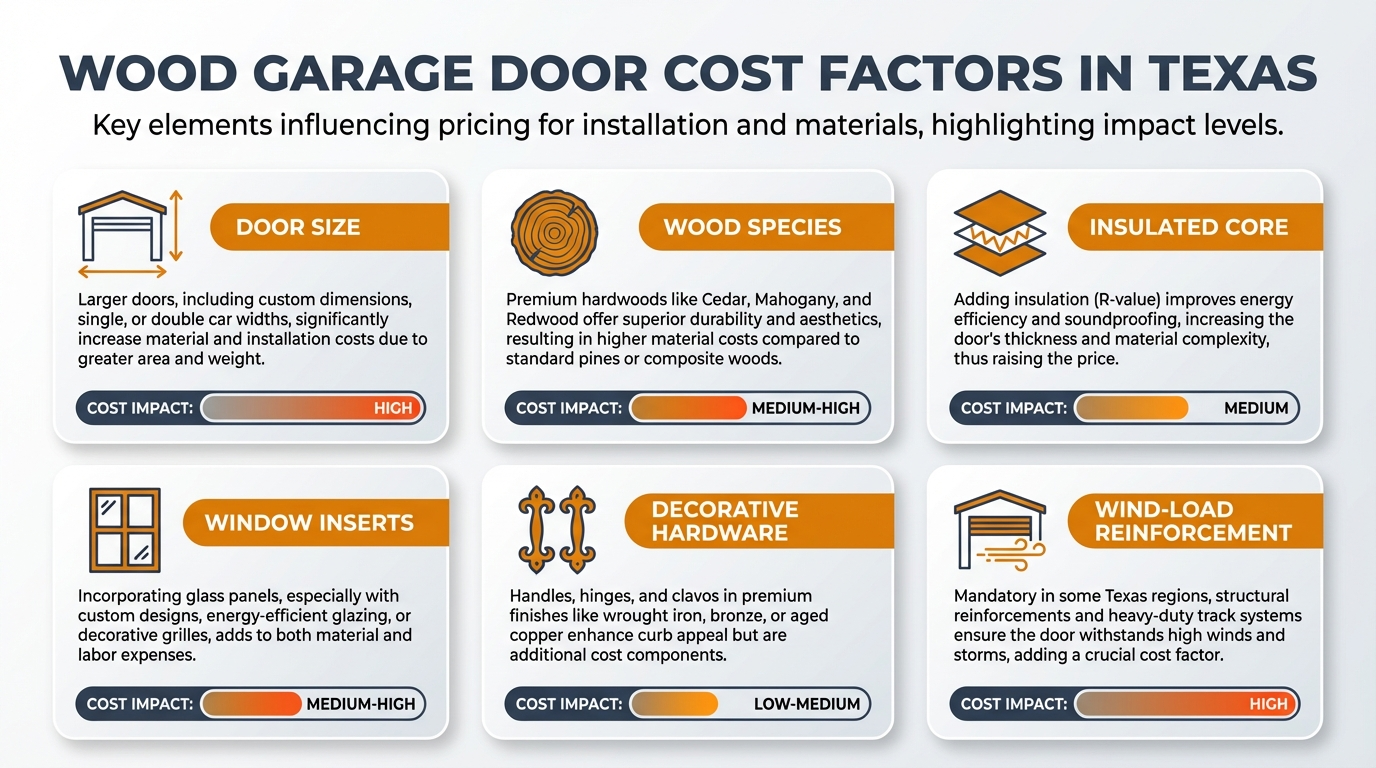
Pricing for wood garage doors varies significantly based on door dimensions, wood species, construction method, insulation, window inserts, decorative hardware, and finish complexity. A basic single-car wooden garage door in a common species can start in the low thousands, while a fully custom double-car cedar door with insulated core, decorative glass, and a multi-coat stain finish can reach well into five figures. Rather than relying on national averages, it is far more accurate to request a quote based on your actual openings and design preferences.
| Cost Factor | Impact on Price | What to Consider |
|---|---|---|
| Door Size (single vs. double) | High | Double-wide doors require stronger framing, heavier springs, and more material |
| Wood Species (cedar, mahogany, hemlock) | Medium — High | Premium species cost more but may need less frequent refinishing |
| Insulated Core | Medium | Adds weight and cost but improves comfort and structural rigidity |
| Window Inserts | Medium | Tempered, frosted, or decorative glass each carries a different price point |
| Decorative Hardware | Low — Medium | Strap hinges, clavos, and handles add visual drama at moderate cost |
| Finish Type (stain vs. paint vs. clear coat) | Low — Medium | Multi-coat stain finishes are labor-intensive but protect the wood longer |
| Wind-Load Reinforcement | Medium | Required in many Texas coastal and high-wind zones |
When you go “custom,” the process typically begins with precise field measurements, followed by design consultation, material selection, and production scheduling. Texas Pros Garage Doors handles this entire workflow in-house — from the first site visit through professional garage door installation services — so homeowners deal with a single point of accountability rather than coordinating between a manufacturer, a contractor, and a finisher.
What Is the Best Wood for a Garage Door?
Cedar — specifically Western Redcedar — is the most frequently recommended species for garage doors in warm, humid climates. According to the USDA Forest Products Laboratory, Western Redcedar heartwood is rated “resistant to very resistant” to decay (fpl.fs.usda.gov). Its natural oils deter moisture absorption and many wood-boring insects, and its relatively light weight per square foot reduces strain on springs and openers.
That said, “best” is context-dependent. Mahogany offers a denser grain and richer color that many homeowners prefer for stained finishes. Hemlock and fir provide cost-effective options with good structural integrity. Regardless of species, the quality of the construction — mortise-and-tenon joinery, proper panel thickness, and professional sealing of all six faces of each component — matters more than the wood name alone.
Cedar Garage Doors: What Makes Them Different from Other Wooden Options?
Cedar garage doors are built from Western Redcedar lumber (solid or laminated) and carry distinct advantages that set them apart from other wooden garage doors. The heartwood contains natural extractives called thujaplicins that inhibit fungal growth, giving cedar an edge in environments with high humidity or intermittent rain. The grain is straight, even, and takes stain beautifully, producing a finish that enhances curb appeal for years when properly maintained.
However, cedar is not invincible. The U.S. Forest Service notes that while the species is highly decay-resistant, it can still be affected by certain insects and requires periodic inspection (research.fs.usda.gov). In Texas, where subterranean termites are common, maintaining a clear gap between the door bottom and the concrete slab — and using an appropriate bottom seal — is essential regardless of wood type.
Comparing Solid Wood Construction to Layered Insulated Builds
| Feature | Solid Wood Door | Layered Wood Door (wood face + insulated core) |
|---|---|---|
| Appearance | Full-depth grain visible on edges; traditional look | Identical face appearance; edges may show composite core |
| Thermal Performance | Moderate (wood’s natural R-value per inch) | Higher (polyurethane or polystyrene core boosts R-value) |
| Weight | Heavier; requires robust spring system | Can be lighter depending on core material |
| Dimensional Stability | More susceptible to expansion/contraction | Core reduces wood movement |
| Cost | Varies by species and thickness | Generally higher due to engineering |
The U.S. Department of Energy recommends checking for NFRC labels when evaluating energy-related performance on exterior products, including doors, to understand air leakage and U-factor ratings (energy.gov). For garages that share a wall or ceiling with living spaces, improving the door’s thermal envelope can meaningfully reduce energy transfer and improve indoor comfort.
Need Help Choosing the Right Wood Species?
Our technicians evaluate your home’s sun exposure, climate conditions, and design preferences to recommend the perfect wood door solution.
Do Wood Garage Doors Warp, Crack, or Rot Over Time?
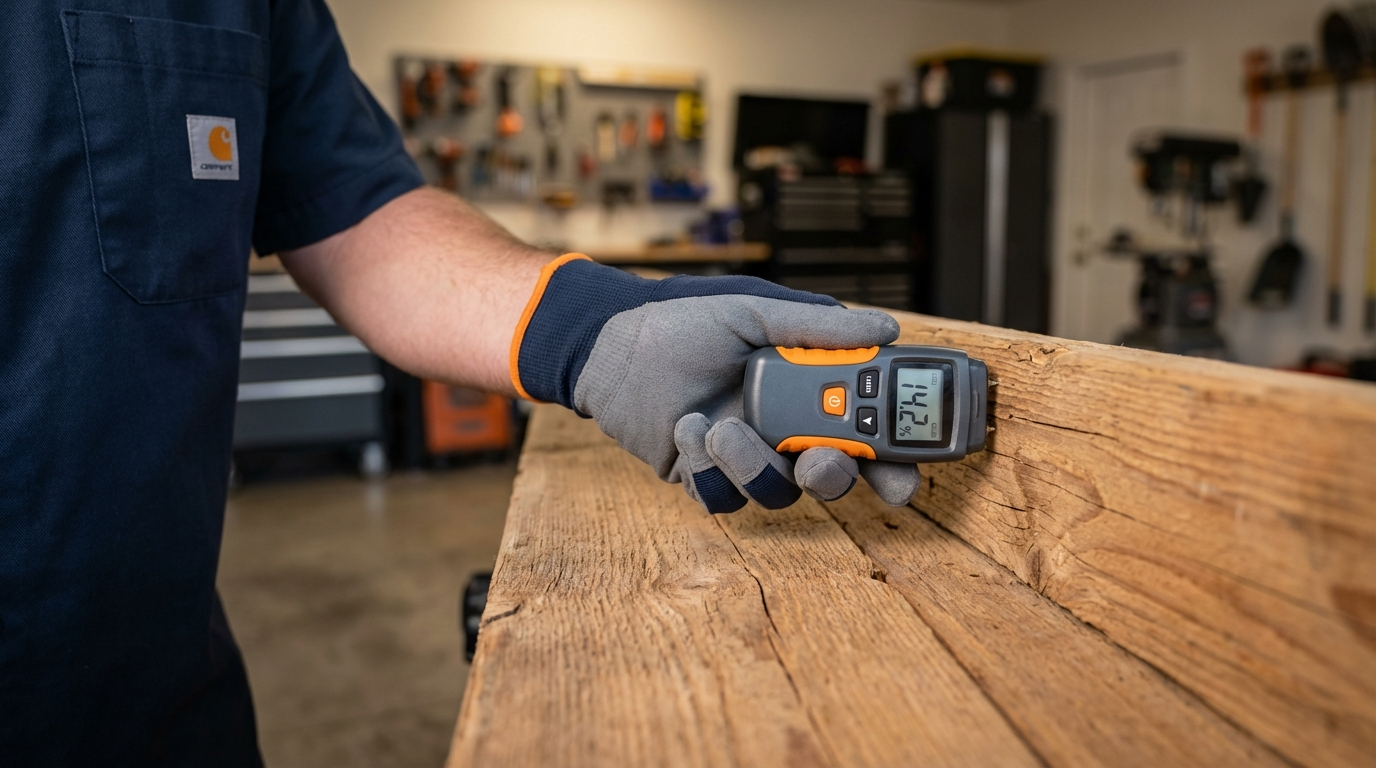
They can — but the degree of risk is almost entirely within the homeowner’s control. Warping and cracking result from uneven moisture exposure: one face of the door bakes in sun while the interior side stays cool and damp, creating differential expansion. Rot starts where finish has failed and bare wood remains in contact with standing water or soil.
The most vulnerable spot on any wooden garage door is the bottom rail. Water splashes up from the driveway, pooling in crevices and penetrating end grain. If the bottom seal is damaged or missing, moisture wicks upward and softens the wood from inside. Annual inspection of the bottom edge, lower panel joints, and areas around window frames catches early signs — softness, discoloration, peeling finish — before structural damage sets in. The EPA recommends maintaining indoor humidity between 30 and 50 percent to prevent mold and moisture-related degradation in enclosed spaces (epa.gov).
Five Common Maintenance Mistakes That Shorten the Life of Wooden Garage Doors
1. Sealing only the exterior face. Every surface — front, back, top, bottom, and both edges — needs finish protection. Leaving the interior face bare invites moisture imbalance and warping.
2. Ignoring the bottom rail. The bottom two inches of a wood garage door endure more water contact than the rest of the door combined. Skipping this area during refinishing is the most frequent cause of premature rot.
3. Using the wrong sealant for the climate. A product designed for temperate Pacific Northwest conditions may break down rapidly under Texas UV intensity. Local expertise matters — Texas Pros Garage Doors recommends finish systems that have been field-tested in central and south Texas heat cycles.
4. Delaying refinishing “just one more year.” Once the UV has broken down the protective layer, bare wood is exposed to rain in a single storm. Staying on a two-to-three-year refinish cycle is far less expensive than repairing or replacing damaged panels.
5. Forgetting the mechanical system. A wood door is significantly heavier than a comparable steel door. Springs, cables, rollers, and the opener motor all work harder. Neglecting these components leads to uneven wear, noisy operation, and potential safety hazards. If hardware issues arise, expert garage door repair should be scheduled promptly to protect both the door and the people around it.
How Long Can You Expect a Wood Garage Door to Last?
With consistent maintenance and a properly applied finish, a quality wood garage door can serve a home for decades. The exact lifespan depends on climate exposure, the species and construction method chosen, and the homeowner’s maintenance habits. In Texas, where summer sun is intense and spring storms bring sudden humidity swings, the finish coat works harder than it would in a milder climate. That means refinishing intervals tend to be shorter — every two to three years in direct-sun orientations versus every three to five years in shaded or covered installations.
Preventive maintenance is the single most cost-effective action a homeowner can take. A half-day spent inspecting and touching up finish annually can extend the door’s functional life by many years compared to a reactive approach that waits for visible damage.
What Our Customers Are Saying
“The spring on my garage door broke and they were able to come out within an hour. Very professional service and fair pricing.”
“Excellent experience from start to finish. They helped me select the right door design and the installation was completed in one day.”
“My garage door spring broke on a Saturday morning. They came out the same day and fixed it quickly. Great service!”
“Professional commercial garage door repair. They understood the urgency for our business and minimized our downtime.”
What Design Styles Are Available for Custom Wood Doors?
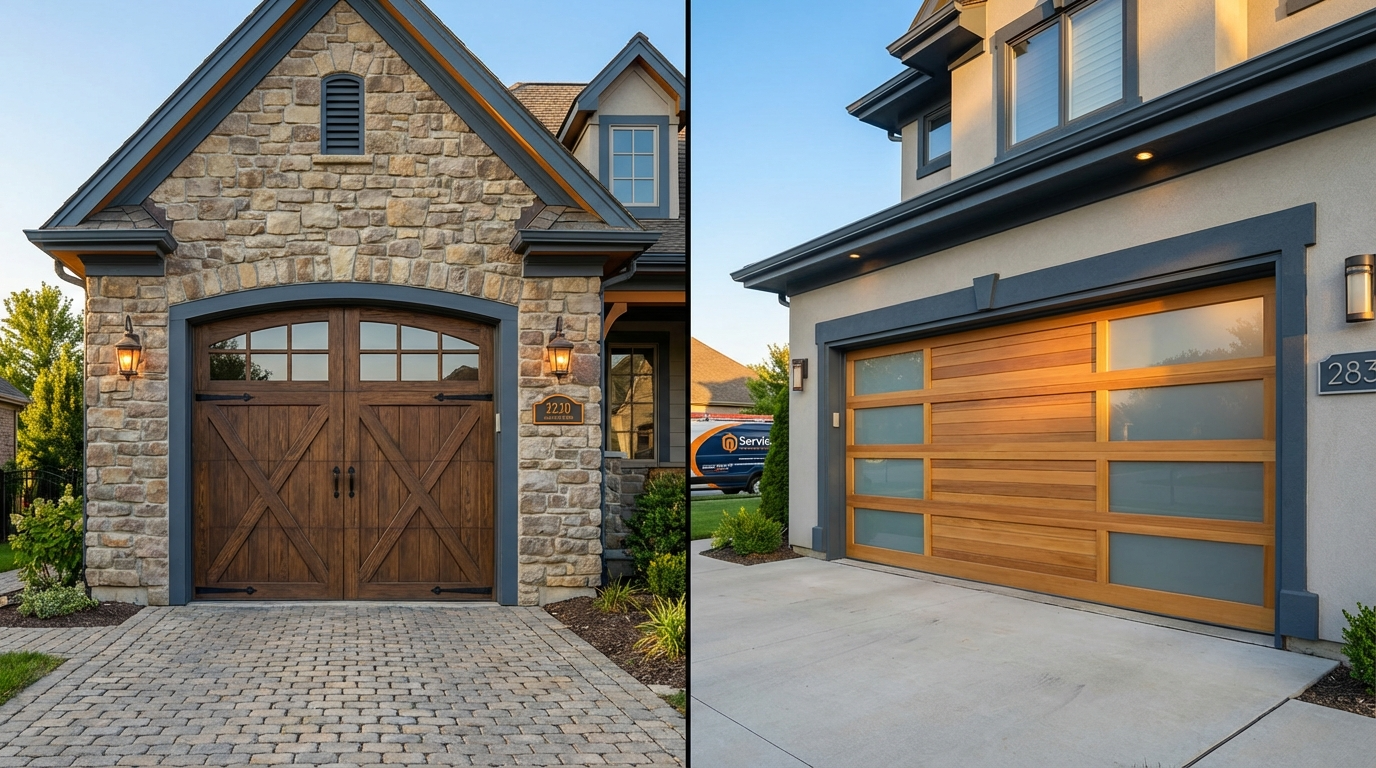
The two dominant categories are carriage house and modern, but the beauty of custom wood doors is that hybrid designs are always possible.
Carriage House Style
Carriage house doors mimic the look of historic swing-out barn doors while operating on a modern overhead track. They typically feature cross-buck panels, arched or rectangular window rows along the top section, and decorative iron hardware — strap hinges, ring pulls, and clavos. This style pairs naturally with brick, stone, and stucco facades.
Modern Style
Modern wood doors emphasize horizontal or vertical plank lines, minimal or concealed hardware, and large glass sections. Flush panels with tight joints and a clear or lightly tinted stain showcase the wood grain as the primary design element. This style complements contemporary, mid-century, and transitional home designs.
Selecting Windows and Decorative Hardware: What Questions Should You Ask?
Window inserts in a wood garage door serve three functions: natural light, visual balance, and architectural style. Before choosing a glass type, consider privacy (do you want passersby to see inside?), solar heat gain (south- and west-facing glass in Texas can raise garage temperatures noticeably), and maintenance (divided-light grilles require more cleaning than single-pane inserts).
Hardware choices — strap hinges, pull handles, decorative bolts — add texture and dimension to the door face. Wrought iron hardware suits traditional and carriage styles, while brushed stainless or matte black hardware complements modern aesthetics. Keep in mind that decorative hardware is non-functional on overhead-track doors; it is attached to the face for visual effect only, so placement should follow proportional design principles rather than structural logic.
If you ever need urgent service for a custom door that has malfunctioned — perhaps a broken spring on a heavy cedar panel or a track misalignment — Texas Pros Garage Doors provides 24/7 emergency support to restore safe operation as quickly as possible.
How Does Professional Installation Differ from a DIY Approach?
Installing a wood garage door is fundamentally different from hanging a standard lightweight steel door. Wooden doors are heavier, which means the torsion spring system must be precisely calculated for the door’s exact weight. Incorrect spring tension creates a door that slams shut or refuses to stay open — both dangerous conditions. Professional installation includes field measurement verification, track alignment, spring calibration, opener force adjustment, and a full safety-sensor check.
Because heavier doors place greater demands on the opener motor, the drive type and horsepower must be matched carefully. Belt-drive openers tend to operate more quietly than chain drives, and a higher-horsepower unit prevents motor strain during daily cycling. Texas Pros Garage Doors pairs every wood door installation with an appropriate opener specification. If an existing opener needs upgrading, the team also services and replaces high-performance garage door openers to ensure the mechanical system keeps pace with the door it supports.
“Called on a Sunday evening when my opener stopped working. They came out the same night and got everything working again. Outstanding service!”
Ortal Peretz
Matching Your Wood Garage Door to Texas Climate Realities
Texas spans multiple climate zones — from the humid Gulf Coast to the semi-arid Hill Country to the scorching Rio Grande Valley. A finish system that performs well in Austin may fail prematurely in Galveston, and a species that thrives in Dallas may need extra protection in Brownsville. This is not a one-size-fits-all product category.
Key climate factors include peak UV index (Texas frequently exceeds UV index 10 in summer), average relative humidity, wind-driven rain exposure, and temperature swings between day and night. A knowledgeable installer accounts for all of these variables during design consultation. Texas Pros Garage Doors draws on direct field experience across the state to recommend species, finish products, and maintenance schedules calibrated to each homeowner’s specific exposure conditions — an advantage that national catalog retailers simply cannot offer.
Frequently Asked Questions About Wood Garage Doors
Ready to See What Custom Wood Garage Doors Would Look Like on Your Home?
Choosing the right wood species, design style, finish, and hardware for your specific property is a decision that benefits enormously from hands-on local expertise. Rather than guessing at configurations from an online catalog, why not start with a professional site evaluation that accounts for your home’s architecture, sun exposure, and personal style? Texas Pros Garage Doors offers consultations tailored to Texas homeowners who want the beauty of real wood backed by installation and service they can count on. Reach out today to start the conversation.
Transform Your Home with a Custom Wood Garage Door
From cedar and mahogany selection to professional installation and long-term maintenance planning, our team handles every detail. Serving San Antonio and all of Texas since 2006.
(210) 469-9003
Get Your Free Custom Quote
Licensed & Insured
4.8-Star Google Rating
Serving Texas Since 2006

Recent Comments