
Estimated reading time: 12 minutes
Garage door insulation is one of the most impactful upgrades Texas homeowners can make for energy efficiency and comfort. With summer temperatures regularly exceeding 100 degrees and unpredictable winter cold snaps, the right insulation transforms your garage from an energy drain into a thermal buffer that protects your entire home. This comprehensive guide walks you through everything you need to know about choosing, installing, and maintaining garage door insulation.
Key Takeaways
- R-value measures thermal resistance – higher values mean better insulation performance for Texas extremes
- Polyurethane foam delivers the highest R-value per inch (R-6 to R-7), ideal for limited panel depth
- Adding insulation changes door weight, requiring spring adjustment to prevent opener damage
- Combining radiant barriers with foam insulation provides comprehensive protection against Texas heat
- Professional installation ensures proper balance, weatherstripping, and long-term performance
▼
- Understanding Garage Door Insulation
- Key Factors When Choosing Insulation
- What Mistakes Do Homeowners Make?
- DIY vs. Professional Installation
- How Climate Affects Insulation Choices
- Comparing Insulation Options
- Maintaining Your Insulated Garage Door
- Signs Your Insulation Needs Upgrading
- How Texas Pros Approaches Insulation
- Frequently Asked Questions
Ready to Improve Your Garage’s Energy Efficiency?
Our insulation experts will assess your garage door and recommend the perfect solution for your home.
(210) 469-9003
Get Free Assessment
Since 2006
24/7 Service
Understanding Garage Door Insulation
Garage door insulation refers to materials installed within or on the surface of your garage door panels to reduce heat transfer between your garage and the outside environment. In Texas, where summer temperatures regularly exceed 100 degrees and winter nights can drop unexpectedly, proper thermal protection becomes essential for maintaining comfortable indoor conditions throughout your home.
Heat moves through your garage door via three mechanisms: conduction (direct transfer through solid materials), convection (movement through air currents), and radiation (energy traveling as waves from warm surfaces). Quality insulation addresses all three pathways, creating a thermal barrier that keeps conditioned air inside and extreme outdoor temperatures out. According to the U.S. Department of Energy, understanding these heat flow principles helps homeowners make informed decisions about protecting their living spaces.
Why Insulate Your Garage Door?
An insulated garage door delivers measurable benefits that extend beyond the garage itself. During Texas summers, an uninsulated metal door can reach surface temperatures exceeding 150 degrees, radiating heat into attached living spaces and forcing air conditioning systems to work harder. Proper insulation reduces this heat gain substantially, contributing to lower energy bills and improved comfort in rooms adjacent to or above the garage.
Winter performance matters equally. The Department of Energy notes that combining air sealing with insulation between unconditioned garages and living spaces significantly improves overall energy performance. Beyond temperature control, insulated doors operate more quietly, resist dents better due to added rigidity, and can extend the lifespan of items stored in your garage by reducing extreme temperature fluctuations.
Key Factors When Choosing Garage Door Insulation
Selecting appropriate insulation requires evaluating several technical and practical considerations. The right choice depends on your specific garage configuration, climate exposure, and intended use of the space. Texas homeowners face unique challenges due to intense solar radiation and humidity variations that differ from northern climates.
R-Value Explained
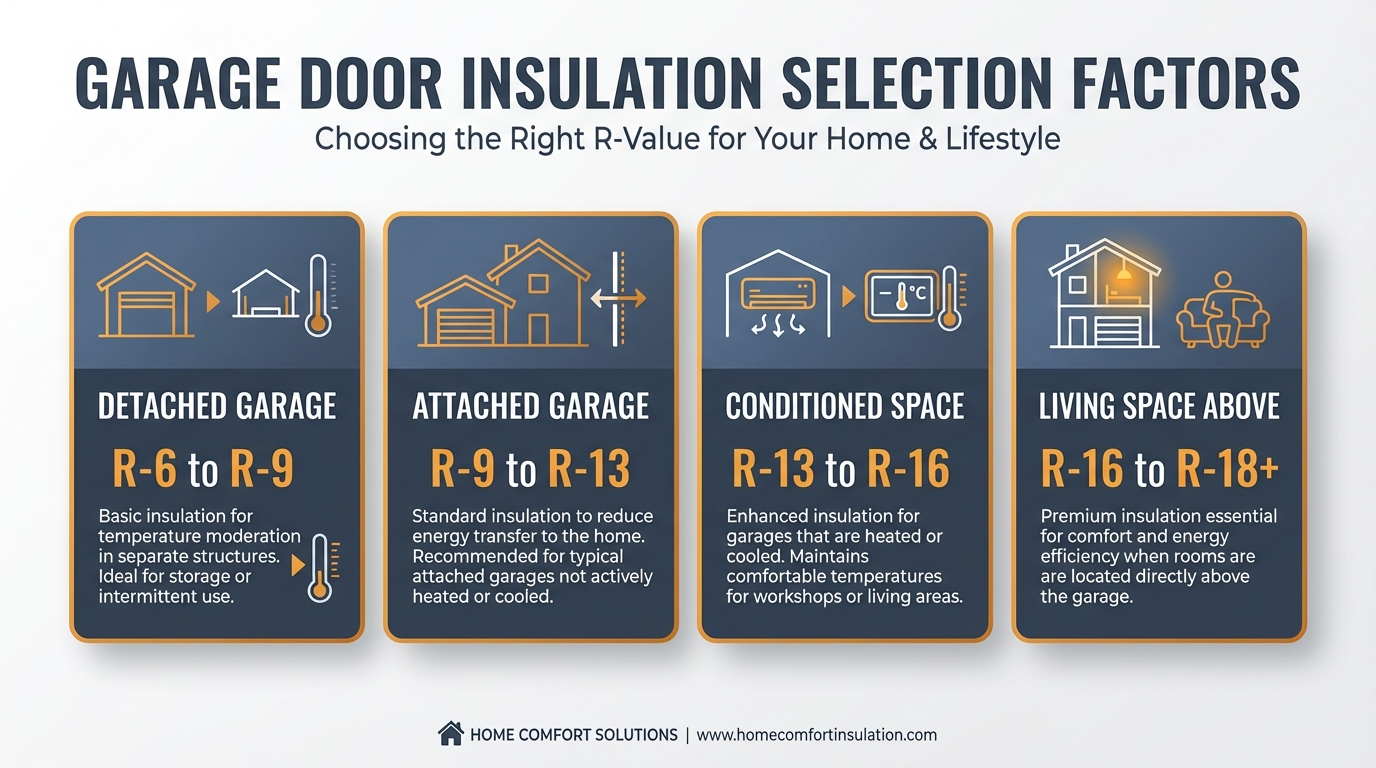
R-value measures thermal resistance – the material’s ability to resist conductive heat flow. Higher R-values indicate better insulating performance. A garage door with R-16 insulation resists heat transfer twice as effectively as one rated R-8. However, the appropriate R-value depends on how your garage connects to your living space and how you use it.
| Garage Configuration | Recommended R-Value | Primary Benefit |
|---|---|---|
| Detached garage, storage only | R-6 to R-8 | Basic temperature moderation |
| Attached garage, unconditioned | R-8 to R-12 | Reduced heat transfer to home |
| Attached garage, conditioned space | R-12 to R-18 | Energy efficiency, comfort |
| Living space above garage | R-16 or higher | Maximum thermal protection |
The Department of Energy emphasizes that installation quality matters as much as R-value ratings. Gaps, compression, or improper fitting reduce effective thermal resistance regardless of the material’s stated performance.
Types of Insulation Materials
Three primary insulation materials dominate the garage door market, each offering distinct advantages for different situations and budgets.
Polystyrene (EPS/XPS) consists of rigid foam panels that provide consistent R-value across their thickness. Expanded polystyrene (EPS) offers approximately R-4 per inch at lower cost, while extruded polystyrene (XPS) delivers around R-5 per inch with better moisture resistance. Both materials are lightweight, easy to cut, and won’t add significant weight to your door system.
Polyurethane foam provides the highest R-value per inch – typically R-6 to R-7 – making it ideal when panel depth is limited. Factory-installed polyurethane bonds directly to door skins, adding structural rigidity while eliminating air gaps. This premium option appears in higher-end insulated doors and delivers superior sealing properties.
Fiberglass batts remain popular for DIY retrofit projects due to their affordability and availability. The Department of Energy notes that fiberglass provides effective thermal resistance when properly installed but can absorb moisture if not sealed adequately – a consideration in humid Texas coastal areas.
Understanding Radiant Barriers
Radiant barriers work differently than bulk insulation materials. Rather than slowing conductive heat transfer, reflective surfaces bounce radiant energy away from your garage. This technology proves particularly effective against intense Texas sun beating directly on garage doors during afternoon hours.
The Department of Energy clarifies that radiant barriers must face an air space to function properly – installing them pressed directly against door surfaces eliminates their effectiveness. When correctly positioned, these reflective materials can reduce radiant heat gain by up to 97%, though they provide minimal resistance to conductive heat flow. Many Texas installations combine radiant barriers with foam insulation to address both heat transfer mechanisms.
What Our Customers Say
Google Review
“The spring on my garage door broke and they were able to come out within an hour. Very professional service and fair pricing.”
Google Review
“Excellent experience from start to finish. They helped me select the right door design and the installation was completed in one day.”
Google Review
“My garage door spring broke on a Saturday morning. They came out the same day and fixed it quickly. Great service!”
Google Review
“Professional commercial garage door repair. They understood the urgency for our business and minimized our downtime.”
What Mistakes Do Homeowners Make When Insulating Garage Doors?
Several common errors undermine insulation projects, wasting time and materials while delivering disappointing results. Understanding these pitfalls helps you avoid them whether tackling installation yourself or evaluating professional work.
Ignoring door weight changes ranks among the most serious mistakes. Adding insulation increases door mass, potentially unbalancing spring tension and straining opener motors. A door that originally weighed 150 pounds might gain 20-30 pounds from insulation materials – enough to cause premature wear or operational failures without spring adjustment.
Overlooking weatherstripping and seals creates another frequent problem. Pristine insulation means little if air flows freely around door edges. Gaps at the bottom seal, between panels, or along side tracks allow conditioned air to escape and outdoor temperatures to infiltrate, negating much of your insulation investment.
Compressing insulation materials reduces their effectiveness dramatically. Fiberglass batts and some foam products rely on trapped air pockets for thermal resistance. Forcing thick insulation into shallow panel cavities eliminates these air spaces, sometimes cutting effective R-value by half or more.
Avoid Costly Insulation Mistakes
Our technicians ensure proper installation, spring adjustment, and weatherstripping for maximum efficiency.
DIY vs. Professional Garage Door Insulation
Deciding between self-installation and professional service involves weighing your skills, available time, and desired outcome against project complexity and safety considerations.
DIY Insulation Considerations
Successful DIY installation requires careful measurement, appropriate material selection, and attention to safety protocols. Begin by measuring each panel cavity individually – garage door panels often vary slightly in dimension. Cut insulation pieces approximately 1/4 inch larger than measured to ensure snug fits without compression.
Safety precautions deserve serious attention, particularly when working with fiberglass materials. The Centers for Disease Control and Prevention notes that fibrous glass can irritate eyes, skin, and respiratory passages. Protective equipment including safety glasses, work gloves, long sleeves, and a dust mask minimizes exposure during cutting and installation.
OSHA guidelines recommend working in well-ventilated areas when handling insulation materials and washing exposed skin thoroughly afterward. These precautions apply equally to foam board installation, which can produce irritating dust during cutting.
When to Call Professionals for Insulation
Professional installation makes sense when garage door configurations present complexity beyond basic panel insulation. Roll-up doors, doors with windows, older systems requiring spring adjustment, or situations where maximum energy efficiency matters benefit from experienced hands and specialized equipment.
Technicians assess existing spring tension and adjust balance after adding insulation weight. They identify and address weatherstripping deficiencies that homeowners might overlook. Professional installation also ensures warranty compliance for door systems where manufacturer specifications require authorized service.
Professional Advantage: Texas Pros Garage Doors provides comprehensive insulation services that address the complete thermal envelope – not just panel insulation but also perimeter sealing, bottom weatherstrip replacement, and spring adjustment to accommodate added weight. This whole-system approach delivers measurable improvements in energy efficiency and door longevity that partial solutions cannot match.
How Does Climate Affect Insulation Choices in Texas?
Texas presents unique insulation challenges due to extreme heat, humidity variations, and occasional freezing temperatures. These factors influence both material selection and installation priorities.
Coastal regions face humidity concerns that make moisture-resistant materials essential. Closed-cell polyurethane and XPS foam resist water absorption better than fiberglass or EPS options. Inland areas with dramatic temperature swings benefit from higher R-values that buffer against both summer heat and winter cold.
Sun exposure patterns matter for south and west-facing garage doors receiving hours of direct afternoon radiation. These orientations benefit most from radiant barrier inclusion, whether as standalone reflective panels or integrated foil-faced insulation products. North-facing doors experience less radiant heat gain and may perform adequately with bulk insulation alone.
Comparing Insulation Options: Performance and Value
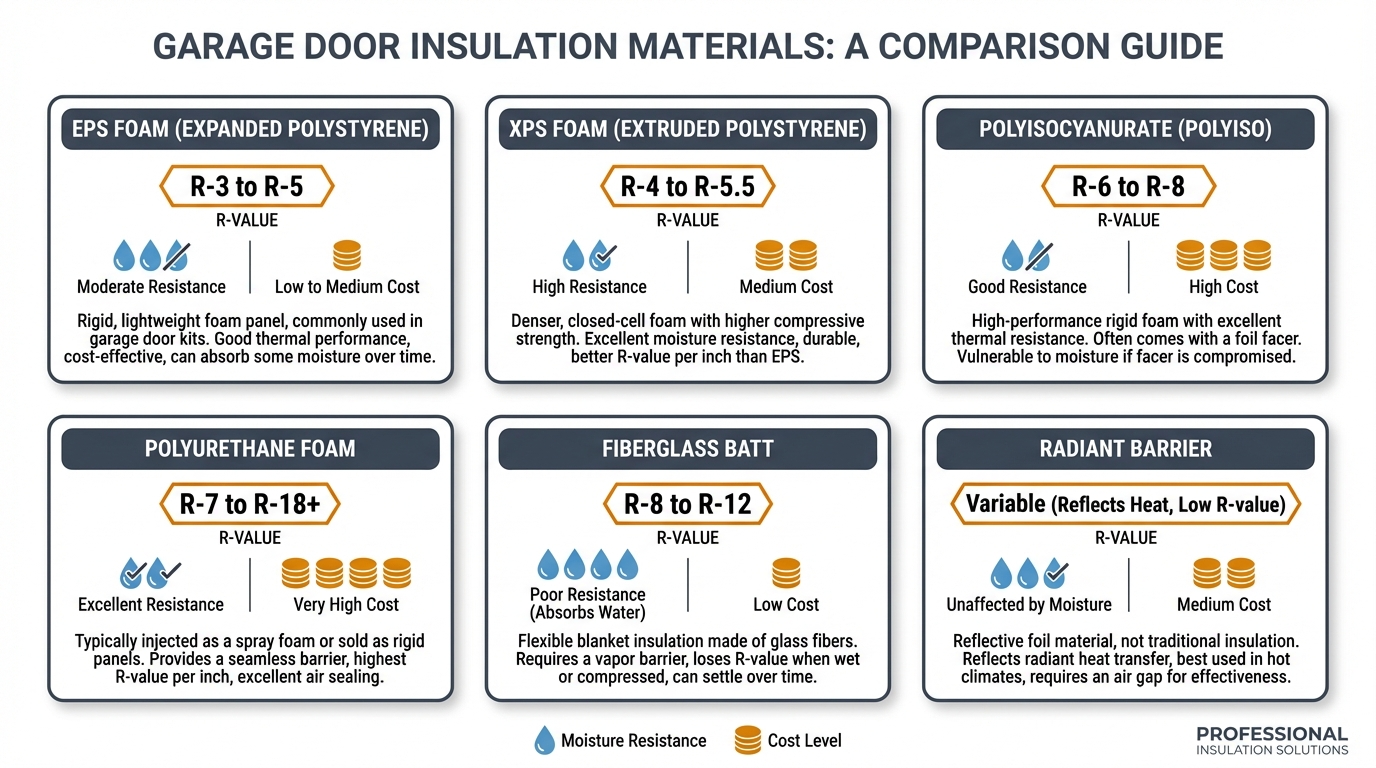
Evaluating insulation choices requires balancing initial cost against long-term performance, durability, and installation complexity.
| Material Type | R-Value per Inch | Moisture Resistance | DIY Suitability | Relative Cost |
|---|---|---|---|---|
| EPS Foam Board | R-3.8 to R-4.4 | Moderate | Excellent | Low |
| XPS Foam Board | R-5.0 | High | Excellent | Moderate |
| Polyisocyanurate | R-5.6 to R-6.5 | Moderate | Good | Moderate-High |
| Polyurethane (injected) | R-6.0 to R-7.0 | Excellent | Professional only | High |
| Fiberglass Batt | R-3.0 to R-3.7 | Low | Good | Low |
| Radiant Barrier | Minimal (reflects radiant) | High | Good | Low-Moderate |
Material costs represent only part of total project expense. Installation time, necessary tools, potential spring adjustment, and weatherstripping replacement all factor into realistic budgeting. Professional services bundle these elements, often providing better value than piecemeal DIY approaches for comprehensive projects.
Google Review
“Called on a Sunday evening when my opener stopped working. They came out the same night and got everything working again. Outstanding service!”
Maintaining Your Insulated Garage Door
Proper maintenance preserves insulation effectiveness and extends overall door system longevity. Regular attention catches small problems before they become expensive repairs.
Regular Inspections and Care
Visual inspection every six months identifies insulation panels that have shifted, compressed, or sustained damage. Check for gaps between insulation and panel frames where thermal bridging reduces effectiveness. Rodent activity sometimes displaces or damages insulation materials, particularly fiberglass products.
Weatherstripping and seals require ongoing attention to maintain the complete thermal envelope. Bottom seals contacting concrete surfaces wear faster than side or top weatherstripping. Replace cracked, flattened, or torn seals promptly – these components are inexpensive but critical for energy efficiency.
Door balance affects both insulation longevity and opener performance. An unbalanced door stresses insulation attachment points during operation and accelerates wear on mechanical components. Test balance annually by disconnecting the opener and manually lifting the door to chest height – it should remain in position without drifting up or down significantly.
What Signs Indicate Your Current Insulation Needs Upgrading?
Several indicators suggest existing insulation no longer performs adequately or was insufficient from the start.
Temperature differences between your garage and outdoor conditions less than 10-15 degrees during extreme weather suggest poor thermal performance. An insulated garage in summer should feel noticeably cooler than the blazing exterior, while winter conditions should show the opposite pattern.
Condensation on interior door surfaces indicates thermal bridging or insufficient insulation allowing cold surfaces to develop. This moisture promotes rust on metal components and can damage stored items. Visible light gaps around door perimeters reveal air infiltration pathways that undermine any panel insulation present.
Energy bill spikes coinciding with extreme weather seasons sometimes trace to inadequate garage insulation, particularly for attached garages with living spaces above. The garage acts as a buffer zone – when that buffer fails, your HVAC system compensates by running longer.
Free Insulation Assessment This Month
Let our experts evaluate your garage door’s thermal performance and recommend the ideal solution.
(210) 469-9003
Claim Free Assessment
Same-Day Available
Written Estimate
How Texas Pros Garage Doors Approaches Insulation Projects
Comprehensive insulation service addresses your garage door as a complete system rather than focusing solely on panel materials. This approach delivers lasting results that partial solutions cannot achieve.
Assessment begins with evaluating current door condition, spring balance, weatherstripping integrity, and overall structural soundness. Adding insulation to a door with failing components wastes resources – addressing underlying issues first ensures your investment performs as expected.
Material selection considers your specific situation: garage orientation, attachment to living spaces, intended use, and budget parameters. Technicians explain options honestly, recommending appropriate solutions rather than pushing premium materials where simpler approaches suffice.
Installation includes proper spring adjustment to accommodate added weight, weatherstripping replacement where needed, and verification of smooth operation under the new configuration. This complete service model means one visit resolves everything rather than discovering problems after the technician leaves.
Frequently Asked Questions
Yes, particularly for attached garages adjacent to or beneath conditioned living spaces. The Department of Energy confirms that insulating and air sealing between unconditioned garages and living areas improves overall home energy performance. Actual savings vary based on your specific situation, existing insulation levels elsewhere, and local energy costs.
Basic panel insulation with foam board requires minimal tools – a utility knife, straightedge, measuring tape, and appropriate adhesive or retention clips. However, adjusting spring tension to accommodate added weight requires specialized tools and knowledge. Many homeowners handle panel installation themselves while calling professionals for balance adjustment.
Quality insulation materials maintain effectiveness for 15-20 years or longer under normal conditions. Foam boards resist degradation better than fiberglass in humid environments. Damage from impacts, rodents, or moisture intrusion shortens lifespan regardless of material type.
Properly balanced doors with adjusted springs place minimal additional load on openers. Problems arise when insulation is added without corresponding spring tension adjustment. Professional installation includes this balancing step; DIY projects should budget for technician spring adjustment afterward.
Neither is universally “better” – they address different heat transfer mechanisms. Radiant barriers excel at reflecting solar radiation from sun-baked door surfaces. Foam insulation resists conductive heat transfer through door materials. Combining both provides comprehensive protection against Texas summer conditions.
Insulation benefits extend beyond conditioned spaces. Even unconditioned garages benefit from temperature moderation that protects vehicles, stored items, and reduces heat transfer into adjacent living areas. The investment often pays dividends in both comfort and energy efficiency.
Manufacturer specifications provide rated R-values for factory-insulated doors – check documentation or search the model number online. Retrofit insulation R-value depends on material type and thickness. Uninsulated single-layer metal doors typically offer R-0 to R-1, while basic factory-filled panels range from R-6 to R-9.
Transform Your Garage’s Energy Efficiency Today
Whether you need guidance selecting materials or prefer professional installation, we’re here to help with honest advice and reliable service.
(210) 469-9003
Contact Our Team
70+ Five-Star Reviews
24/7 Emergency Service

Recent Comments