
If you have ever pressed your garage remote early in the morning and cringed at the grinding noise that echoed through the house, you already understand why so many San Antonio homeowners search for a quieter alternative. A belt drive garage door opener replaces the traditional metal chain with a reinforced rubber belt, producing noticeably less vibration and sound every time the door moves. Whether your garage sits directly beneath a bedroom, shares a wall with a home office, or serves a commercial space where noise matters, this technology addresses one of the most common frustrations property owners face. In the guide below you will find a practical breakdown of how belt drives work, what makes them genuinely quiet, how safety standards and electrical codes apply in Texas, and what a professional installation should include so you get the smooth, reliable result you are paying for.
- Belt drive openers use a reinforced rubber belt instead of a metal chain, significantly reducing noise and vibration transfer into your home’s structure.
- A truly quiet installation depends on the entire door system being in balance, including springs, rollers, tracks, and mounting hardware, not just the opener unit itself.
- Federal safety standards require two forms of entrapment protection on every residential opener, and Texas electrical code mandates GFCI-protected outlets in garages.
- Belt drives handle heavy and insulated doors effectively when the motor is properly sized and the spring system is correctly adjusted by a trained technician.
- Professional installation includes a multi-point inspection, vibration-isolating brackets, sensor calibration, and a homeowner walkthrough, steps that DIY kits typically skip.
▼
- What Exactly Is a Belt Drive Garage Door Opener?
- Are Belt Drive Garage Door Openers Really Quieter?
- What Actually Creates a Smooth Operation Opener?
- Belt Drive vs. Chain Drive — A Side-by-Side Comparison
- Can a Belt Driven Opener Handle a Heavy or Insulated Door?
- How Much Horsepower Do You Actually Need?
- Common Mistakes Homeowners Make
- Essential Safety Standards Every Homeowner Should Know
- Electrical Requirements for Installing in Texas
- When Does Repairing Make More Sense Than Replacing?
- Is a Belt Drive Opener Suitable for Commercial Use?
- What Should a Professional Installation Include?
- Practical Checklist Before Your Opener Upgrade
- How Much Does Installation Cost in San Antonio?
- Why Is My Belt Drive Opener Making a Whining Noise?
- Frequently Asked Questions
Tired of a Noisy Garage Door? Get a Free Quote Today
Our technicians evaluate your entire door system, not just the opener, so you get a genuinely quiet result. Transparent pricing with no hidden fees.
(210) 469-9003
Schedule Free Evaluation
Serving San Antonio Since 2006
24/7 Emergency Service
What Exactly Is a Belt Drive Garage Door Opener?
A belt drive garage door opener uses a steel-reinforced rubber or fiberglass belt to move the trolley along the rail, lifting and lowering the door. Because the belt is flexible and non-metallic on its outer surface, it absorbs vibrations that a metal chain would transmit directly into the rail, ceiling joists, and walls. The result is a quieter cycle from open to close. Modern units typically pair this belt with a DC motor, which can vary speed electronically rather than running at a single high-torque burst. That combination is what manufacturers refer to when they market a quiet garage opener experience.
The belt itself requires minimal lubrication compared to a chain, and because there is less metal-on-metal contact, long-term wear on the drive mechanism tends to be lower. Still, the belt is not indestructible — periodic inspection through professional opener repair services helps catch early signs of cracking or stretching before they cause a breakdown.
Are Belt Drive Garage Door Openers Really Quieter?
In most real-world scenarios, yes. Consumer testing by outlets such as Better Homes & Gardens consistently places belt drives at the top of noise-reduction rankings, specifically recommending them for homes where the garage is attached to living spaces or bedrooms sit directly above. The difference is most apparent during the opening stroke, when a chain drive produces a distinctive metallic rattle that resonates through framing. A belt dampens that resonance because rubber flexes rather than clangs.
However, “quiet” is not determined by the belt alone. A door that is poorly balanced, fitted with worn nylon rollers, or mounted on a misaligned track will generate noise regardless of what drives the trolley. That is why San Antonio technicians who specialize in opener upgrades always evaluate the entire door system — not just the motor unit — before quoting a replacement.
What Actually Creates a Smooth Operation Opener — the Belt or the Motor?
Both contribute, but in different ways. The belt handles vibration damping, while the motor controls acceleration and deceleration. A DC motor can ramp up gradually at the start and slow down before the door reaches its end limit, a feature commonly called soft start and soft stop. According to manufacturer documentation from Hörmann, this function reduces mechanical stress on the rail, brackets, and door panels while also lowering the peak noise level during each cycle.
In contrast, an AC motor typically runs at a fixed speed and stops abruptly, creating a noticeable jolt at the top and bottom of travel. When you pair a reinforced belt with a variable-speed DC motor, you get a smooth operation opener that feels — and sounds — noticeably different from a basic chain-and-AC setup.
Where Does Residual Noise Come From Even With a Belt?
Vibration can travel through ceiling-mount brackets into roof trusses. Worn hinges and rollers create clicks and squeals independent of the opener. Loose hardware on the door itself rattles during movement. And an unbalanced spring system forces the motor to work harder, increasing motor hum. Addressing these factors before or during installation is what separates a truly quiet result from an expensive disappointment.
Belt Drive vs. Chain Drive — A Side-by-Side Comparison
Many homeowners weighing an upgrade want a clear, factual comparison before making a decision. The table below maps the most common selection criteria to each drive type so you can see where a belt driven opener outperforms a chain — and where a chain may still make sense.
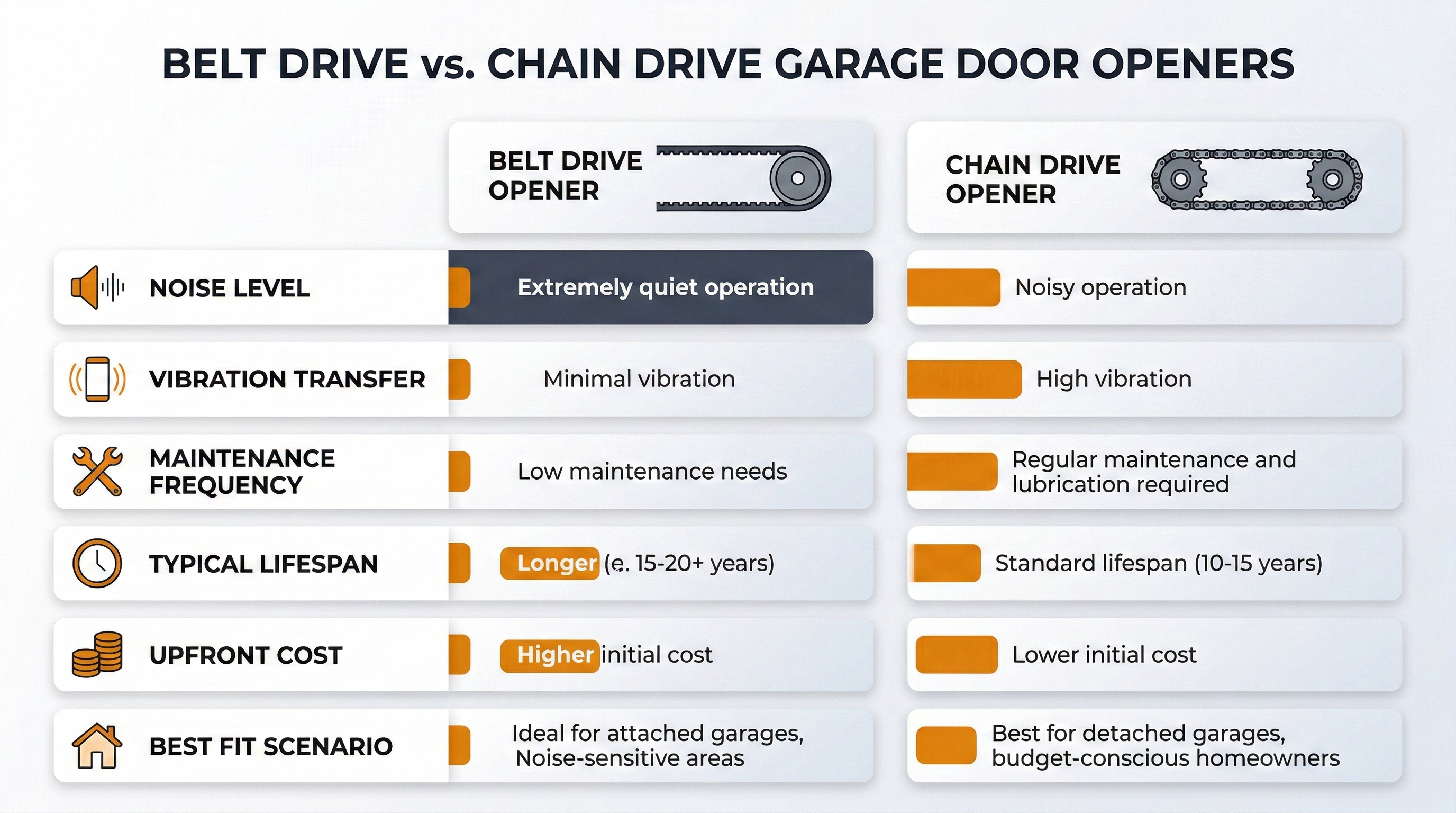
| Criterion | Belt Drive | Chain Drive |
|---|---|---|
| Noise Level | Low — rubber belt absorbs vibration | Moderate to high — metal chain on metal rail |
| Vibration Transfer to Structure | Minimal | Noticeable, especially in attached garages |
| Maintenance Frequency | Lower — less lubrication needed | Higher — regular lubrication and tension checks |
| Typical Lifespan | Comparable when properly maintained | Comparable when properly maintained |
| Upfront Cost | Slightly higher | Generally lower |
| Best Fit Scenario | Bedroom above garage, shared walls, offices | Detached garage, budget priority, high-noise environment |
| Compatibility With Heavy Doors | Yes — requires correct motor sizing | Yes — requires correct motor sizing |
The takeaway is straightforward: if noise and vibration matter in your daily life, a belt drive is the practical upgrade. If the garage is detached and you are less sensitive to sound, a chain drive still performs the mechanical job reliably at a lower price point.
Can a Belt Driven Opener Handle a Heavy or Insulated Door?
Absolutely, as long as the system is sized correctly for the door’s weight and cycle count. In San Antonio, many homeowners choose insulated doors to combat the intense summer heat, and these doors can weigh significantly more than a single-layer steel panel. The critical factor is not the belt itself — modern reinforced belts are rated for thousands of pounds of pulling force — but the motor’s torque rating and the condition of the spring system.
If the torsion springs are weak or incorrectly sized, the motor compensates by drawing more power and straining the belt, shortening the life of both components. A quick balance test before installation reveals whether the springs need adjustment, which is a task that should always be handled by a trained technician due to the extreme tension stored in torsion hardware.
How Much Horsepower Do You Actually Need?
Horsepower ratings on residential openers can be confusing because DC motors often use marketing-derived figures like “HP equivalent” or “HPS” that do not translate directly to traditional AC horsepower. Rather than chasing a number on the box, focus on the opener’s rated door weight capacity and its duty cycle.
A standard single-car door in good balance may work fine with a unit rated for doors up to 350 pounds. A double-wide insulated door or a commercial roll-up may require a unit rated above 500 pounds with a higher duty cycle. When Texas Pros Garage Doors evaluates your garage, the assessment includes measuring the actual door weight and cycle demand so the recommendation matches the real workload — not a generic spec sheet.
Common Mistakes Homeowners Make When Choosing a Quiet Garage Opener
One of the most frequent errors is purchasing a premium belt drive opener and mounting it on a door system that has underlying mechanical issues. No opener can compensate for bent tracks, seized rollers, or a door that drifts when disconnected from the carriage.
A second common mistake is ignoring the ceiling and bracket connections — loose lag bolts transfer motor vibration directly into the structure, producing a low-frequency hum that homeowners mistakenly blame on the opener.
A third pitfall is skipping the balance test entirely, assuming that a new opener will “power through” an unbalanced door. This approach accelerates wear, increases noise over time, and can void the opener warranty. Taking the time to address these issues before or during the upgrade is what delivers the quiet, smooth result you are expecting.
What San Antonio Homeowners Say
“The spring on my garage door broke and they were able to come out within an hour. Very professional service and fair pricing.”
“Excellent experience from start to finish. They helped me select the right door design and the installation was completed in one day.”
“My garage door spring broke on a Saturday morning. They came out the same day and fixed it quickly. Great service!”
“Professional commercial garage door repair. They understood the urgency for our business and minimized our downtime.”
Essential Safety Standards Every Homeowner Should Know
Since 1993 all residential garage door openers sold in the United States must comply with federal entrapment-protection rules tied to UL 325 standards published by the Consumer Product Safety Commission. The regulation requires at least two forms of entrapment protection. The first is an inherent reversal mechanism: if the door contacts an obstruction while closing, it must reverse automatically. The second is an external device — most commonly photoelectric sensors (the “electric eyes” mounted near the floor on each side of the door opening).
These sensors must be positioned no higher than six inches above the garage floor to reliably detect a child, pet, or object in the door’s path. Compliance is not optional, and proper sensor alignment is a critical component of any expert garage door installation.
Why Sensor Position Matters More Than You Think
If the sensors are mounted too high, small objects or children crawling near the threshold may not break the beam. If they are misaligned due to a bumped bracket, the door may refuse to close at all — or worse, it may close without the safety net of beam interruption. During every installation Texas Pros Garage Doors performs, sensor height, alignment, and wiring integrity are verified as part of a multi-point safety check before the job is signed off.
What Are the Electrical Requirements for Installing a Belt Drive Opener in Texas?
A standard residential belt drive garage door opener typically requires a dedicated 120V, 15A or 20A outlet mounted on the garage ceiling near the motor head. Under the National Electrical Code 2023 edition — which Texas adopted through TDLR effective September 2023 — all 15A and 20A, 125V receptacles in a garage must have GFCI (Ground-Fault Circuit Interrupter) protection, including the one powering your opener.
This is a safety measure designed to prevent electrical shock in an environment where moisture, concrete dust, and vehicle fluids are common. If your garage lacks a GFCI-protected circuit near the opener location, an electrician will need to install or upgrade one before the opener can be connected safely and in compliance with code. As noted by EC&M’s NEC guidance, this requirement applies broadly and is enforced during inspections in many Texas municipalities.
Need Help Choosing the Right Opener for Your Door?
Our technicians measure your actual door weight, inspect your spring system, and verify your electrical setup before recommending a specific unit. No guesswork, no upsells.
When Does Repairing an Existing Opener Make More Sense Than Replacing It?
If the issue is a dead remote, a misaligned sensor, or a minor logic board glitch, a targeted repair is usually faster and more cost-effective than a full replacement. However, if the opener is more than 15 years old, uses an AC motor with no safety-sensor compliance, or repeatedly fails to lift the door smoothly, replacement with a modern belt drive system is the more practical investment.
Older openers also lack features like rolling-code security, battery backup, and soft start/stop — all of which improve daily convenience and safety. A professional diagnostic visit can clarify exactly which path saves you money and hassle in the long run.
Is a Belt Drive Opener Suitable for Commercial Use?
It can be, depending on the application. In environments where noise disrupts business operations — medical offices, shared commercial plazas, climate-controlled warehouses adjacent to office suites — a belt drive offers a clear advantage. The key consideration for commercial settings is duty cycle. Residential-grade openers are typically rated for a limited number of cycles per hour. A busy loading dock or parking structure may exceed that rating quickly, leading to premature motor failure.
Commercial-grade belt drive units are built with higher-rated components, heavier belts, and thermal protection to handle frequent use. For businesses that also need access control, status monitoring, or integration with alarm systems, it is worth noting that in Texas certain monitoring and logging features can trigger private-security licensing requirements, so consulting a knowledgeable installer matters.
What Should a Professional Belt Drive Installation Include?
A thorough installation is more than bolting a motor to the ceiling and threading a belt. The table below outlines what a complete, professional installation process looks like versus a basic or incomplete job.
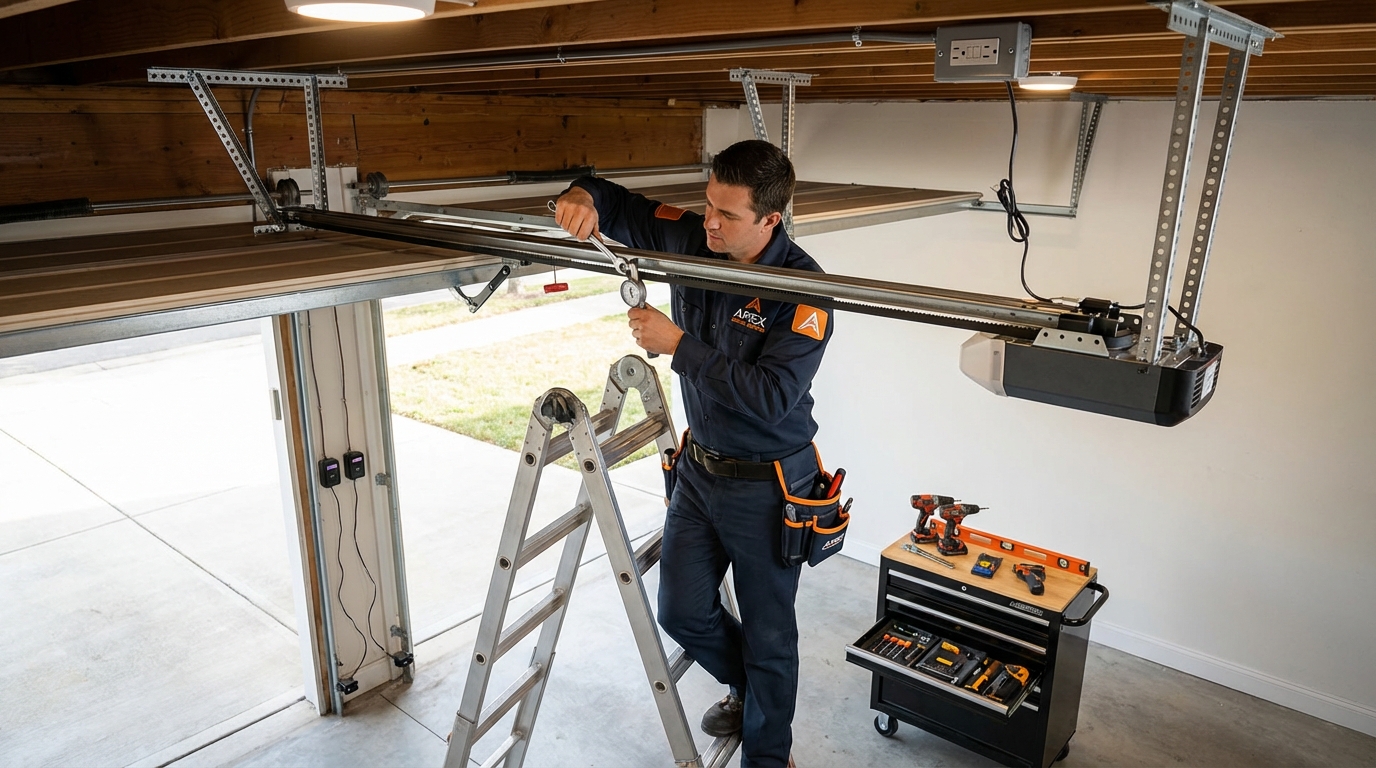
| Installation Step | Complete Professional Process | Shortcut / Incomplete Job |
|---|---|---|
| Pre-Install Door Assessment | Balance test, spring check, roller inspection, track alignment | Skipped — “just mount the new unit” |
| Mounting & Hardware | Vibration-isolating brackets, proper lag bolt into framing | Drywall anchors or reuse of stripped holes |
| Belt Tension & Alignment | Adjusted per manufacturer spec with deflection check | Eyeballed or left at factory preset |
| Travel Limits & Force Settings | Set and tested with obstruction simulation | Left at factory default |
| Safety Sensor Setup | Mounted at correct height, alignment verified, wiring secured | Loosely placed, not tested under real conditions |
| Electrical Verification | GFCI-protected outlet confirmed, polarity check | Plugged into nearest available outlet |
| Final Walkthrough | Demonstrate remote, wall button, manual release to homeowner | Hand over remote and leave |
When Texas Pros Garage Doors handles an installation in the San Antonio area, every step in the left column is standard — not an upsell. The goal is to hand you a system that runs quietly, operates safely, and keeps running that way for years.
Practical Checklist Before Your Opener Upgrade
Before a technician arrives, there are a few safe observations you can make to speed up the process. Disconnect the opener and try lifting the door manually to roughly waist height. If it stays in place, the springs are likely balanced. If it slams down or shoots up, the springs need adjustment — this is not a DIY task due to the extreme tension involved.
Check whether the garage has a ceiling outlet near the center of the door run, and verify it is GFCI-protected by pressing the “Test” button on the outlet or breaker. Look at the rollers: if they are metal without bearings and visibly worn, upgrading to sealed nylon rollers during the installation will further reduce noise. Finally, measure the door height — standard 7-foot and 8-foot doors use different rail lengths, and knowing your measurement in advance helps the installer arrive with the correct hardware.
How Much Does a Belt Drive Garage Door Opener Installation Cost in San Antonio?
Pricing varies based on the opener model, door size and weight, condition of existing hardware, and whether electrical work is needed. A straightforward swap on a standard single-car door with an existing compatible rail and outlet will cost less than a new installation on a double-wide insulated door that also needs spring adjustment and a new GFCI circuit.
Rather than publishing a number that may not reflect your specific situation, the most reliable approach is a brief on-site evaluation. Texas Pros Garage Doors provides transparent quotes after inspecting the door, springs, tracks, and electrical setup — so you know exactly what is included before any work begins. There are no hidden fees added after the fact.
Why Is My Belt Drive Opener Making a Whining Noise?
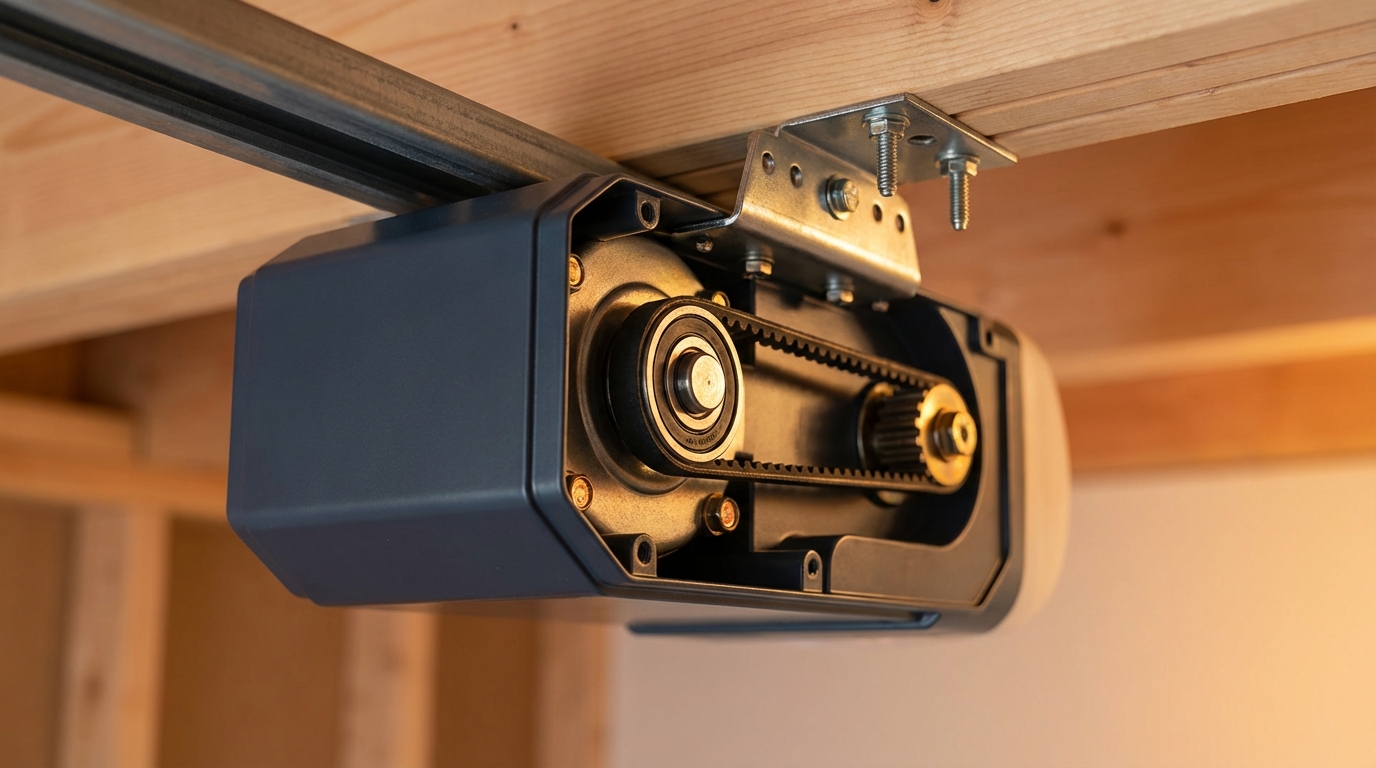
A high-pitched whine from a belt drive unit is usually generated by the DC motor itself, not the belt. This is often normal at low levels, similar to the hum of an electric vehicle motor. If the sound is new or has increased in volume, it may indicate a worn motor bearing or an internal gear issue.
A separate rattling or knocking sound, on the other hand, typically points to loose mounting hardware, worn hinges, or a door panel that has shifted. Diagnosing the source accurately matters because the fix for a motor bearing is very different from re-torquing ceiling brackets or replacing a hinge. If the noise appeared suddenly after a temperature swing — common in San Antonio’s climate — thermal expansion may have shifted alignment slightly, and a quick adjustment can resolve it.
Quick Noise-Reduction Steps You Can Safely Check
Visually inspect the mounting brackets for any obvious looseness. Verify that the rail hangers are secured into solid framing, not just drywall. Look along the belt for fraying or uneven wear. Listen during a cycle to identify whether the sound comes from the motor head, the rail, or the door panels. If anything looks or sounds off, a service call will pinpoint and resolve the issue before it escalates into a more costly repair.
“Called on a Sunday evening when my opener stopped working. They came out the same night and got everything working again. Outstanding service!”
Frequently Asked Questions About Belt Drive Garage Door Openers
Ready to Experience a Quieter, Smoother Garage Door?
If you are tired of the rattle, the vibration, or the worry that your current opener is on its last legs, a belt drive garage door opener may be the upgrade that changes your daily routine for the better. The question is not whether the technology works — it is whether the installation is done correctly for your specific door, springs, and electrical setup.
Texas Pros Garage Doors serves San Antonio and surrounding communities with same-day availability, transparent pricing, and a multi-point safety check on every job. And if something unexpected happens down the road, the team also offers 24/7 emergency repair support so you are never left with a door that will not move. Ready to get a clear quote and find out exactly what your upgrade involves? Reach out to Texas Pros Garage Doors today to schedule a free on-site evaluation.
Get Your Free Belt Drive Opener Quote Today
On-site evaluation, transparent pricing, and professional installation with a multi-point safety check. Serving San Antonio and surrounding areas since 2006.
(210) 469-9003
Schedule Your Free Evaluation
No Hidden Fees
Same-Day Service Available

Recent Comments